

From its origins as a small reading circle to a cornerstone of local arts and activism, the annual gathering lives on.
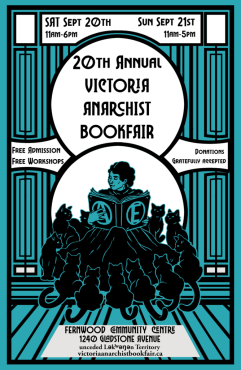
Poster via victoriaanarchistbookfair.ca.
On the third weekend of September, the Victoria Anarchist Bookfair turned 20, with a celebration on Sept. 20 and 21 at the Fernwood Community Centre. For two decades, the book fair has brought together writers, artists, and activists across Victoria. What began as a modest anarchist reading circle in 2004, followed by a small anarchist zine fair in 2005, has grown massively, with the first Anarchist Bookfair in 2006.
From the start, the event was about more than just books. Dr. Allan Antliff, co-founder of the fair, is a professor of art history at UVic, and also the director of the anarchist archives at the McPherson Library. During the early days, Antliff said, the fair had “Festival of Anarchy” events, including musical performances, art exhibits, and public talks. These gatherings expanded the fair into a cultural space, where art and politics could collide.
Over the years, the bookfair has acted as a hub, not only for culture, but for mobilization. In 2009, undercover police were spotted monitoring the event in the lead-up to protests against the Vancouver Olympics. In 2010, the fair became a platform for pipeline resistance on Wet’suwet’en territory, and for anti-logging campaigns closer to Victoria. This dual identity as a cultural and political event, Antliff said, has always been part of the Anarchist Bookfair’s fabric.
The 20th bookfair in 2025 carried forward that balance of festivity and urgency. Visitors browsed tables stacked with books and handmade art, each offering a look into someone’s politics, craft, and imagination. On the side, workshops covered a range of topics, including housing activism, anarchist sociability in Cuba, adaptive self-defence, and collective singing. These workshops offered practical tools, encouraged historical reflection, or simply created space for people to learn together.
According to the fair’s website, accessibility and inclusion are pillars of the fair. The event is wheelchair-accessible, masks are provided free of charge, and organizers emphasize their commitment to minimizing the social barriers that can arise even in the most well-intentioned spaces.
Each bookfair begins with a welcome from August Thomas of the Esquimalt Singers and Dancers, acknowledging that the gathering takes place on the overlapping territories of the Songhees and Esquimalt nations. This grounding is more than ceremonial. Over the years, the fair has consistently highlighted Indigenous resurgence and resistance.
In 2012, Gitxsan/Wet’suwet’en anarchist Mel Bazil spoke on the affinities between anarchism and decolonization, urging participants to get to know each other’s histories and embrace unlearning as part of building solidarity. That spirit has carried forward as part of the fair’s ongoing relevance.
The bookfair has connected Victorian anarchists to a much wider world. Visitors and contributors have come from as far as Argentina, Japan, France, Mexico, Germany, and New Zealand.
“Bookfairs can attract people from far-flung places, whose participation enlivens the scene,” Antliff said. The event serves as both a local anchor and an international junction, a space where global ideas filter into Victoria’s cultural life.
Running such an event has never been simple. Venue rental has always been a big financial challenge, but continuous donations keep the doors open year after year.
“Everything we do is for the love of anarchy and the planet,” Antliff said, noting that the bookfair is entirely volunteer-run.
The twentieth anniversary highlighted the fair’s enduring role in Victoria’s cultural and political landscape. Rather than hinging on a single event or keynote, its significance lies in the sustained engagement of participants and organizers over time. Antliff emphasized the ongoing personal and communal value of the work, and described his involvement in the bookfair as “a continuously enriching experience.”
That may be its lasting contribution: not performance, but renewal. Each September, the space comes alive again, reshaped by the issues, voices, and minds of the moment. Two decades in, the fair stands as a testament to sustained curiosity and collaboration, a recurring weekend where art, politics, and community converge.