

UVic ECS students share their experiences with misogyny, microaggressions, and UVic’s support services
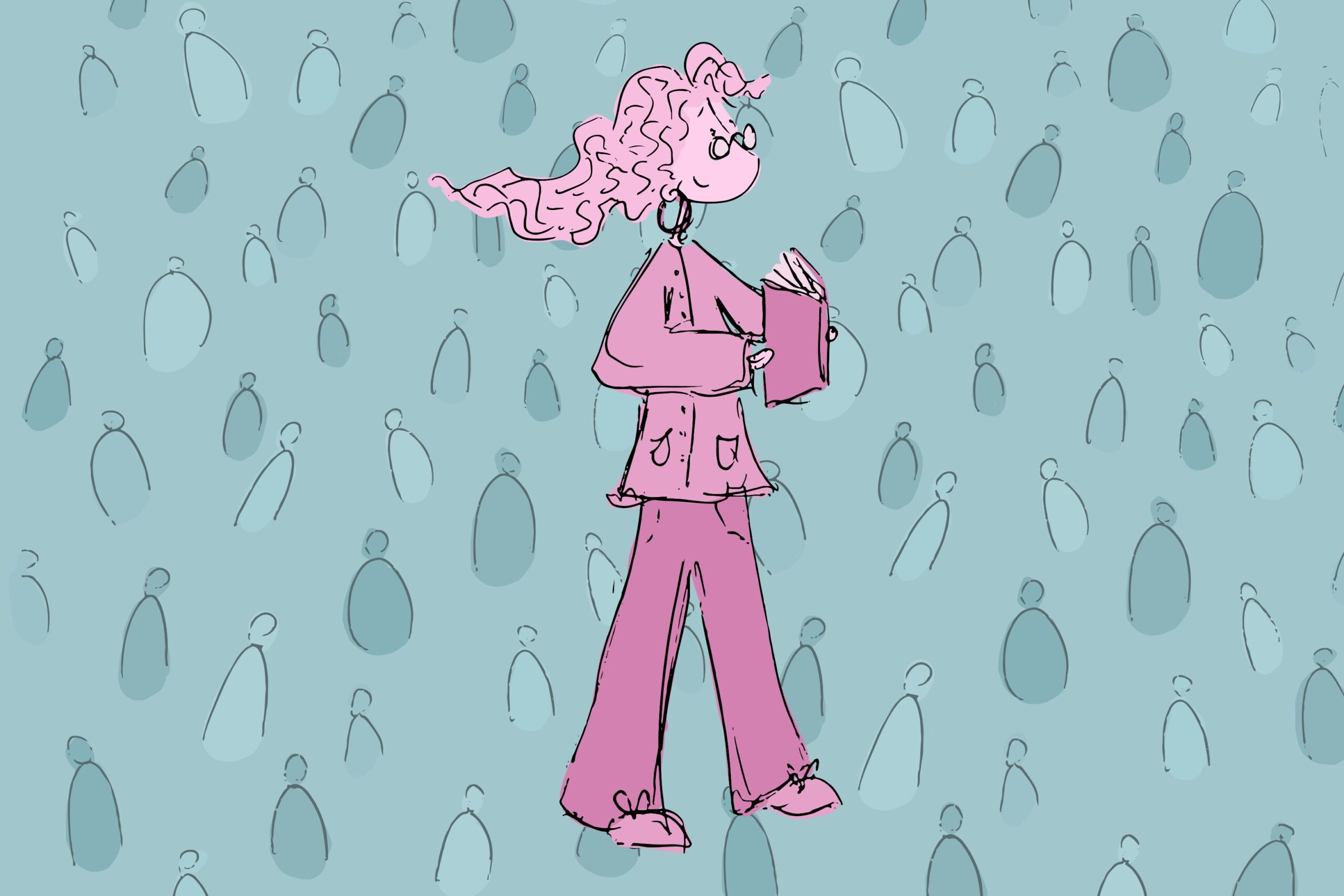
Illustration by Sage Blackwell.
*Names have been changed and identifying information has been omitted to protect the privacy and safety of those interviewed.
UVic’s Faculty of Engineering and Computer Science (ECS) has committed to “30 by 30,” a nationwide initiative to increase the rate of women graduating from engineering programs to 30 per cent by 2030. In 2019, UVic’s faculty of ECS had 19 per cent enrollment of self-identified women. As of February this year, that number has increased to 24 per cent.
Across Canada, the graduation rate of women in undergraduate engineering programs remains low. Engineers Canada, based on their data from 2025, reported the national average was 21 per cent. B.C.’s average was 22.1 per cent.
Despite efforts in both the faculty and across the country, many women in the field still face misogyny, gender bias, and sexism — be it on-campus, in extracurriculars, or in co-op placements.
Some UVic students told the Martlet that group settings, such as off-campus jobs, extracurriculars, or group projects, feature prominently as a venue for misogynistic behaviour and gender bias. One fifth-year student, Olivia*, recalled her first year engineering design groups, where she was “forced to do a lot of the [group organizing]” because the men in her groups wanted to do the technical work.
Another student, Emma*, whose experiences largely come from extracurriculars, said she had experienced microaggressions while working in group settings as well.
“There’s sort of an idea that you have to be intending to be sexist to be sexist, whereas it’s more like little things like on a group project [like] ‘oh, you’re better at writing.’ But it happens only to women, and pretty consistently,” she said.
Another student, Jamie*, also shared her experience with microaggressions. “On co-op terms I’ve had both good and bad teams, as well as supervisors, and I think the same goes for school with lab partners or extracurriculars.… Most of the time it’s usually ‘just’ microaggressions that kind of build up. It’s never overt sexism or anything, which makes it kind of harder to pinpoint, or be like ‘hey, that is not okay,’” she said.
“It starts with little things like being interrupted a lot when I speak, or if something is my job or my task, people will refer to a male instead, even if they’re not necessarily on a specific project,” she continued.
Jamie* told the Martlet she has to “constantly” ask for credit for her contributions. “The fact that I have to do that every day is frustrating,” she said. “And they subsequently think that they’re an ally because if I ask [for credit], I get it. But I have to ask in the first place, and not everyone does.”
Despite being called a “microaggression,” these actions can have significant impacts on an individual’s mental wellbeing. Academic research on microaggressions and “subtle discrimination” frequently recognizes the negative impacts these behaviours can have, including associations with anxiety and depression.
“It makes me very anxious. I show up … on offense all the time. I have to be more outgoing, and I almost reach a point where I’m incredibly insecure even if people aren’t intending to make me insecure. The smallest thing can set me off and I’ll be like, ‘where did that come from?’ ‘Was that sexist?’ And I almost get paranoid, because I’m questioning every single thing and the intent of every person,” Jamie* said.
“I’ve had times where I’ve been crying everyday because I have to go to work and deal with certain environments and certain people,” Jamie* continued.
Olivia* told the Martlet she felt her female friends in ECS were a great support.
“A lot of the women tend to be friends with each other, so that’s a good support network. I believe the women in engineering are amazing.”
She also said she felt there were “a lot of men in engineering” but “not the majority” who are advocating for equality.
Some students, however, feel there is a bystander effect — a phenomenon where an individual is less likely to help someone when other people are present. Jamie* told the Martlet that people often don’t feel comfortable calling out misogynistic or sexist behaviours
“I’ve been told to watch myself. I’ve been told [I’m] gonna anger people by calling them out, or [that] they’re already angry,” she said.
Jamie* told the Martlet that she had not brought up issues with professors, TAs, or faculty, for matters that occurred in school, but had for extracurriculars. She said faculty have expressed that they could help address issues, but she said has opted not to get faculty involved due to fears of being seen as a tattletale.
“I think I’ve always felt scared that we’re all adults and [tattling] kind of becomes a thing,” she said. “I’m not sure having someone else step in will solve the problem, or if it’ll just come back.”
Emma* also said she’d observed the bystander effect in engineering spaces. “A lot of people are fine enough on their own, but you get them in a group, and [the misogyny is] a lot worse somehow. Just because if you’re being backed up by people, you’re gonna be able to do a bit more,” she said.
“It’s easier to become close friends with people you know better and you can understand better … that often leads to women kind of getting left behind, because … they don’t feel like they can relate to people in their groups, and … the groups don’t feel like they can really relate to them as much,” she said.
“So [women] are left out of social opportunities and oftentimes that ties in with technical opportunities.”
Some students expressed the feeling that university supports were lacking, or had barriers.
Emma* told the Martlet she felt there were no clear lines of communications for support.
“There’s not really a dedicated line of support within the faculty, there’s not really a pipeline for ‘if you have a complaint, here’s where you go and this is what you do.’ If there is, we’re not made aware of it,” she said.
Olivia* said that the predominance of men in authoritative positions in the faculty, especially in mechanical and electrical, is a barrier to seeking support.
“The last thing I would do is talk to one of them about my experiences, because they just exude this aura of sexism,” she said. “I do believe the faculty, especially in electrical, needs an overhaul.”
“To look around the room and see just men and a few women is so isolating,” she said. “I think that it’s an environment that’s really hostile to someone that may already be suffering from imposter syndrome.”
Olivia* told the Martlet that, in her time at UVic, she had never been informed by a professor about the university’s Equity and Human Rights Office (EQHR,) but that it’s possible there were references to it in course syllabi.
The Martlet asked the faculty if professors and Teaching Aid’s (TA) receive any instruction to inform students on available supports. In a statement, Jessica Vandenberghe, assistant dean community and culture, said the faculty does “focus on ensuring students, faculty members, and staff have ready access to resources and education that promote respectful behaviour and an inclusive and equitable environment.”
She also told the Martlet that the faculty is “updating [it’s] orientation materials for faculty members and staff to ensure that they know what exists for programs and services and where to direct students to.”
The faculty has a list online of available supports, which includes EQHR, resources for BIPOC and gender-diverse individuals, and student-led groups such as Women in Engineering, Science, and Technology (WEST), which seeks to “empower female-identifying STEM students at the University of Victoria,” and Women in Engineering and Computer Science (WECS), which aims to “support women and nonbinary students” at UVic.
Olivia* said the women in engineering were a good support network. “The women in ECS are very strongly connected and there’s lots of women-specific opportunities, like the women’s engineering club[s].”
Emma* said she had “heard really good things” about WECS and WEST, but that women should not have to be the only ones pushing back against sexism.
“Women should not bear the burden of having to fix sexism, and I think a lot of it comes down to all of the support systems are student-run and they’re only women,” she said.
The Martlet asked the faculty what steps they are taking to improve the environment for women. Vandenberghe said the faculty is organizing events to support the retention of “first-year women and gender-diverse students,” launching mentorship opportunities, and “actively [promoting] training and resources available across campus, including Bystander and Sexualized Violence Prevention training.”
The faculty has also supported 30 by 30 by introducing scholarships and bursaries to help support women in ECS, such as the Cora Arena and Carol Artemiw second year retention award, the Women Continuing in Engineering and Computer Science award, and the 30 by 30 award.
Olivia* told the Martlet she thought the funding going to women in engineering is “a great initiative” and “significant,” but that “the environment itself is what’s preventing 30 by 30.”
“I think there’s definitely more women in classes. I don’t think that translates necessarily to industry or extracurriculars,” Jamie* said.
Jamie* said that outside of classes, she had been passed up for leadership roles due to misogyny and gender bias. “There’s been opportunities where I’ve been denied. While no one ever outright says ‘you’re a girl, that’s why’ it’s usually implied that people aren’t ready to follow a girl if it’s a leadership position…. Sometimes women are held to a higher standard.”
Jamie* and Olivia* felt there were some people who were intentionally misogynistic, and others who were ignorant. “But I don’t think that’s an excuse anymore,” Jamie* said.
Jamie* said she feels like there’s a “premeditated gender bias that exists in the world.”
According to research by the Diversity Institute, women comprise only 25.2 per cent of undergraduate engineering enrolment across Canada, and only 15 per cent of engineering professionals are women as of 2022.
The same research suggests gendered education and work environment biases remain prevalent and contribute to the under-representation and career stagnation of women in these fields.
Jamie* described her experience as “constantly fighting for respect.” Still, despite the environment and sense of discouragement against calling out misogyny, she pushed forward.
“I don’t see the point in supporting a sexist environment,” she said.