

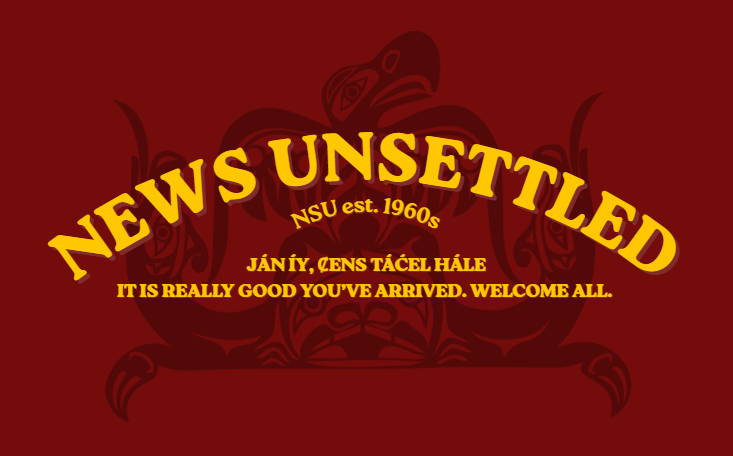
Graphic courtesy of the Native Students Union.
Did you miss us? Because we missed you.
JÁN ÍY, ȻENS TÁĆEL HÁLE — It is really good that you have arrived. Welcome all.
In case you’re unaware, the NSU is a UVSS advocacy group run by Indigenous students for Indigenous students on Lək̓ʷəŋən and W̱SÁNEĆ unceded land. We aim to follow our constitution in providing various resources and spaces for registered NSU members.
The NSU’s structure involves an Indigenous council of elected student volunteers. 2026/2027 Council includes Firekeeper K’sana Wood-Lynes Ford, Amisha Mercer as advocacy councillor, Kwiadda McEvoy as communications councillor, and Leo Dougan as administrative councillor.
Councillors-at-large includes Christina Costa, Christobel Piché, Kaylee Oliver, and Hillary Davies. The staff members are myself, Ave Federspiel, as the outreach officer and our office coordinator, Anagya Durocher.
Together, we act on unanimously-made decisions that will benefit the Indigenous student body. Despite being an Indigenous-focused group, we interact with many non-Indigenous groups and organizations on-campus to meet NSU needs.
This has led to a spectrum of treatment in our received correspondence, ranging from good to downright mediocre.
Mediocre examples include the NSU being asked to present land acknowledgements for campus events, receiving requests for provisions of Indigenous student bodies to check off diversity boxes for funding (tokenism), or receiving surface-level inquiries about Indigeneity that I am certain Google would appreciate answering more than I would.
Although this was expected when I joined the NSU, I have seen many other instances of respect, reciprocity, and advocacy from our non-Indigenous supporters. Pinamach, îsnîyes/I am grateful, thank you.
There will always be two sides to every coin, the good and bad, all of which I witness from the inside looking out.
As much as I look out, I have also looked inward.
Flipsides can be attributed to anything, including the NSU. Nothing is completely perfect. My introspective realizations have shown me who we are not, who we are, and who we can be.
Here is what the NSU is not: An Indigenous body and knowledge commodity. We’re not ‘things’ to be used for personal gain or to meet criteria. We’re not historically mystical, nor do we carry spiritual auras of which you can siphon from to feel better about being non-Indigenous on stolen land. We’re not here to teach you how to sit with the uncomfortable.
We are a resource for Indigenous students and alumni. We’re here to reveal how our collective discomfort is manifested into care and community. We’re a resilient group, handling obstacles only we can understand. In every decision we make, our members’ wellbeing is the top priority.
Being a part of the NSU and the UVic Indigenous community feels like you’re a part of the inside scoop only we get to know and it’s simple: it’s understanding and relational. It doesn’t matter who you are, if you are Indigenous, we get it. You do not need to explain to us, for we already know what happened.
Indigenous trauma doesn’t go anywhere, we evolve it into something greater than what created it. This is done by showing up, making inevitable mistakes, showing up again, trying again, and finding the answer (whether it was the one you wanted, or not). This is where the NSU’s imperfection shines bright.
By continuously showing up, the mistakes made along the way reveal the path to the right pieces of the puzzle we are all trying to put together. The NSU can always be stronger, more united, and improved, and is obliged to our niichiis’ contribution to make it so.
The NSU welcomes you in any state and we are excited to have you in our space. Thank you to our current and future supporters and collaborators for helping make NSU space possible.
As the most recent News Unsettled columnist since 2022, readers can expect dives into Indigenous topics and challenges to your pre-existing knowledge (or assumptions).
Now that we’ve been introduced, I am pleased to make your acquaintance for Volume 79 of the Martlet.