
The collection unveiled this May explores the communities architecture and the stories each building contains
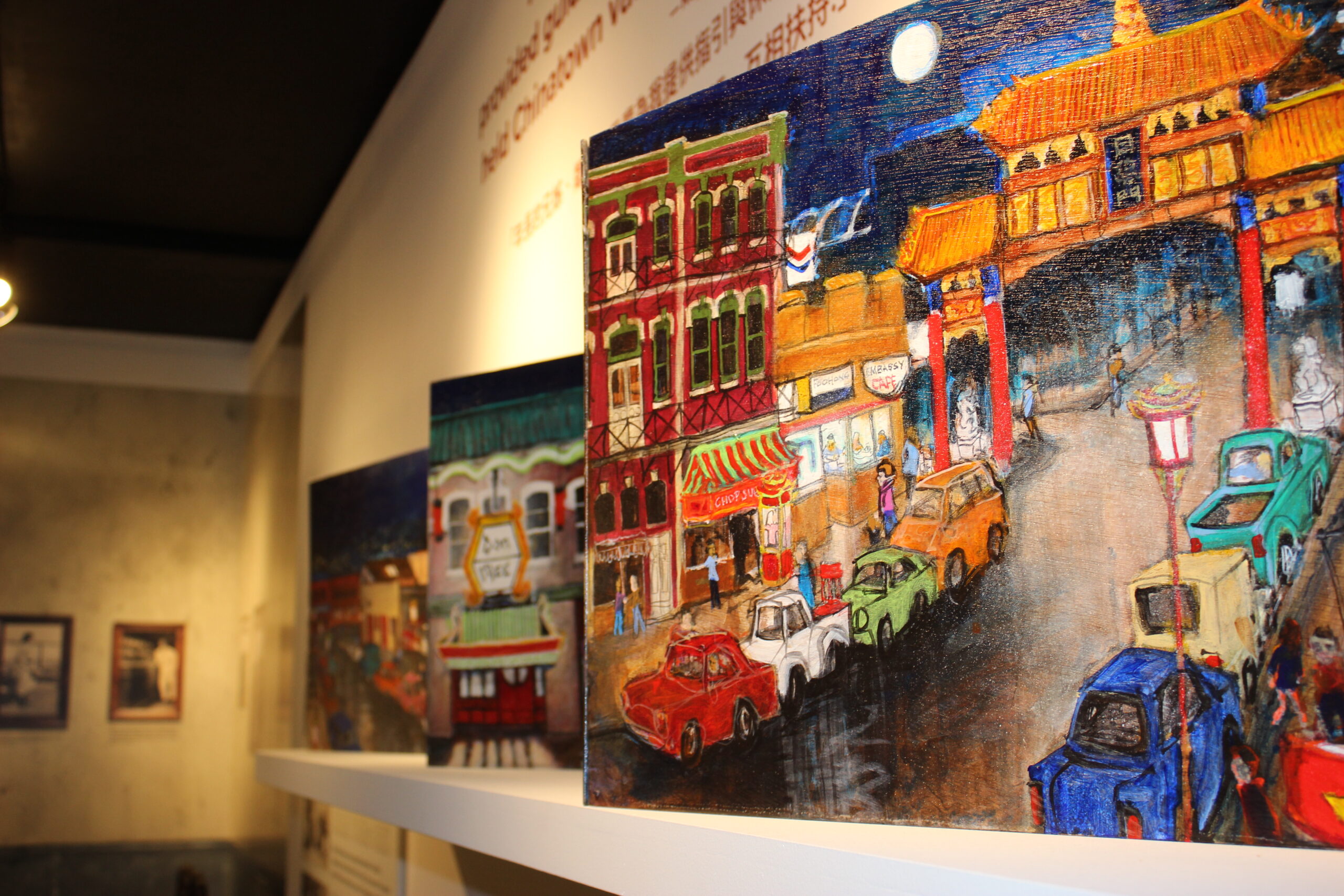
Photo by Al Tantalidou.
This May, the Victoria Chinatown Museum opened its first exhibit curated entirely by staff and board members, entitled “If These Walls Could Talk: Exploring Chinatown’s Stories (舊牆留聲).”
The collection centers on local buildings, exploring the myriad stories of each space ranging from schools to restaurants and residences.
Linda Tzang, the new associate director of the Victoria Chinatown Museum said that “the grounding [of the exhibit] is in the buildings, but each building can be viewed and interpreted through different lenses.”
“It’s a singular building,” she said, “but there are many stories.”
Chinatown’s architecture thus serves as a medium to reveal the community’s economic and cultural history, alongside a wealth of individual narratives.
Information on Canada and B.C.’s history of anti-Chinese legislation and discrimination, like the Chinese Head Tax, helps situate the collection. “You can’t really understand a lot of these personal stories without understanding the context,” Tzang said.
Notably, the exhibit features C.I.45 certificates, which were required for all Canadian-born Chinese children under the sinophobic 1923 Chinese Immigration Act — commonly referred to as the Chinese Exclusion Act.
According to Tzang, these IDs confirmed “you were born in Canada, but you have no rights as a citizen.”
Chinese kids also faced explicit segregation in Victoria’s public schools. In response, the community banded together to construct the Victoria Chinese Public School in 1909.
Initially teaching pupils English to facilitate a transition to public school, and then higher education, the school later became a “bǔxí bān (补习班)” — an after-school Chinese language program.
Today, the building still operates as a private school, offering afternoon and weekend classes in topics like Cantonese, calligraphy, and dance.
Stories from former students grace the wall, with one quote from Genevieve Sneddon (陈美鳳) reading “I have mixed emotions when I reflect on my experience… It was challenging to be learning something for the first time and already feeling ten steps behind. Despite this, Chinese School was a way for me to connect to my Chinese heritage.”
In one corner, at a pair of midcentury school desks, visitors are invited to try their hand at Chinese calligraphy on practice sheets. On display beside the station is a gridded workbook of young pupils’ own attempts.
The exhibit’s emphasis on physical buildings also includes iconic local restaurants like the Embassy Cafe, Don Mee, and Foo Hong Chop Suey. Booklets describe the story of each business, including the families who built and operated the beloved eateries.
Chinese restaurants in Canada provided not just income and a taste of home, but were, according to Tzang, “an entree into this new country.”
They were often Chinese immigrants’ first jobs, Tzang said, allowing newcomers to learn both English and cultural norms “in a safe environment.”
Many served Canadian fare alongside Chinese menus without English translations, saving more traditional dishes for those in the know. Tzang recalled that even for first or second-generation kids like her, who couldn’t read Chinese, the menu was a stamp of approval.
Traditional dishes continue to be passed down within Victoria today, even as Chinatown experiences change. In one room of the exhibit, lovingly illustrated family recipes line the walls, detailing the diasporic origins of desserts like Sesame Balls (煎堆) and Tapioca Cake (千層糕).
Museum visitors are even invited to take home a recipe card to taste a piece of history for themselves.
Tzang hopes that visitors can understand the multifaceted nature of history and these featured stories, emphasizing the agency of immigrants over a narrative of universal victimhood.
“I’m sure some of them were depressed and some of them were happy,” Tzang said, but “they lived the life that they could live.”
She added that many immigrants made choices which we must acknowledge and respect.
Ultimately, she concluded, “Chinese-Canadian history is Canadian history. We are not other. We have been in this country, specifically in B.C., as an early community and our contributions to this province are not merely as cheap labour.”
“For good or worse, we help shape this province,” she said.
Over the past two years, the Victoria Chinatown Museum Society has undergone a transition into an independent entity, separate from its former organization, the Chinese Canadian Museum. As the society’s first solo exhibit, “If These Walls Could Talk: Exploring Chinatown’s Stories (舊牆留聲)” serves to set the tone and framework of future endeavours.
Guests will have ample opportunity to attend the limited exhibit, which will run until Spring 2027 at the Victoria Chinatown Museum in historic Fan Tan Alley.