
The Vancouver School Board is rolling out Microsoft Copilot AI chatbot accounts for students aged 13+, and has little in the way of explanation to back the move
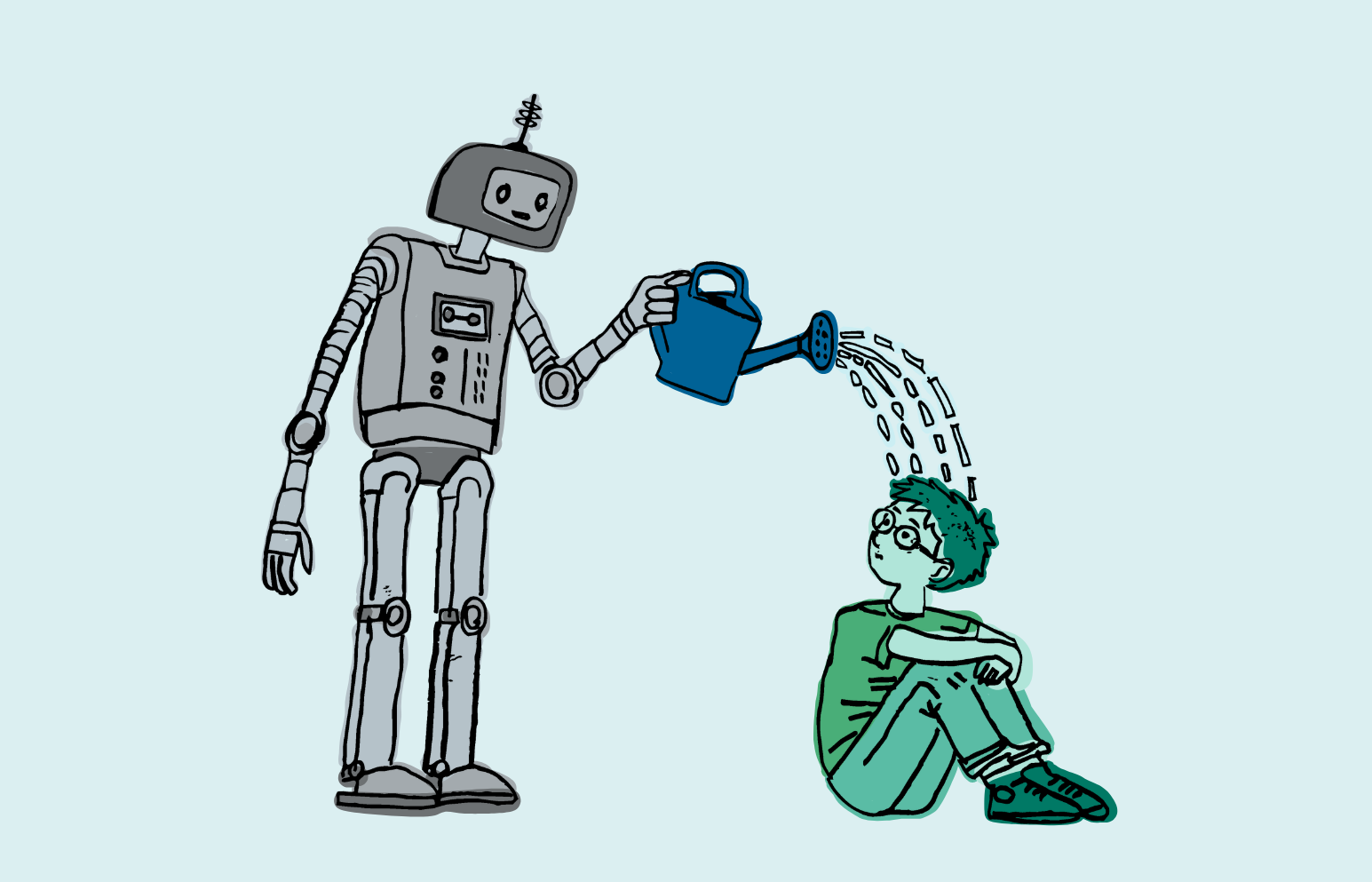
Illustration by Sabina Mendoza.
At the beginning of June, the Vancouver School Board (VSB) rolled out Microsoft Copilot AI chatbot accounts for every student aged 13 and up. But what process went into making such a bold step so quickly?
A recent MIT study showed that excessive reliance on generative AI may contribute to cognitive atrophy and the shrinking of critical thinking abilities. The study also showed that individuals who used the AI chatbot to assist in writing their essays remembered little of their own work, reflecting a bypassing of the deep memory process.
AI is a new technology that has proven to interfere with the process of learning, so why does it have a place in Vancouver classrooms?
In a statement to the Martlet, the VSB said that they have taken this measure to “support student learning and readiness for a rapidly evolving, technology-rich world.” Some B.C. parents have already raised concerns about kids relying on AI at school.
The VSB said that their approach is “to set up parameters that empower students to utilize AI safely and responsibly in a District-supported learning environment.”
In an attempt to better understand Microsoft Copilot and how it may aid learning, I decided to run an experiment. Without creating an account, I entered a simple prompt into the chatbot: “I have to write an essay for my social studies class, can you help me?”
The chatbot sent back a lengthy response outlining the essay-writing process and asked for my topic, the essay style, and my word count. I responded again: “It’s about the black death and it’s 800 words argumentative.”
Though I had not explicitly asked the chatbot to write the essay for me, I watched it generate an entire essay for me in response. This is a tool being implemented into classrooms to “support student learning.” How is a student supposed to learn to write an essay when their work is done for them, without them even asking for it?
Like any skill, writing skills are developed through practice. From sixth grade onward, I was writing essays and other assignments regularly, and I was writing them myself.
I now study writing at UVic, and practice the skill in my career. If I had access to an AI chatbot in seventh grade, I likely would not have developed those skills and be where I am.
Surrey School superintendent Mark Pearmain told CBC that “students are using ChatGPT or Claude or other platforms outside of the school district time,” and that they “just want to ensure that they know how to safely use that and how to safely use the platform in a morally positive way and ethically.”
The VSB has not yet made clear exactly how Copilot will be used in the classroom and what role it will play in student learning. While there is obvious value in teaching youth how to use AI safely and ethically, the district did not elaborate on how this will be done.
There is no denying that AI safety is an important skill to teach youth — it is no different from cyber-safety or sexual education, both of which we are taught in school. Beyond academic pursuits, schools are places where youth are prepared to lead safe lives in the real world.
In grades six through 12, I had an annual lesson on cyber-safety. But I was never given an Instagram account by my school district. My educators were able to successfully teach me how to safely navigate the digital world without putting those tools in my hands.
Many students had social media accounts by that time, and actively used them in and out of school time. But the decision to have an account was completely left to the student and their guardian.
A group called Parents for AI Caution in Educational Spaces (PACES) Vancouver launched a petition demanding that “the Ministry of Education and Child Care enact a two-year pause on AI in classrooms.”
Copilot 13+ includes safeguards that protect student data, filter out harmful content, and it does not use the chats to train AI models. The VSB said that families with concerns about Copilot 13+ are encouraged to speak with their child’s educator and administrators. However, the board did not comment when asked about whether parents will have the ability to opt their child out of Copilot 13+.
AI safety could be taught to students in the same way that cyber-safety is. Provide youth with real-life examples of misuse and the consequences of it. Continue to teach academic integrity, and how it is evolving in an era of AI.
AI is everywhere. There is no denying that it is a part of our world, and children should be taught to navigate it, but there are other ways to do so before handing them access to an AI chatbot.