
The sea’s past may help inform its future as climate change threatens the seaweed ecosystems
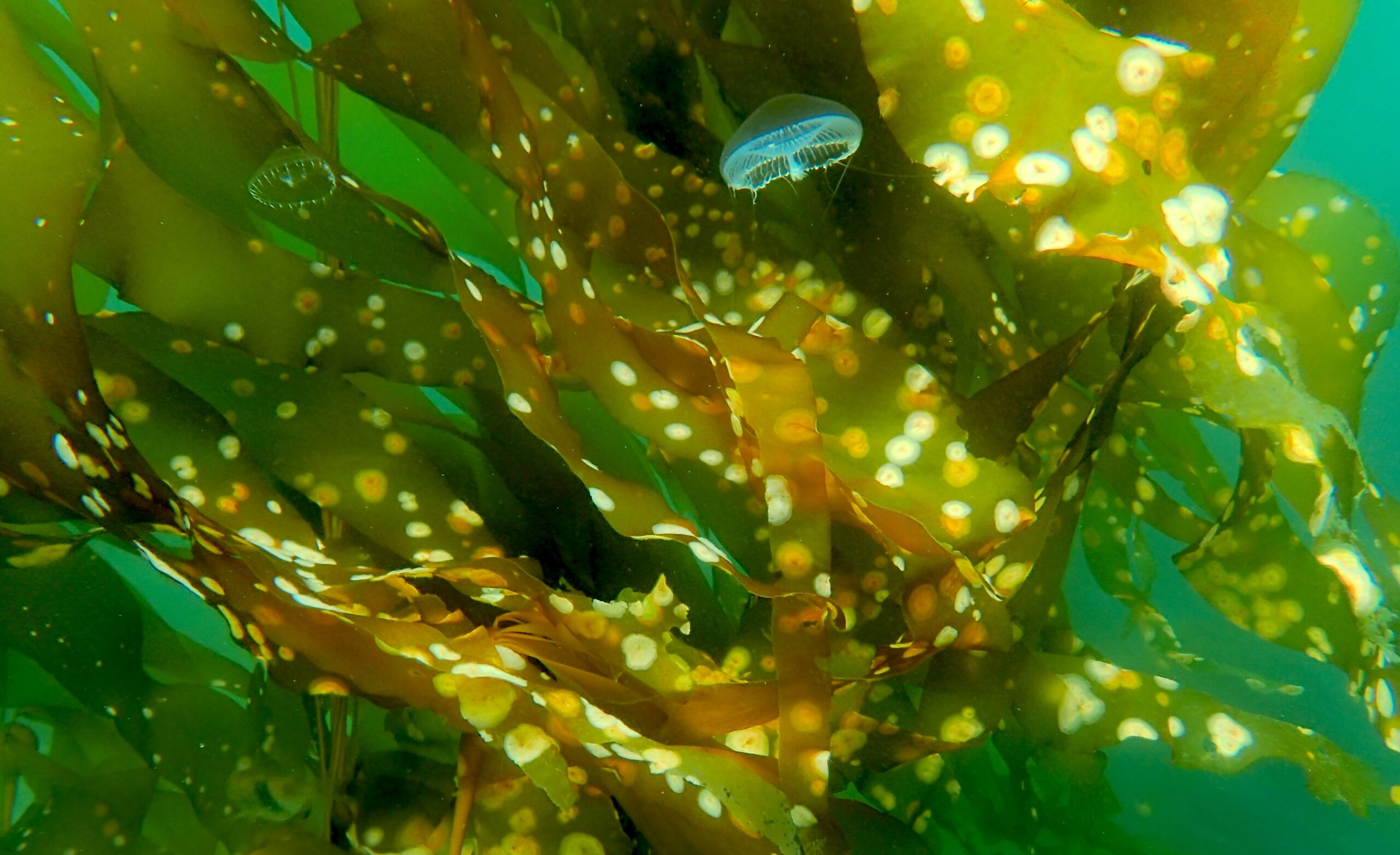
Photo by Matt Bakken.
New research from the University of Victoria reports that vast kelp forests around the North Salish Sea vanished decades earlier than previously understood, largely due to warming ocean temperatures.
Brian Timmer, a PhD candidate in UVic’s Baum Lab and collaborator of the Kelp Rescue Initiative, was the lead author of the paper recently published in Ecological Applications.
A decade ago, when the “blob” heatwave struck British Columbia, Timmer witnessed the dramatic die-offs of marine species as a scuba diving instructor in Nanaimo. “In a single year, every single kelp forest, all of my favourite dive sites, disappeared,” he said.
Now pursuing his passions as an academic, Timmer’s research centers on both kelp restoration and climate change.
When he came across decades-old kelp forest data, donated to the UVic archives by late Biology professor Dr. Alan Austin, he wondered whether any of those same forests remained, prompting the PhD project.
In 2023, Timmer and collaborators — including researchers from the Hakai Institute — meticulously mapped kelp forest size and abundance around the North Salish Sea, including near Comox, Denman Island, and Oyster River.
The team replicated previous aerial photos and scuba diving surveys by referencing old field notes and data. “Feeling like you’re following in the footsteps of … these people from the past was really cool,” said Timmer.
The project received funding from Fisheries and Oceans Canada, the Natural Sciences and Engineering Research Council, the National Geographic Society and the Royal Canadian Geographic Society’s Trebek Initiative.
They have now published their findings, detailing how “a half-century ago, bull kelp … formed expansive kelp forests in the region” spanning over 550 hectares, a new baseline ten times larger than what experts previously assumed, yet none of them remain.
Satellite imagery showed the majority of the forests were lost in just twelve years, between 1972 and 1984, due to rapidly warming temperatures compared to the early 20th century.
Kelp forests are integral to British Columbia’s coast and climate resilience, both capturing carbon and protecting shorelines from erosion.
Dr. Lauren Dykman, a postdoctoral fellow at UVic’s Baum Lab and Restoration Science Lead for the Kelp Rescue Initiative, said in a statement to the Martlet that “kelp are like the trees of the ocean, providing habitat that shelters fish and invertebrates, including juvenile salmon … they form the base of coastal food webs.”
“Kelp forests are disappearing from parts of BC’s coastline for reasons including climate change, marine heatwaves, and imbalances in food webs caused in part by human actions,” Dykman warned.
The recent research out of UVic is particularly significant, as it could help forecast future conditions and impacts along the rest of British Columbia’s warming coastline, potentially informing policy on conservation and climate action.
Timmer said that is because “the area that we were looking at has been a rapidly warming microclimate … and has gotten hotter than essentially the rest of the coast has so far.”
While the research has encountered some pushback online from skeptics, Timmer expressed optimism that their paper will create respectful and open communication of scientific findings.
“It’s our responsibility as scientists to make sure [our research is] … shown to the rest of the world and people that are trying to live their regular lives,” he said, especially for those who may not “understand how important it is these changes have been happening over a long period of time.”
In the face of disappearing forests and increasingly warm waters, restoration efforts across the Salish Sea continue to make new breakthroughs by growing and transplanting seaweed.
Timmer said the Kelp Rescue Initiative conducts scientific research on effective kelp restoration to “draw up these blueprints that we can then hand over to … communities and First Nations” as a tool in their toolbox.
He went on to spotlight the many First Nations guardian programs who have been monitoring and assisting kelp forests across British Columbia’s coast over the last decade.
Dykman also shared about one flourishing kelp forest that the initiative restored offshore from Denman Island, where kelp had been absent for 11 years due to marine heatwaves.
“It was emotional to know that it was only there now due to our hard work,” she wrote.