
Climate activists rallied across the country on June 25 to encourage MPs to oppose Canada and Alberta’s MOU to build a pipeline to the West Coast. However, Canada and Alberta are moving ahead with the project.
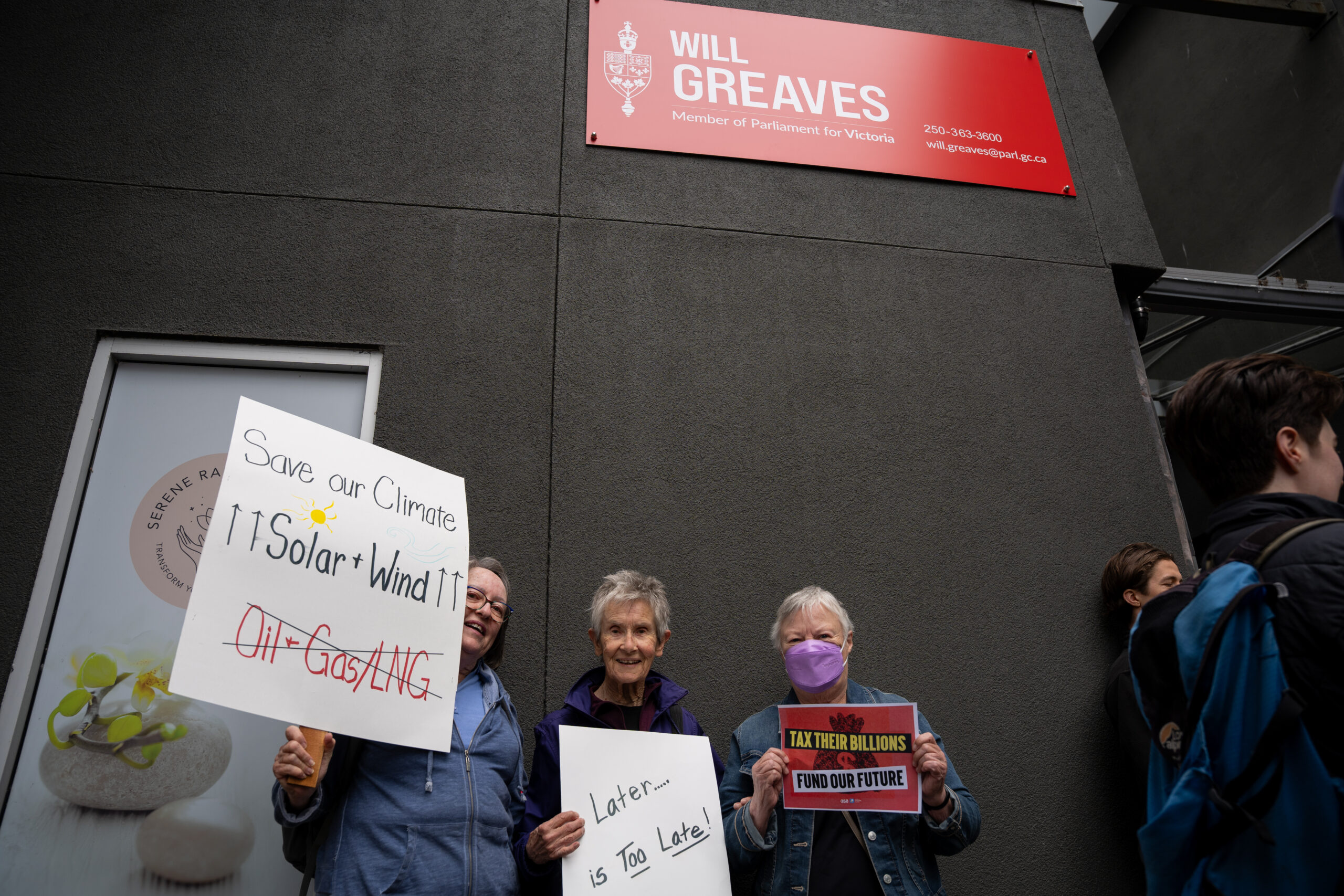
Photo by Declan Snowden.
On June 25, a series of rallies, organized by 350 Canada, occurred across the country, including a demonstration in Victoria outside the office of Liberal MP Dr. Will Greaves. The demonstrators sought to push Greaves to break party lines and continue to oppose Alberta’s Memorandum of Understanding (MOU), an agreement between the federal government and Alberta’s provincial government made in November 2025 to work together to build a new pipeline to Canada’s West Coast.
In November 2025, Greaves broke away from the Liberal Party and opposed the MOU with Alberta. He has also been a vocal critic of pipelines in the past.
The MOU faced criticism from B.C. Premier David Eby, as well as several First Nations in the province.
Fourteen Liberal MPs also sent an anonymous letter to Prime Minister Mark Carney in April 2026, raising concerns about environmental backsliding. Carney himself recently said his government will not continue working toward the Trudeau-era climate goals, acknowledging that emissions will be higher in the years to come.
Alongside the demonstration outside, a youth delegation of four representatives met privately with Greaves to discuss Alberta’s MOU. Furthermore, 350 Canada published a “People’s MOU,” which urges MPs to “stop fast-tracking destruction,” stop building pipelines, and impose an “excess profits tax” of 75 per cent on the fossil fuel industry.
The demonstration drew the attention of notable community members, including members of the Raging Grannies, an international organization started in Victoria, and seeks to promote social justice and economic equality through music and humour. Jack Sandor, a Victoria city council candidate, was also in attendance.
“I think it’s ridiculous to be spending money on pipelines, or even considering spending money on pipelines, given the state of the climate, and especially given the state of renewable energy at this point,” Sandor told the Martlet.
Dr. Marie Campbell, professor emeritus at UVic, also attended the rally. “I’m really worried about [where] Prime Minister Carney [is] taking Canada,” she said. “He has attracted a lot of people like me, for instance, who thought ‘oh good, he’s going to bring Canada back into good times again.’ But he seems to be more Conservative than Liberal, for one thing.”
“The Liberal Party has become a pipeline party, and they’ve become a party that is not taking real climate action, and is actually investing in big oil and fossil fuel infrastructure, and that’s not okay,” said Jordana Pangburn, a UVic student who attended both the rally and the private meeting with Greaves.
“We don’t think that’s representative of Will Greaves, who has published extensively on being opposed to pipelines.”
In November 2025, Greaves told Canada’s National Observer that he had been hearing from constituents for “months” that were “almost universally opposed to lifting the tanker ban and [were] deeply skeptical of building another pipeline to tidewater through the central interior of BC.“
On July 2, B.C. and Alberta both announced significant “nation-building” projects. Eby and Carney announced a multibillion dollar deal between the B.C. and Federal government, which will fund several projects across the province, including upgrades to the Port of Vancouver, Port of Prince Rupert, and Port of Prince Stewart, as well as highway upgrades.
During this press conference, Carney and Eby confirmed the northern oil tanker ban in B.C. would remain in effect, which has been celebrated by Coastal First Nations.
Later in the day, Alberta Premier Danielle Smith held a press conference with Carney, announcing her plan for a pipeline to the West Coast. The pipeline, which could not go through B.C.’s north due to the oil tanker ban, is set to go to B.C.’s south coast, and will follow much of the existing route of the Trans Mountain pipeline.
The project is estimated to cost between $35.2 and 43.7 billion, with construction starting as early as 2027 and ending as early as 2034.
In the private meeting between the youth delegates and Greaves on June 25, prior to Smith’s announcement, Pangburn claims Greaves said he could not have an opinion on the pipeline until the plan was presented.
She also said Greaves expressed issues with the “framing” of some parts of the People’s MOU, such as the assertion that the Liberal government is fast-tracking projects.
The Martlet reached out to Greaves for comment on his stance on the newly proposed pipeline, for clarification on his stance on the People’s MOU, and to confirm if these claims are accurate. The Martlet did not hear back from Greaves in time for publication.
Now, climate activists in B.C. and across the country will face a new set of challenges as the pipeline to Canada’s West Coast moves forward. Greaves, conversely, will have to balance his future electability in a historically dominant NDP riding that largely opposes new pipelines, while also maintaining party solidarity.