
Alberta rolls out new ID’s that include a citizenship marker amidst growing anti-immigration sentiment in the province
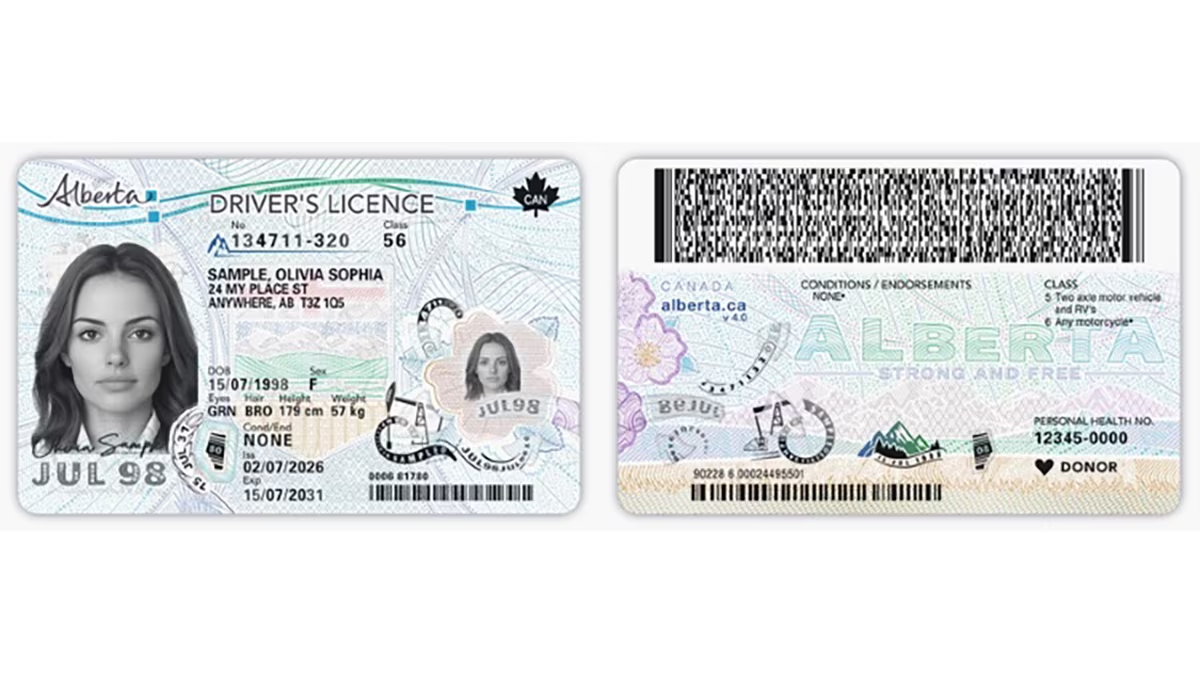
Photo via Government of Alberta.
On June 3, Danielle Smith, premier of Alberta, announced the province would be rolling out new three-in-one identification cards in July, combining a driver’s license, personal health card, as well as the addition of a citizenship or legal status marker. Framed as a way to streamline services and prevent election fraud, Alberta’s new ID cards open up the door for increased discrimination against Canada’s most vulnerable.
Identification cards with citizenship markers are, quite frankly, short-sighted, fascistic, and dangerous. Featured famously in states that have carried out genocide, such as Nazi Germany and Rwanda, during the 1994 genocide against the Tutsi people — though they were introduced earlier during Belgian colonial rule — they have long been used as a tool to discriminate against and marginalize others.
As much as I’ll criticize my home province, Alberta, it is obviously not nearly as extreme as either of those countries during those timeframes. Still, the province is moving to the far-right at an increasingly alarming rate, with a growing separatist movement fueled by disinformation, foreign interference, and an inflammatory premier who has worked toward U.S. style healthcare, continues to rely on climate-destroying energy sources, and fans the flames of anti-immigrant sentiments.
The change is especially unfortunate when looking toward the U.S., whose Immigration and Customs Enforcement (ICE) agency rounded up over 43 000 people in June alone, and sent many of them to what can rightfully be considered modern-day concentration camps.
The situations where you realistically need proof of citizenship, like getting a SIN number or passport, are already strictly regulated and inconvenient; having a citizenship marker on your driver’s license will not make the process significantly easier.
Instead, a license is mostly used for daily life, such as at a traffic stop, or having your age checked at a bar. In both cases, the person checking your ID does not need to know your citizenship status, and making this information accessible only invites bias. Licences will now immediately alert police, who are already shown to disproportionately target marginalized groups, such as Black men and Indigenous women, to those who have more or less legal protections.
Since Smith announced the new three-in-one IDs, immigration lawyers, human rights activists, and advocates have warned of the potential dangers of citizenship markers on Alberta’s ID, with some going so far as to suggest that some governmental agencies may try to target non-Canadian citizens through the cards.
Beyond police profiling, these new IDs introduce a slew of other profiling-related harms, with the Alberta Civil Liberties Association pointing out that banking, housing, employment, and schooling opportunities could be affected by one’s citizenship status.
Despite such concerns, Minister of Service Alberta Dale Nally has claimed that, in Alberta — where police profiling is already a prominent issue — these IDs will not lead to discrimination.
At the same time, Alberta’s fall referendum questions include adding an “Alberta-approved immigration status” to the province with the intention of limiting immigrants’ access to services, despite immigration being a primary responsibility of the federal government.
Smith blamed the province’s $9.4 billion deficit (which may now become a surplus, due to skyrocketing oil prices following the U.S. and Israel’s war in Iran) largely on immigration, despite asking former Prime Minister Justin Trudeau to increase immigration just two years earlier, in 2024.
North America’s political climate is already alarmingly anti-immigrant, both in the U.S. and Canada, and Smith’s actions in Alberta risk further normalizing hate and discrimination at home as she mimics U.S. style politics in Alberta for her own gain.