

Using interviews and dusty newspapers, we uncover what UVic was like six decades ago
Almost 60 years ago, UVic officially put an end to its nomadic lifestyle. From Craigdarroch Castle to Victoria High to current-day Camosun College’s Lansdowne campus, 1967 was the year that UVic completed its final move to a sunny spot up the hill from sŋéqəʔ (Cadboro Bay).
At its time of purchase, the new grounds consisted mainly of an old army camp and 141 acres of second-growth forest (previously logged by the Hudson’s Bay Company). In five years, UVic fashioned the essential buildings and swung open its doors to its (then) biggest ever enrollment in fall of 1967 — although, campus wasn’t without its oddities.
The staff lounge, the UVic theatre, and certain classes could still be found inside the World War ll-era army huts scattered across the grounds. An old army drill hall acted as the school gym and main exam hall.
In the fall of 1967, 3 800 undergraduate students graced its halls — over double the student population three years previous. Although today’s undergraduate population is roughly 19 000, at the time it marked a new chapter for student culture with a student population growing faster than ever on a brand-new campus.
What was it like to be a student at UVic during this exciting year? The Martlet tracked down two alumni who experienced it first hand as undergraduates in 1967.
Renowned ethnobotanist Nancy Turner was majoring in biology and taking anthropology classes at UVic in 1967. She worked closely with honours thesis supervisor the late Mark Bell, and met weekly with the late Christopher Paul from Tsartlip, whom she had been introduced to through his son, Chief Philip Paul, after attending a guest lecture from him about First Nations life and culture.
Turner attended UVic with her now-husband of 57 years, Robert. They married the week after they graduated UVic. Turner was heavily involved in the biology club, which lobbied UVic regarding a range of environmental issues at the time.
Derek Reimer served as Men’s Athletic Rep on the 1967 Students Council (now known as the UVSS). Reimer played for the Vikings volleyball team, and in 1967 played alongside two other Vikings as starters on the B.C. team, who won gold at the first Canada Winter Games. He also played on the UVic rugby team later on in his degree. Reimer was completing a Bachelor of Science at the time, and later became a lab instructor for the geography department.
The brand new campus
Reimer noted that when he first arrived at UVic, there was only half of a ring road. During his first year, they completed the ring and dismantled the “extension of Henderson road [that] went right straight across the campus.”
“When I go to UVic now and I go to the main quadrangle, I think back of the quadrangle that I remember — it is so completely different. First of all, no Native art, none … the trees were saplings … they were 15 feet high. And it was a barren plain.
“I go there now and I think this is a lovely space. In those days, it was just a thing to get across because the thing you wanted to get to was over there, and across the quadrangle you had to go. Now it’s lovely … well aged,” he said.
Turner had her eye on UVic’s approach to landscaping.
“Of course, the campus was just being set up, and … being a botanist, I really really wanted them to use native plants in the landscaping … [as] a wonderful educational experience for everyone.”
“I talked to the … head of landscaping at the time … and they essentially said no, we need ‘proper’ landscaping. And so, they ended up planting eastern tulip trees around the library and eastern oak trees and Scots pine … they rejected the idea of using native plants in the landscaping.”
“It wasn’t until many many years later that, when they built the First Peoples House, that they landscaped it with native species, I’m very happy to say.”
“There have been some really nice initiatives relating to the School of Environmental Studies … [and] work that’s been done in the restoration of natural systems program…and now there are native plants in many different areas of the campus, so I’m really happy about that.”
“It was frustrating back in the day when the conventional landscaping was just, you know, the only thing.”
The Student Union Building (SUB)
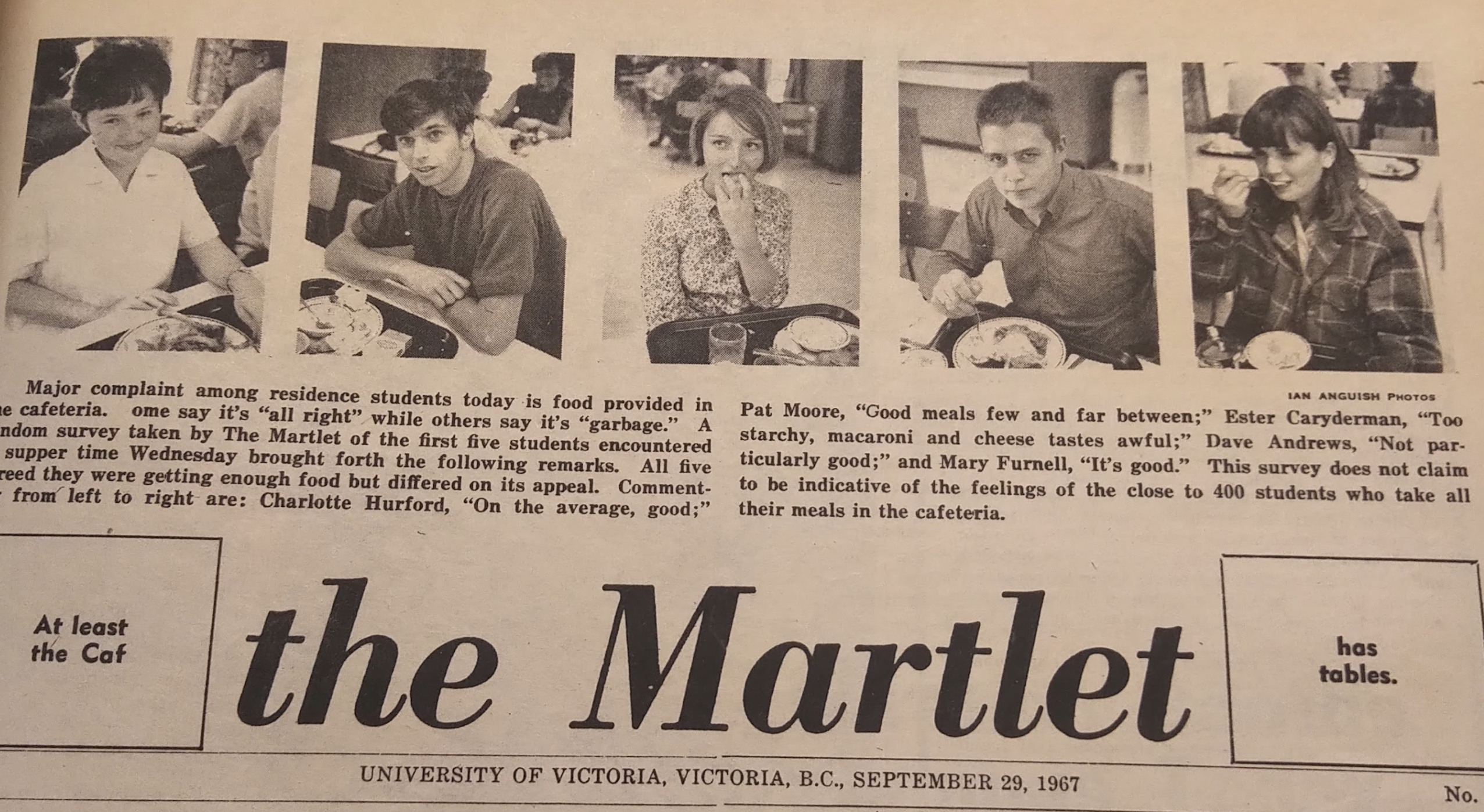
UVic students are interviewed about food on campus (1967), the Martlet. Photo via UVic Archives.
The Martlet came across many 1967 newspaper articles focused on the quality of food at UVic. An “objective investigation of campus food services” was undertaken by 1967 Student Council President Dave McLean. The SUB was one of the two main school cafeterias on campus at the time, and was run by the Student Council.
“I don’t remember the investigation, but I do remember the food and it was dreadful. It was really, really bad,” said Reimer. “They had hamburgers that they’d microwave … and they would stick the hamburger in the microwave and so it would come out thin and dense and horrid. But I ate my share of them.”
Reimer recounted that aside from a cafeteria, the SUB was used as a gambling den.
“Oh, there was a lot of money that changed hands everyday in the Student Union Building. They played particularly hearts, and sometimes for relatively high stakes. And they also played bridge and crib for money, but hearts was the thing … I wasted a good few hours watching hearts in the student union building.”
Student Council
Frosh Week
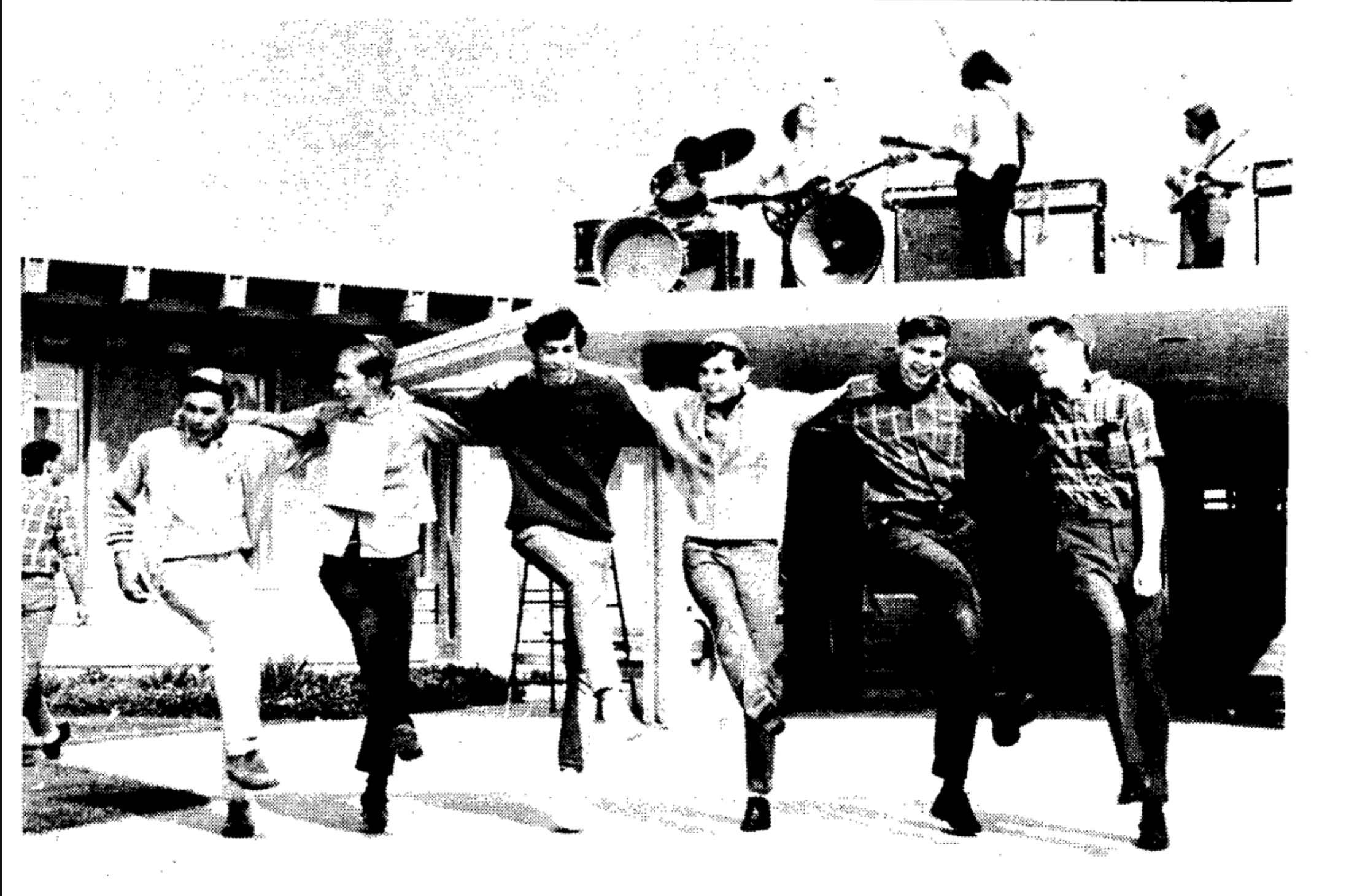
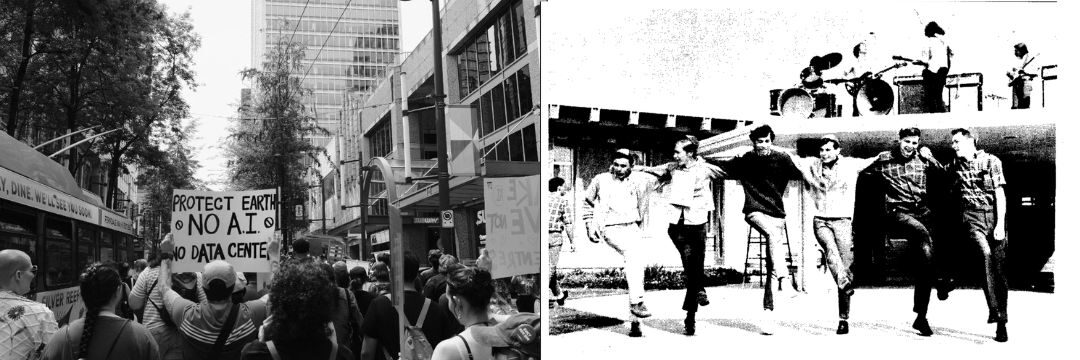
UVic students dance in front of the SUB to the band playing on the roof, 1967. Photo via UVic Archives.
Frosh Week in 1967 had a major focus on live music events, commonly referred to back then as ‘sock-hops.’ Student Council organized a ‘frosh bash’ in Esquimalt, featuring “San Francisco’s acid rock band, the Peanut Butter Conspiracy,” followed by a dance at The Purple Onion, with tunes from local Victoria rock band The Pharaohs.
To finish off the week, Frosh were serenaded by folksingers at an outdoor barbecue at the SUB, followed by a final dance in the UVic library parking lot, with Victoria’s leading blues band, the Blues X Five.
In addition, ‘costume sockhops’ (themed dances) were held throughout the week at the SUB. Monday was mod, Tuesday was hard times, Wednesday was beach wear, and Thursday was protest night.
Reimer recalled attending the Peanut Butter Conspiracy show during frosh week that year.
“I’m pretty sure it was at the Esquimalt Arena … and they came up from California. They also did a [psychedelic] light show as part of this … and of course this was just well, mind blowing, that’s what it was, it was mind blowing. But yes I went to that dance and saw the light show…I remember my date — Gail Bigsby. Stephen Bigsby’s [1966 Student Council President’s] sister.”
Reimer also mentioned that “there was also a very good musical series that was put on in those days,” where artists such as Gordon Lightfoot, Sonny Terry, and Brownie McGhee played at the school gym.
The other main event during frosh week was an annual “Log and Saw”, which consisted of students sawing up driftwood and selling it to Victoria residents to raise money for the “Victoria Community Chest,” a charity that aimed to alleviate poverty in the city.
Reimer recalls the high volume of fresh driftwood at Clover Point, and that students would sell a truckload for “a buckdollar or two.” In 1967, students in the Arts, Science, and Education faculties competed at different beaches to see who could make the most money.
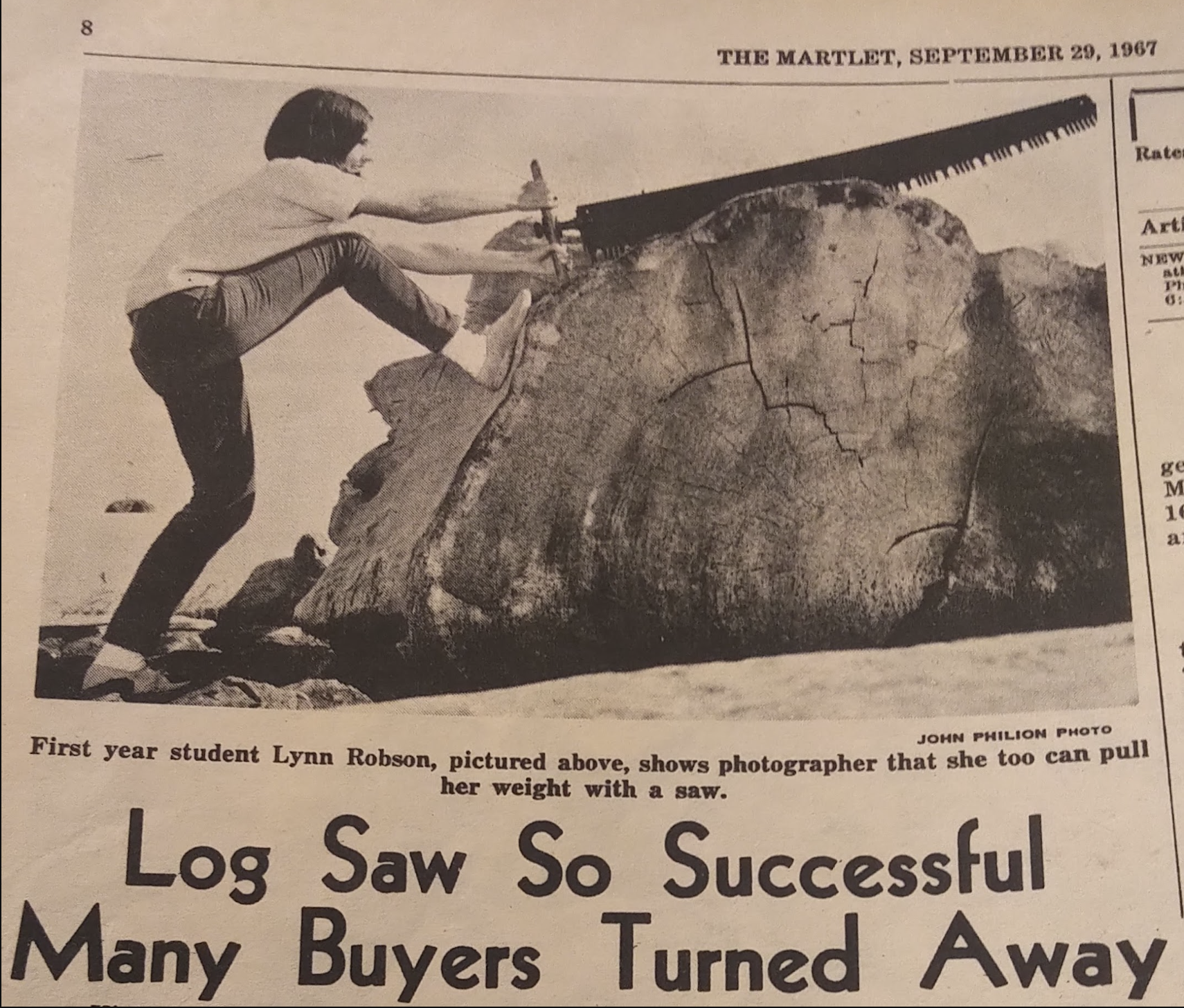
The Martlet reports on student ‘Log and Saw’, 1967. Photo via UVic Archives.
Publications
In 1967, the Student Council’s director of publications was in charge of the Martlet (we wouldn’t become independent until the 1990s), as well as an avant-garde student annual called Tower (named after the Lansdowne campus clock tower).
“My impression is that quite a substantial portion of the student body read [the Martlet]. You know, they might not have respected it very much but they read it. There were some very good journalists that worked for the Martlet. [The late] Ian Halkett … he worked for the Martlet and he was excellent. Susan Mayse — a really outstanding writer, she worked for the Martlet. Stephen Hume … he wrote for the Sun … he was a columnist for them.”
Advocacy
In 1967, a growing topic of concern among students was public transit. That year the Students Council studied a plan to implement two new bus routes that would provide “a substantial saving in transportation costs” for students in Foul Bay, Hampshire, Central Beach Drive, Lower Richmond, and Fort. This is one topic that has spanned the decades — just last year, the UVSS led a transit campaign to reduce walk-on ferry prices for students.
Other student concerns were more topical.
“It was the era of the Vietnam War, and there was a lot of agitation at the university about [it],” said Reimer. He recalled that at their first Student Council meeting of the year, one director put forward a motion condemning the Vietnam War, which Reimer seconded. That resolution failed; however, later in the year the Student Council publicly opposed a chemical company recruiting student employees at UVic that produced napalm for use in bombing Vietnam.
According to a Martlet newspaper from January 1967, Student Council “unanimously passed a motion giving $1500 to the Viet Nam Teach-In Committee,” which ran a speaker series featuring singer-songwriter, musician, and activist Joan Baez and other prominent speakers on “both sides of the problem.”
Additionally, that year, the Martlet left the pages of their Christmas edition blank as a “formal protest against the affluence of our Christmas season which demonstrates our lack of social responsibility to the millions of people now victims of disease, hunger, violence and war.”
Instead, they donated their publishing funds for that edition to UNICEF, which was providing aid in Vietnam at the time.
A major successful campaign that Student Council spearheaded in 1967 regarded student involvement in university governance.
“The Senate and the Board of Governors (BOG) in those days had no student representation. And that didn’t seem fair, since we were the ones ultimately who were going to be most … directly affected by these policies,” Reimer said. This culminated in a campaign to get student representation on both governing bodies. ”
The Student Council submitted a formal report to UVic outlining what they felt “should be the relationship between the student and the university.” This report, along with pressure from future student council members, resulted in students being elected for the first time to the UVic Senate in January 1968, and the first student on the BOG in the early 1970s.
One of the most famous stints from the Student Council in 1967 was hosting UVic’s first student sit-in, when three professors were fired without public reason. Students occupied the third-floor hallway of the MacLaurin building for 25 hours, where the University President held their office at the time.
Student Culture
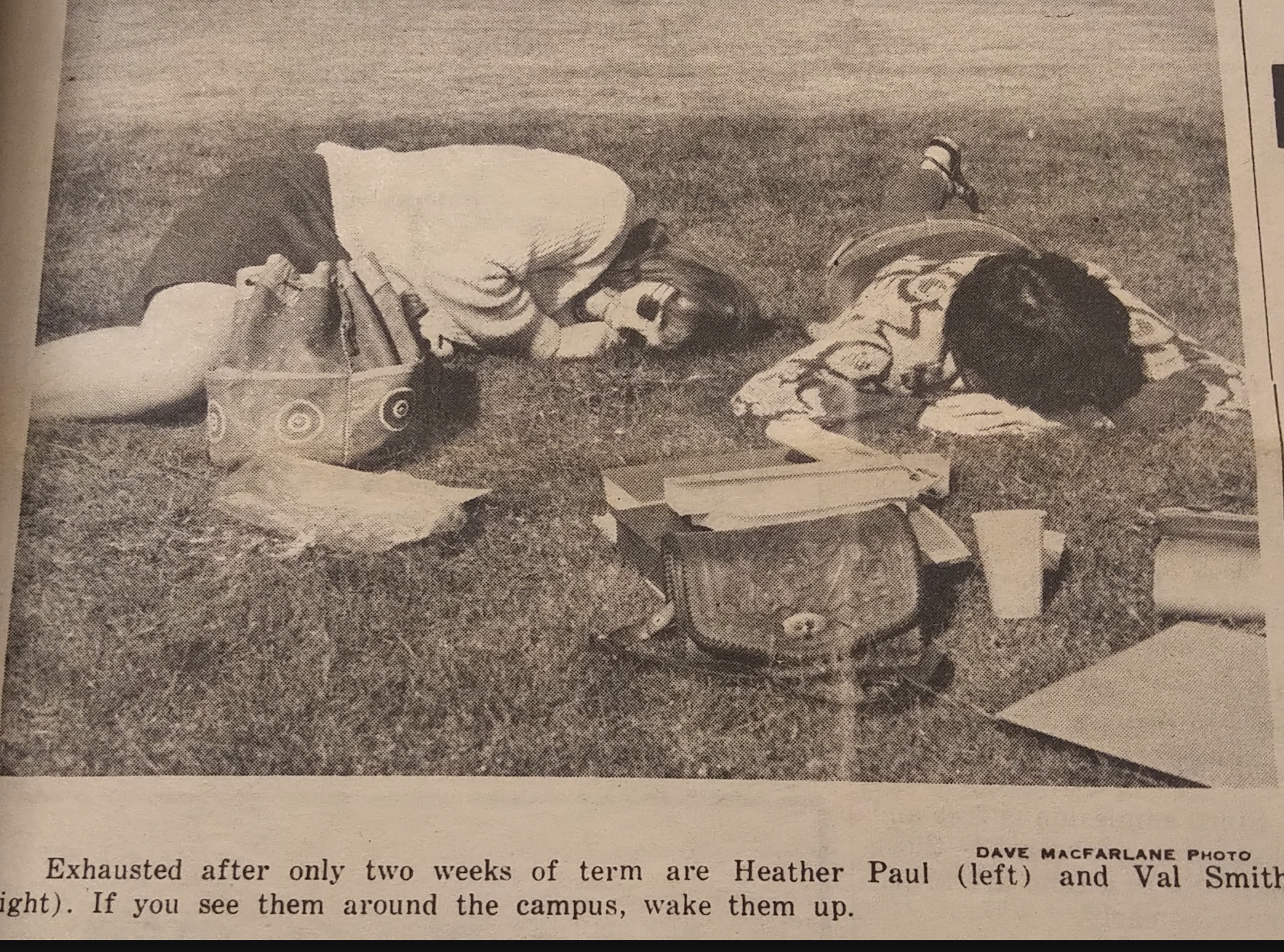
UVic students lying in the grass, 1967. Photo via UVic Archives.
On Hippies and Drugs
While diving into the archives, the Martlet came across terms that are not common among students today. In 1967, students held “speakeasy’s,” which Reimer clarified were not in fact secret meetings, but “a public meeting to air opinions about [a] topic”.
Additionally, students classified each other as either “hippies” or “straights/squares.” Reimer shed light on this, describing hippies as left-leaning students “with long hair, [who] wore sandals in January and … [used] marijuana maybe, but not necessarily.”
In an interview with The Martlet in 1967, Student Council President Dave McLean described hippies as “people who are with it.”
“An influx of hippies to Victoria this summer would be good for the student body,” he said.
“Actually, drug use, even use of marijuana was very risky in those days, and the police were pretty determined that the use of marijuana was not going to get a toe hold in Victoria, including UVic,” Reimer recalled.
In 1967, the Student Council President Dave McLean claimed that narcotics officers were working undercover in the SUB.
Reimer noted that alcohol, on the other hand, was common, and “hard drugs, by which we would have meant something like heroin in those days,” was very rare. His impression was that there was a small amount of LSD use, but mushrooms were not commonly used among students at the time.
Student Clubs
Reimer was part of the UVic Rugby Club, which he said was “a little bit controversial, in that it would do kind of riotous things.”
“I remember one year on April fools day, they smuggled a bunch of books into the library, you know, junky old books and squirrelled them away into the library in the morning.
“At lunch time, when the quadrangle was full of people, they went to the library, picked up these books and RAN out with them, passed, you know burst through the security, took them out onto the quadrangle, dumped gasoline on them and set them on fire. And then disappeared.”
“And you know there was outrage following because you know the rugby players were breaking into the library and burning books. Well, that wasn’t really what it was, it was really an April fools joke. But that would be typical of the kind of nonsense they would get up to.”
Reimer also recounted the Rugby Club’s classy wine and cheese parties.
“In those days the cheapest wine that you could buy was wine that was vented right here in Saanich … they made grape jack, apple jack, cherry jack, and they came in kind of big gallon jugs, and were just the lowest quality … nastiest wine that you could buy. And so we would hold these things that we called jack and velveeta parties, instead of wine and cheese.
Reimer was also part of the “Apollo Club.”
“[It] was basically a scam,” he said. “There was a small group of us, and we convinced the student government of the day — and I want to say this was not when I was on it — that we were a group of people who were interested in philosophy. And we wanted to get together to discuss, you know … philosophical matters, and the way we were going to do that was by having a sauna every Sunday night.”
“Well, of course the sauna cost money … so we got a little bit of money from the clubs council, and so that we had a budget, and then we used that to rent the sauna. So I was in the Apollo Club, and Steve Sullivan … he was the president of the Apollo Club. Steven ‘Steam’ Sullivan, we called him.”
In 1967, one famous club on campus was the French Club, which aimed to recreate “a typical Parisian sidewalk cafe” by setting up Café de la Paix in the SUB basement, serving croissants, brioche, and café au lait.
The Grind Coffee house hosted live folksinging and poetry readings with refreshments every Saturday night in the SUB.
Certain clubs that exist on campus today were just as popular back then, such as the ski club or the outdoors club.
Nancy Turner was an active member of the Biology Club, which was “always lobbying for maintaining the wild areas of the campus.”
Aside from creating trails through the natural areas to help everyone “[appreciate] how important they were to the overall campus,” the Biology Club fought for the natural areas “from being built over.”
“They wanted to build buildings on that camas meadow” by Finnerty Gardens, said Turner.
“Bowker Creek and the water, there were ponds around, there were a couple of really important ponds, that supported frogs and you know the wetland ecosystems … they were all really important to us, and we were always lobbying to look after them.”
“Well if you go to any of those wild areas, the garry oak meadow or the woods … think about those times, and the battles that people had to keep those and not have them be destroyed by zealous developers should we say.”
“Even Mystic Vale, the fact that [it] is there, and there’s a beautiful trail that goes through it, that you can enjoy, that’s the hard work by the people that saved it from being destroyed. And that little creek going down, all of those natural features that are so important today — maybe more important than ever.”
Although many things have evolved at UVic since 1967, it is clear that one thing remains the same: a strong sense of student culture and community, no matter what circumstances students face. What will it be like to go to UVic in another 60 years? Hopefully, the Martlet will be there to investigate.