
With literacy rates declining, interest in news media dwindling, and attention spans plummeting, Substack is exactly what we need to help ourselves out of this pit.
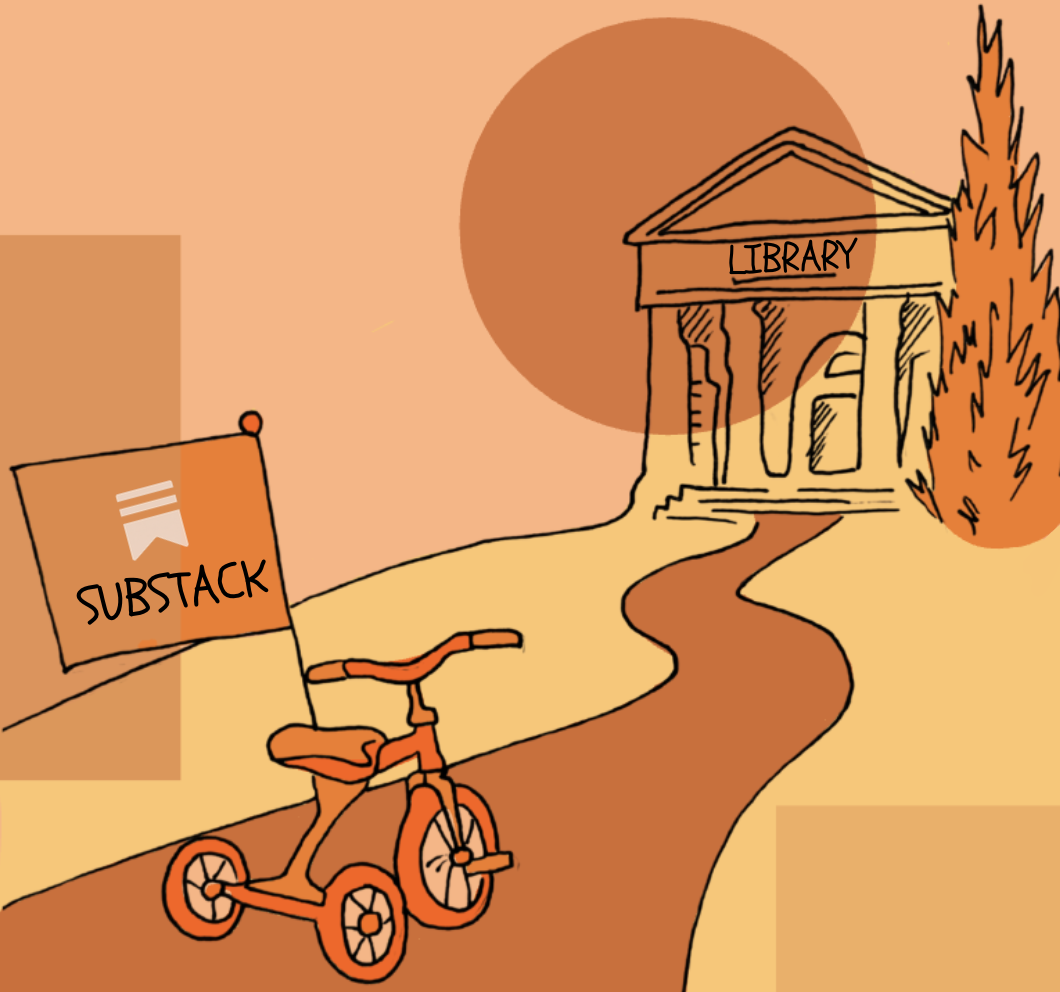
Illustration by Sabina Mendoza.
Substack, first launched as a publishing and newsletter platform, was created in 2017 by founders Chris Best, Jairaj Sethi, and Hamish McKenzie. The idea was simple yet brilliant: create a way for writers to independently publish their work while connecting directly with their audience.
Since then, the platform has since expanded to become a multi-medium network where users can share poetry, social commentary, journalism, essays, podcasts, or even one-sentence blurbs. This expansion, alongside notable figures such as Charli XCX, Dolly Parton, and Pamela Anderson joining Substack, has drawn in over 35 million users.
Unfortunately, as social media becomes tightly wound into everyday life, our minds are somewhat wired to accept the aestheticization, over-productivity, and political provocation which fuel mainstream platforms. The synthetic society created by platforms such as Instagram and TikTok shapes how we see reality, but we aren’t always aware that it’s happening.
Additionally, social media addiction is unique because its widespread nature makes it socially acceptable. Yet, after spending hours on end watching videos that have already escaped our memory, we are often left feeling guilty. Why? My theory is that, on some level, we know that what we are consuming is meaningless.
Creativity needs boredom to survive, and the constant access to dopamine that social media affords leaves no room for boredom. These platforms aim to fill the void of boredom for many users, putting a chaotic lullaby in the place of silence and intention. Seeing strangers on the internet display their vibrant, visionary lives makes us forget that raw creativity comes at the great cost of both vulnerability and imperfection.
However, there is a solution: the same models that these platforms depend on can be used to undo the damage. These models, if we disregard the sneaky algorithms, centre around sharing pieces of your life with others, either with a select few people or millions. This in itself is a wonderful way to build connections, learn new things, or derive inspiration. As we can see, the concept of social media itself is not the problem. Rather, it is the way the platforms were, and are, designed. This is exactly the route that Substack has taken. It has given me hope for our future, and given creativity a chance to thrive once more.
Substack differs from the norm in that it is propelled by subscriptions, instead of algorithms. This means that, when you want to hear more from an author, their work — once you are subscribed — is sent directly to your email. There is also an optional paywall function used by many independent journalists, career-writers, and influencers; however, many writers who are on the platform simply to share keep their work accessible and free. This way, you can use the platform to read the work you want without being pulled in by content you never signed up for. The difference is not the time you spend on each platform, but the way you spend your time. For many Substack users, that time is spent with intent and attention, as opposed to passively riding a merry-go-round of fruitless information.
The fact that Substack has gained so much popularity in recent years may show us something promising: long-form writing might not become a thing of the past. While perusing Substack in preparation for writing this piece, I found countless accounts with very small followings that were scattered with a plethora of writing. I found pieces that were raw, diverse, sometimes sloppy, but nevertheless real. They ranged from childhood mementos to opinions on current affairs, yet carried the same thread of originality throughout. These accounts were not for anyone in particular to see; they were simply people with ideas to share, and with enough creative stamina to turn those thoughts into something genuine. One user wrote a 42-line poem about poetry which made me cry. This post had 12 likes.
But we shouldn’t jump to conclusions. Although Substack may be a step in a good direction for our “brainrotted” minds, there is no denying that these magnetic, easy-reward platforms aren’t going away. The rate at which many of us consume short-form videos (SFVs) has been proven to be harmful to our cognitive abilities, sleep quality, mental health, and attention span, leading to deep-rooted effects. As many of us know, the algorithms integrated into these platforms are designed to suck us in, and bribe us to stay.
However, Substack is an accessible way for people who have struggled with these effects to be reintroduced to slow-release dopamine activities such as reading and writing. The act of simply picking up a book to read seems to have become intimidating for many, because it requires one to hold their attention span longer than they are used to. If books are like mountain biking, Substack is like riding a tricycle. You can’t jump on a mountain bike after your first day on training wheels, but it’s a step in the right direction.