
Student lounges are loved by students and departments across UVic, although not every faculty has one.
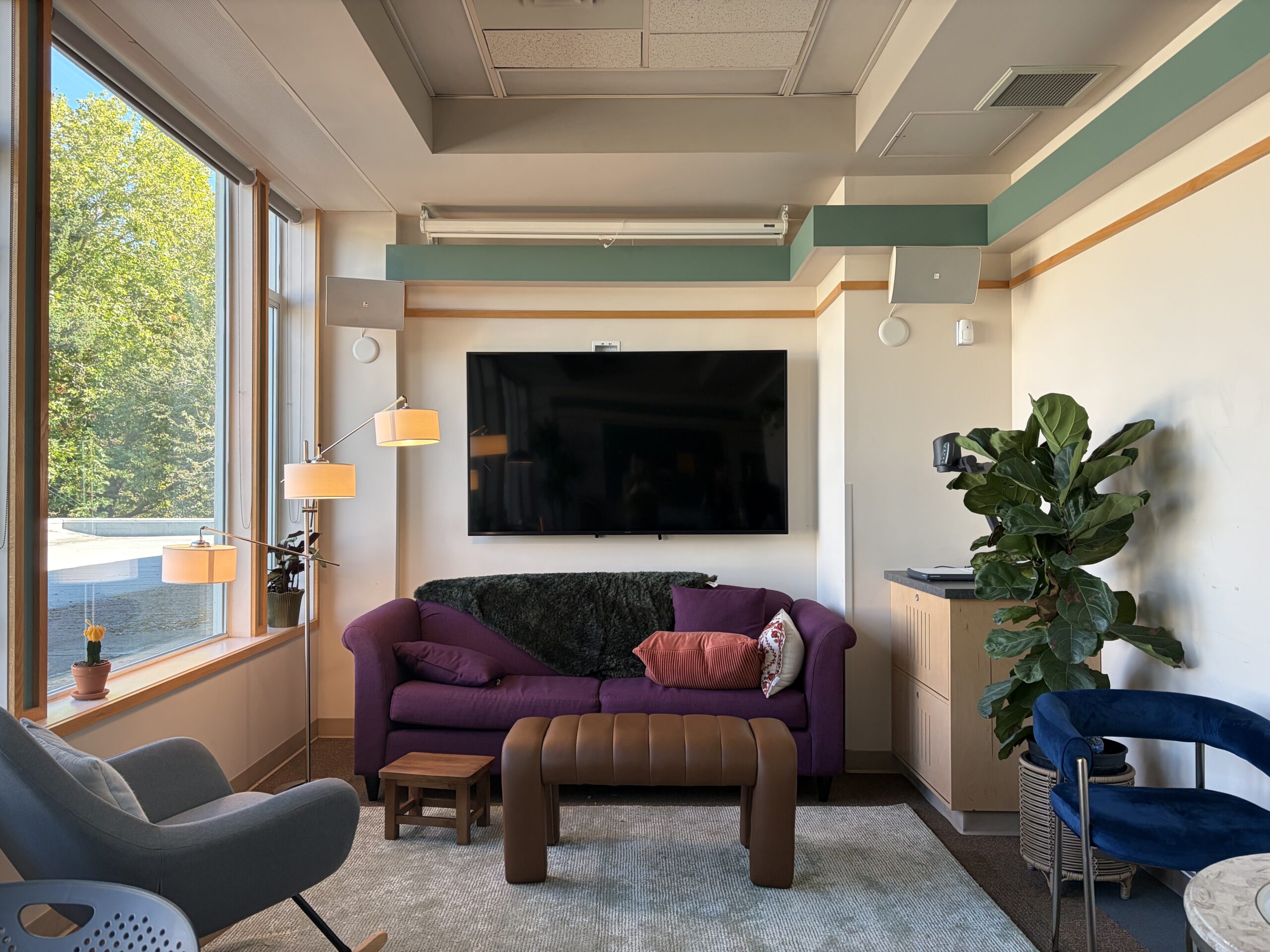
Photo by Ruby Harris.
Forget the sterile, gray walls found across campus. This term, writing students have a new sanctuary — one born from a desire to build community, fight food insecurity, and give artists a vibrant, non-institutional space to collaborate. However, not all students across UVic’s many departments have equal access to such a space.
The writing lounge is one of UVic’s most recent student lounges — designated spaces on campus where students in a given area of study can work, eat, relax, or connect.
Over the summer, staff from UVic’s Department of Writing transformed a classroom in the Fine Arts Building into a cozy and eccentric space, complete with couches, study areas, reading material for students, plants, snacks, and two fridges.
Some lounges were integrated into the original design of UVic buildings, such as the two Gustavson Student Lounges established in 1997, while others have been converted from classrooms, storage rooms, or lobby areas. For example, the music department has a puzzle table, message boards, and a kitchenette in lobby areas for student use, managed by the Music Students’ Association.
Many lounges were created by a department and its faculty, though others were advocated for by students and student groups. Some students currently without a department lounge say they plan to advocate for one in the future.
Lee Henderson, chair of the writing department, said that the desire for a student lounge had been around in the department for years and that he, along with other writing faculty, had been actively preparing to create the current lounge over the past year.
The need for space and funding were both obstacles to creating the lounge earlier, and to make room for the lounge, the department had to give up teaching space. Despite this steep commitment, Henderson decided to move forward with the project when he became department chair.
He said he was motivated by his desire to establish a dedicated “third space” for undergraduate writing students — an environment outside of home (the first place) and work (the second place) where individuals can engage with others and build community.
“As writers, we need to be finding ways to remind ourselves that we’re not institutional,” Henderson said. “We’re here in an institution, but writing is non-institutional, and third spaces, I think, are an important way for students to temporarily be relieved of some of the institutional expectations.… For me, that’s as important as a classroom.”
Elena Stalwick, graduate secretary of the writing department and a key figure in the creation of the lounge, said that even after being denied funding from the university two years in a row through the annual “Routine Capital Requests” process, the department was determined to find a way to make the lounge possible.
Stalwick helps manage the department budget, and was able to find “little pockets of unused money” to buy amenities like a fridge and microwave for the lounge.
The writing lounge’s decor is almost all second-hand. Henderson said that he, Stalwick, and another faculty member said they had a “great time” thrifting from places like Habitat ReStore and the Salvation Army.
“I wanted people to feel like this was a little bit different than the rest of the department or the campus. Something a bit more bohemian maybe, or like you’re in my undergrad apartment,” Henderson said.
Providing food was also central to the lounge’s design, sparked by concerns with widespread food insecurity and rising grocery prices. Henderson wanted the department to take action, however small, to combat the issue. Stalwick said she has heard students talk about how they can not afford food, and noticed that prices at UVic Foods Services outlets had increased over the past year.
Now, the department regularly stocks the lounge with things like granola bars, fruit, and canned drinks.
“It’s hard to think without food to fuel your brain. I remember being a student and feeling how my attention and focus would suffer if I didn’t eat. Now I always think about ways we can make sure students feel like they can access food when they need it,” Stalwick said.
Claudia Phillips, current secretary of the UVic Writing Undergraduate Course Union (UWUCU) said that snacks can make students feel more welcome in a space, and drawn to going to the lounge.
According to her, the room was used informally as a lounge, and to host events and social gatherings, before its official transformation. She said that one writing professor would even leave snacks there, knowing students frequently gathered in the space.
Brendon McCallum, former president of UWUCU, also noted that providing fridges in the lounge allows writing students to store food from home, rather than having to buy campus food.
The lounge has been “pretty well received,” Phillips said. “I’ve overheard a lot of compliments [from] people saying that it looks really nice. I have some friends who have graduated, they’re writing alumni now, and they’re all jealous that now there’s a lounge.”
She said that the only complaints she has heard about the lounge are from students wishing it was here earlier.
Students in the writing department are not the only ones who have wanted to see a lounge space made available to them.
The English Students’ Association (ESA) is currently in the process of converting a room in Clearihue, which was previously used as storage for an academic publishing group, into a student lounge. Over the past few weeks, the association, with the help of the English department, has been clearing out the space.
Jacqueline Vanden Berg, ESA president, said that it took continuous effort and discussions with the department to secure the space, and that they met with generous support from other students and staff.
They hope to create a comfortable space for English students to study and relax and plan to include couches, tables, lamps, rugs, free books, and a coffee and tea station.
While new lounges pop up around campus, students from the psychology department are wondering if they will get a dedicated lounge.
Psychology Undergraduate Students Association co-president Trinity Schlitz said first-year psychology students especially seem to want an approachable space like a student lounge where they can engage with their community
“We are one of the largest departments on campus, yet we don’t have a designated space for students to come together and connect,” Schlitz said.
Schlitz said she received several questions about the lack of a lounge during Clubs and Course Union Days, and iis looking into psychology students’ department engagement and connection. If the results reveal a weak sense of community, she plans to investigate whether the lack of a designated student space is a contributing factor.
Ultimately, she hopes PUGs can build a strong case for establishing a student lounge.
UVic’s chapter of Psi Chi, the International Honour Society in Psychology, also said they would love to see an undergraduate psychology lounge, given that many other departments already offer dedicated student spaces. However, they acknowledged the current space constraints at UVic, including limited office space for faculty.
Dr. Catherine Costigan, professor and chair of the Department of Psychology, said that the department would consider a request for a student lounge in the future based on available space and resources.
“The absence of a psychology undergraduate lounge should not be interpreted as a lack of support for our students or their interest in building community,” she said.
Student lounges are everywhere at UVic, and are important parts of departments’ personalities. The Department of Biology’s lounge, affectionately coined as “the BUGS lounge” is home to a digital display showcasing campus news, informational handouts for students, and more, while the lounge run by the Engineering and Computer Science Student’s Society (ECSS) sells food at-cost, as well as ECSS merchandise.
The Art History and Visual Studies (AHVS) lounge, “AHVS Commons,” is a space full of colour, and is used not just by students but also for department meetings. The School of Languages, Linguistics and Cultures also has three reading rooms inherited from the four previous departments that now make up the school.
Students and staff have also made lounges their own by adding decor, food, even foosball and video games. Some students are actively trying to improve their student lounges; for example, Undergraduates of Political Science (UPS) are hoping to get amenities like a microwave and a kettle reinstated in their lounge.
Barriers to the ongoing operation of student lounges continue to exist across campus. Stalwick said the writing department is still considering how to maintain funding to allow for continued food in the lounge. The elevator in the Fine Arts Building frequently breaks down, creating an accessibility issue for the second-floor lounge, and when items from the lounges go missing –– a lamp was stolen from AHVS Commons when the lounge was created –– departments are on the hook for replacement costs.
Despite this, both students and faculty across departments are keen to support the continuation of student lounges and hold strong beliefs about their importance.
“Make it happen,” Henderson said, about departments who may be weighing the costs of creating a lounge. “Sometimes you’ve got to make a sacrifice, but the benefit is always going to outweigh that sacrifice. I think students these days really crave it, as they should, and I think it benefits your community.”