
This meeting clarified language in several academic policies, and saw the discontinuation of the Non-credit Certificate in General Studies
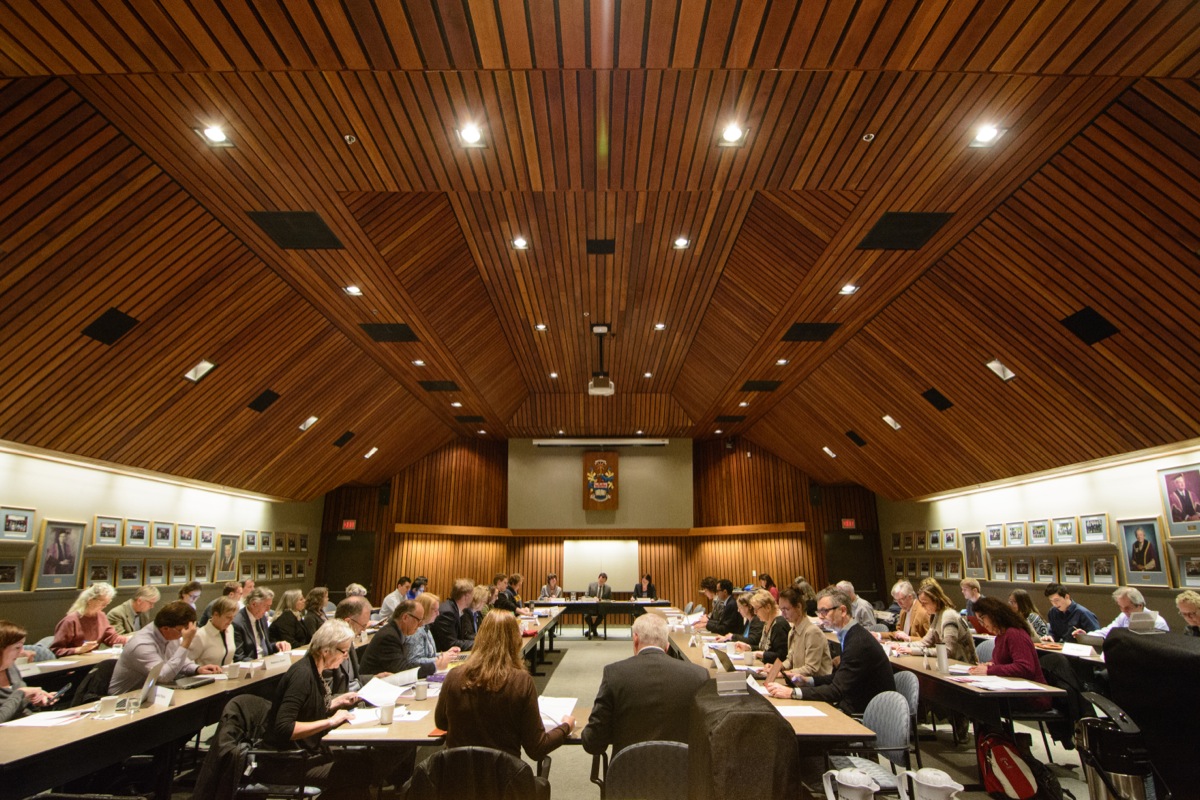
File photo by Hugo Wong.
UVic’s Senate kicked off the academic year with a quick meeting on Oct. 2 filled with housekeeping items and motions to clarify important academic standards and regulations.
In her opening remarks, Acting President and Senate Chair Dr. Elizabeth Croft said the incoming cohort is 5 255 people, the “largest” in UVic’s history.
The meeting’s agenda and the minutes of the April 10 meeting were approved without any discussion. However, a student senator wanted the minutes of the May 8 meeting to reflect a challenge to the Chair, which was ruled out of order. The student senator was told that the minutes are intended to record “high-level issues,” and that issues that can be handled without consideration of the motion are not typically included in the minutes. The minutes were then approved without any amendments.
Following the student senator’s objection to the minutes, several consent motions, including accepting reports from the Senate Committees on Academic Standards, Continuing Studies, and Curriculum, respectively, carried. Later in the meeting, other standard motions carried, including the approval of the 2026/2027 standing committees, the approval of items in the January 2027 academic calendar, reappointing the university’s orator (John Dower) for an additional three-year term, the approval of academic important dates for 2028, and the approval of several academic awards.
The Senate Committee on Academic Standards then introduced five motions. The first was a motion to remove the C+ requirements from 100- and 200-level courses in the Political Science Honours degree program, effective May 2027, which carried.
Another motion to add new language to the Graduation Standing language for the Faculty of Social Sciences in the Undergraduate Academic Calendar carried. The revised language clarifies that students with cases of plagiarism or cheating could be removed from the Dean’s List.
Following the trend of clarifying language, the Senate Committee on Academic Standards motioned to approve revisions to the “Grade Below B” grading regulation in the Graduate Academic Calendar, effective January 2027. The new language says that graduate students who score below a B in a course will undergo a remediation process, as B- and below are considered “unacceptable work” at the graduate level.
A senator had concerns over “a set of courses where an undergraduate course and a graduate course are cross-listed.” The senator asked if the motion could go back to committee to address such courses. The speaker responded that, while there are instances of graduates and undergraduates sharing a classroom and instruction, they are generally working on different syllabi. Ultimately, the motion was carried.
The same committee then moved to include language regarding grade submission deadlines and the release of grades to the Graduate Academic Calendar. Currently, the Graduate Academic Calendar is missing criteria such as when grades must be submitted, despite the Undergraduate Academic Calendar having this language. The motion was carried without any discussion and will be implemented in January.
The Senate Committee on Academic Standards’ final motion of the evening was to approve revisions to regulations in the Graduate Academic Calendar regarding leaves of absence and limits for leave. According to the speaker, there is a concept of “course currency” in the undergraduate academic calendar. When a student withdraws from a program and later returns, coursework is assessed for currency. Particularly old courses may no longer count for credit, since disciplines change over time. These revisions add guidelines for how students who take medical leave, which may cause a course credit of theirs to expire, are to be handled. This motion was also carried without any discussion.
The Senate Committee on Agenda and Governance moved to approve revisions to the Senate Rules and Procedures. The updated rules and procedures “affirms the Chair’s authority to provide procedural guidance and make rulings on matters of process, order, and the interpretation of Senate Rules and Procedures.” In the last Senate meeting, a senator challenged the Chair, a procedure that does not exist in UVic’s Senate.
One senator had concerns that there was no statement or guidance for when the Senate disagrees with the Chair’s ruling. They were told that the Chair does have the ability to make procedural rulings to guide the Senate. It was suggested that they approve the motion and make an amendment at a later date to address the senator’s concerns.
Another senator commented that the Senate needs more clarity on the rules of order and that they hope this is the first step to having clearer language. The motion then went to a vote and was carried with a majority of senators in favour.
The Senate Committee on Awards motioned to approve revisions to the Undergraduate Academic Calendar Regulations which include clarifying language on eligibility for scholarships and awards, and that students enrolled in co-op work terms or practicums are eligible to be considered for in-course scholarships, amongst others. The motion carried.
The Senate then voted to discontinue the Non-credit Certificate in General Studies. One senator asked if a student, who has not taken coursework since 2023, was notified that the certificate program was nominated to be discontinued. They were told any student who comes back could complete the certificate with the current menu of courses. The Senate also voted to approve changes to the Entrepreneurship Minor, including removing the COM 220 requirement.
The Senate Committee on Planning moved to renew the Centre for Asia-Pacific Initiatives (CAPI) as an approved multi-faculty research centre for a new five-year term (July 1, 2026 to June 30, 2033). The motion was carried without any discussion.
Following motions introduced by senate committees, the Gustavson School of Business motioned to approve revisions to the school’s bylaws, including clarification on the appointment procedures and authorities of Dean, Associate Deans, Academic Directors, and the school’s standing committees, as well as updating provisions to reflect how the school currently operates, amongst others. The motion also carried without any discussion.
Following the motions, an update was given on Senate elections. The Chair said there were three by-elections over the summer.
At this meeting, the Senate also elected the Vice-Chair. Only one Senator was nominated (Dr. Robin Hicks, the dean of graduate studies). He was acclaimed to the position.
Following this, the public portion of the meeting concluded. The next Senate meeting is on Nov. 6. Agenda materials will be available on the Senate meeting page one week in advance of the meeting.