
In the era of artificial intelligence, it more important than ever that we all reflect on our own education — and what we really want out of it
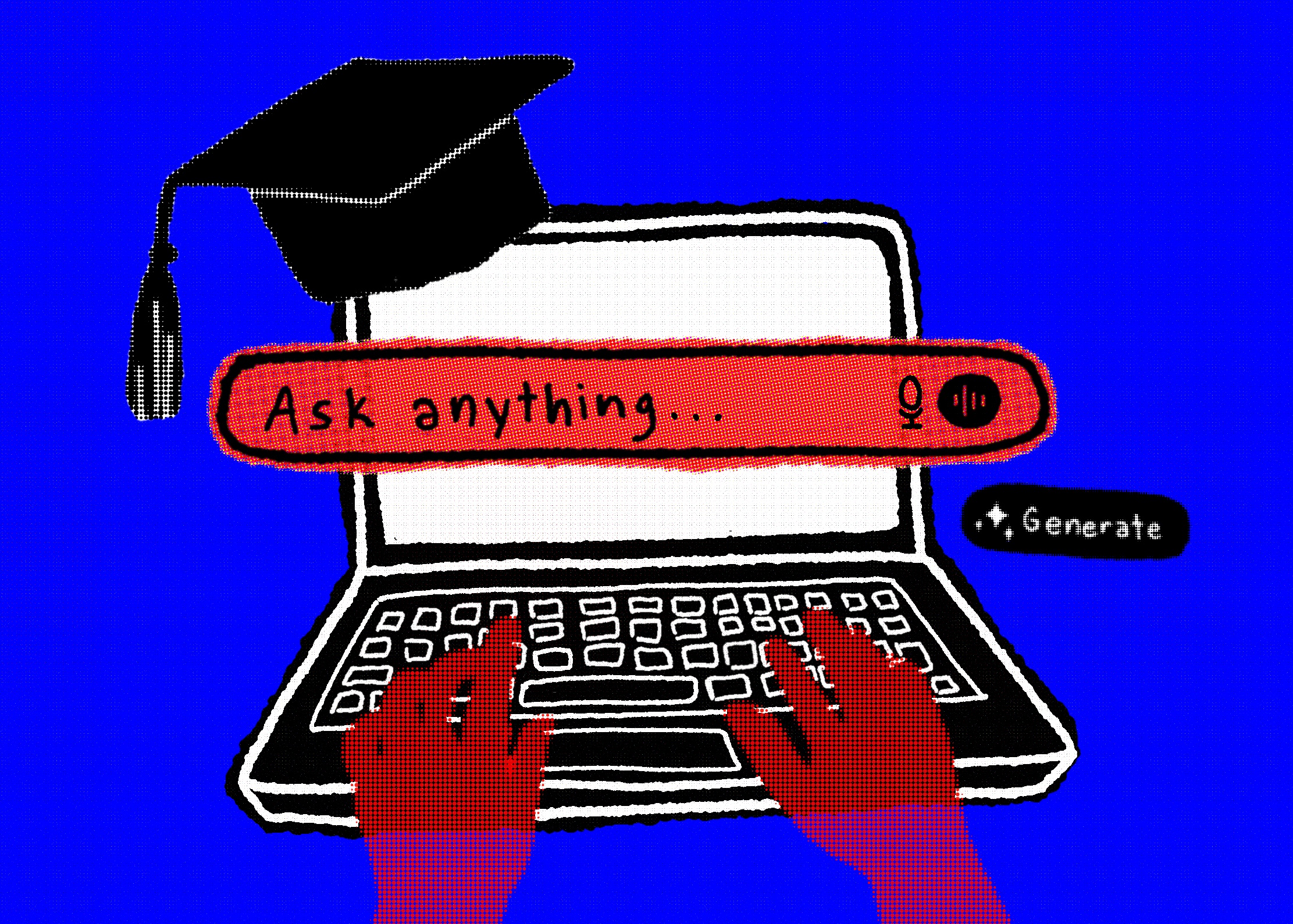
Graphic by Luisa Dela Cruz.
Like so many others I entered my post-secondary education — and adult life — during the age of artificial intelligence (AI). I’ve watched it overtake social media content and discourse, transforming into a part of our daily routines. I have seen people I know and care about become utterly dependent on AI chatbots in their lives. It is looming and unavoidable.
OpenAI released ChatGPT for public use in November 2022, and almost immediately it took over. Everyone was in total awe of this new, almost magical chatbot that seemingly held all of the world’s knowledge, and could generate essays in minutes. It was ready to take on the mental load for us, and many of us were ready to let it.
I am not innocent in all of this. I first used ChatGPT when I was in the twelfth grade and couldn’t be bothered to decipher the deeper meanings behind the symbolism in George Orwell’s 1984 myself. Ironic, right?
I knew that it was a slippery slope, and if I wasn’t careful with my use, it could cause an array of problems. I was under the impression that utilizing it solely as a “learning assistant” — to help me summarize and decipher meaning from texts, but never to do an assignment for me — was perfectly acceptable.
After all, everyone else around me was doing it. My classmates regularly confided in me that they submitted entire essays written by ChatGPT. This was normal, I thought. So, while I justified my own use as miniscule and not crossing the line of academic integrity, I was really inhibiting my own learning.
I’ve always loved learning, and so as the AI-craze grew, I took it upon myself to learn more about generative AI — the implications nobody seemed to be paying attention to: literacy, climate, intellectual property, and so on.
The more I learnt, the less I used it, and eventually I even became an anti-AI advocate — encouraging those in my personal life to take on the same stance, and advocating for it through journalism. Most importantly, I’ve observed a significant, positive difference in my learning outcomes after quitting AI altogether.
While there are many other legitimate concerns about generative AI, its impact on learning remains the biggest concern for me.
I am proud of my personal journey with generative AI, and I know that I am not alone in my concerns. However, many others continue to increasingly rely on generative AI in their lives.
This fall semester, I returned to campus for my third year of university, and I immediately noticed that many of my peers had ChatGPT open on their laptop screen during lectures.
Last week, in a political science lecture, I noticed the student beside me using the audio message feature on ChatGPT to record and upload our professor’s lecture to the chatbot in real time. ChatGPT regurgitated what I assume to be notes on the lecture, and the student copied and pasted the material into their own document — all while scrolling on Instagram, completely disengaged from their surroundings.
I spent the rest of the lecture struggling to focus on my own learning while I watched this happen.
My first thought pertained to the intellectual property of our professor, which, completely unbeknownst to him, was going straight from his mouth into a generative AI chatbot. My second thought was about how disrespectful this was to both the professor and other students in the room, who attended the lecture with the intention of learning.
Finally, I wondered, why are you here? What could you possibly be getting out of this? The answer is nothing.
I recently heard someone equate AI use in education to attending the gym and watching others lift weights, then expecting your muscles to grow, even though you didn’t lift anything yourself.
This is the perfect analogy.
Learning is not easy; anyone who tells you that it is is lying. It is hard, and takes significant effort, but without that effort it doesn’t work. Like the gym, you will only ever get out of it exactly what you put in. The offloading of all of the mental labour that is crucial to learning onto an AI chatbot will be the demise of intellectualism in an already anti-intellectual age.
The other week, I was chatting with another student about my heavy workload of readings. She laughed and said “that’s when you use ChatGPT.” The utter shock that came over her when I told her that I don’t use generative AI illustrated to me just how widespread this problem is. She couldn’t fathom how I’m making it through a post-secondary education without the help of ChatGPT, because most people can’t anymore.
Beyond student-initiated use, AI is also entering our classrooms in a manner that is facilitated by educators. Last June the Vancouver school board rolled out Microsoft Copilot accounts for every student over the age of thirteen.
As generative AI-use continues to grow in educational spaces, it is important that we all reflect on why we are there, and what we want out of our own education. I am willing to bet that AI is not the omnipotent solution that so many of us think it is.