
Ontario is proposing changes to FOI legislation, which would keep the records of the provinces most powerful offices secret
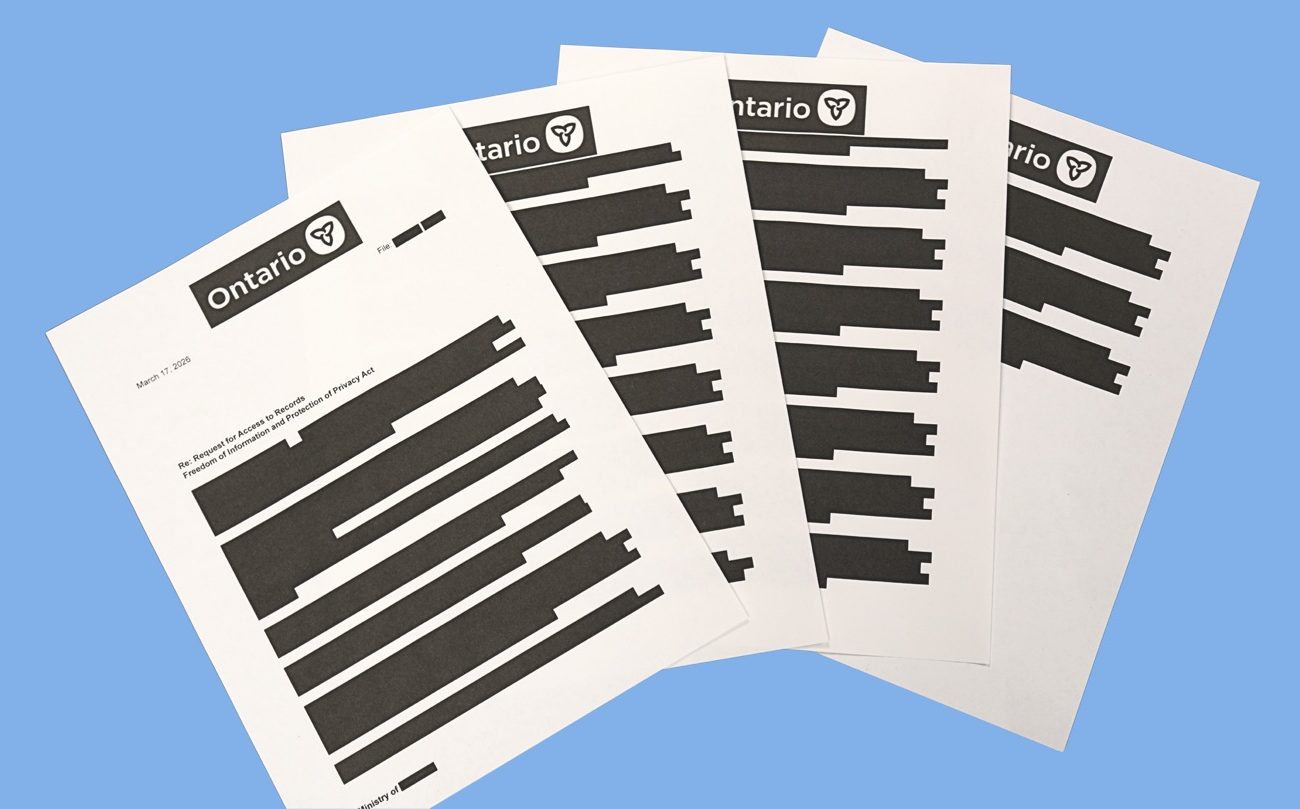
Graphic by Rae Dawson.
Ontario is proposing a change to Freedom of Information (FOI) law — law which allows members of the public to request government documents, such as reports, emails, briefing notes, memos, and contracts — that would make the records of the premier, cabinet ministers, parliamentary assistants, and their offices, secret — and thus unobtainable by FOI requests.
This isn’t the first time provincial governments in Canada have changed legislation, making it harder to access their documents. In 2021, B.C. passed Bill 22, which introduced filing fees for submitting FOI requests and was criticized as posing barriers to accessing information.
Access to information is a crucial part of democracy. The ability to obtain government documents and understand the processes going on behind the scenes is an invaluable tool in holding them accountable. Legislation like this, that seeks to make information less accessible — or even impossible for certain offices — jeopardizes our ability as journalists’ to hold the government accountable and report on matters of public interest, and undermines democracy as a whole by making information less accessible to citizens.
As they stand, the processes for obtaining records via FOI request are already flawed, oftentimes taking several months to receive the documents you request; when you get them back, they are often heavily redacted, further drawing out the process of uncovering information that serves the public interest, while also racking up high processing fees. In Ontario’s case, this proposed legislation risks normalizing government secrecy, and could set a precedent for other provinces to follow suit.
This legislation comes at a time when access to information, and the work of real journalists, is more important than ever. Across the globe, we are seeing constant attacks on journalism, the consolidation of media under corporate ownership, and rampant disinformation.
In Canada, threats to access to information often coincide with efforts to hide government scandals. In 2015, the B.C. government, then under the BC Liberal Party, was caught in the “triple delete” or “delete, delete, delete” scandal, where a staffer for the transportation ministry, George Gretes, came under controversy for allegedly deleting emails and records surrounding the Highway of Tears — a 716 kilometre stretch of highway between Prince George and Prince Rupert, known for the large number of Indigenous women and girls that have been murdered or gone missing on it. Gretes also, allegedly, lied under oath.
“Triple deleting” entailed moving an email to the computer’s “deleted” folder, deleting it from that folder, and then manually overriding a backup, which would allow the system to recover the deleted email for up to 14 days.
The issue was pervasive, with high-power individuals, such as Michele Cadario, the deputy chief of staff in the premier’s office, allegedly mass-deleting emails on a daily basis, according to the privacy commissioner’s report.
The scandal came to light after a whistle-blower, Tim Duncan, former executive assistant to the minister of transportation and highways, took the matter to the privacy commissioner after being told to “triple delete” emails he had related to the Highway of Tears.
In Canada, governments are supposed to keep all “non-transitory” records — decision records, instructions, advice, and documentation of policy matters — but, according to the commissioner’s report, Cadario did not retain a single email she had ever sent from her government email address.
Instances like triple delete are an affront to government accountability and transparency, and Ontario’s newly proposed legislation isn’t any better. It’s just the latest in a long line of assaults on freedom of information, democracy, and journalism, and will make holding our elected officials accountable that much harder.
Ontario’s proposed changes come in the midst of the “Greenbelt” scandal — where the Ontario government attempted to open up protected areas to development, which allegedly favoured certain developers over others, potentially providing billions of dollars in increased property value for select land owners.
What’s worse in this case is that the proposed legislation would be upheld retroactively, meaning in-progress requests for the Premier’s and cabinet members’ records would be inaccessible. Ontario’s Information and Privacy Commissioner, Patricia Kosseim, said public accountability would be “eviscerated,” an assessment I find far too generous.
This legislation is fascistic, dystopian, and abhorrent. Any restriction on access to information is an attack on our democracy as a whole. Weakening the freedom of information request — one of the most powerful tools in the public’s arsenal — is an affront to democracy, accountability, and transparency, and it brings us one step closer to authoritarianism. Triple delete, Ontario’s proposed legislation, it’s all the same — an attempt to avoid any semblance of accountability for our elected officials, at the expense of our democracy.