
Several grad students have filed a formal complaint, arguing the GSS’s referendum process was “substantially unfair”
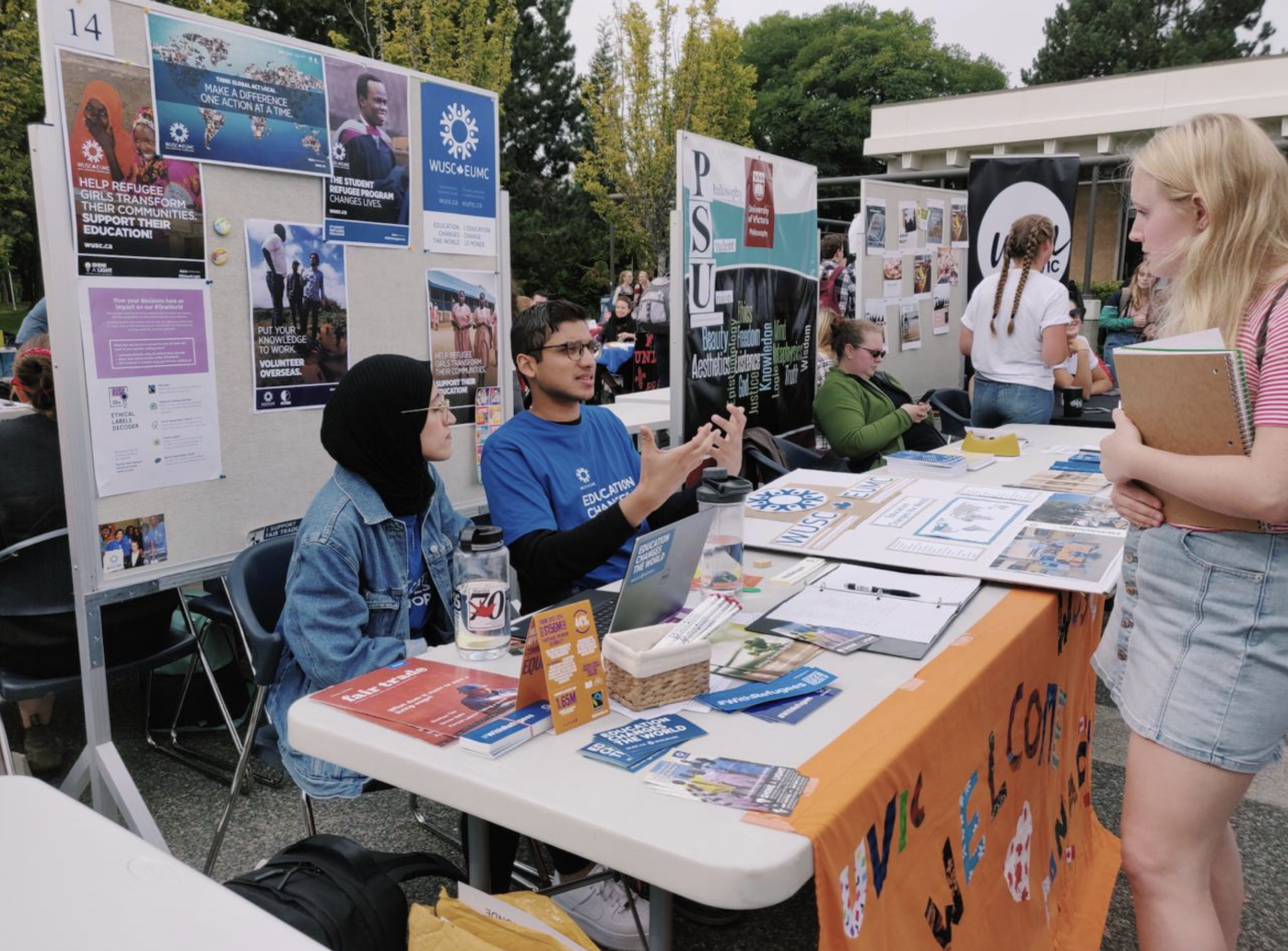
Photo courtesy of the World University Service of Canada UVic.
In the most recent Graduate Students Society (GSS) election, almost two-thirds of voting graduate students supported a referendum question to cut funding to World University Service Canada (WUSC) UVic — a student group that sponsors refugee students at the university — by $4 per graduate student.
The election period was held from March 4 to 6, where graduate students voted on a number of fee referendum questions to determine the allocation of graduate student fees. On March 6, Simply Voting Inc. verified the results; all referendum questions passed.
Graduate students voted to reduce the WUSC fee from $5 per term to $1 per term for on-campus members. The fee supports WUSC’s local UVic chapter in resettling refugees to study at UVic through its student refugee program.
According to Dr. Marlea Clarke, a political science professor involved with WUSC UVic, the result means the organization will be forced to reduce the number of refugees it can resettle by one or two, unless other funding is secured.
In a statement emailed to the Martlet, a UVic spokesperson also said that the fee decrease will lead to fewer students being sponsored. They noted that WUSC UVic will be able to sponsor three students in 2026, down from the four students they sponsored in 2025.
WUSC UVic said in a statement on its Instagram that the fee decrease will result in an approximately 17 per cent reduction in the total funding obtained via student fees next year, or about $19 416.
WUSC UVic also receives funding from the university, and $2.50 per full-time undergraduate student through the UVSS.
A total of 217, or 62.2 per cent of participants, voted in favour of reducing the WUSC fee, while 132 voters, or 37.8 per cent, voted against.
Eight voters, or 2.2 per cent, abstained, for a total of 357 votes cast. According to the election results, 2 921 graduate students were eligible to vote, but only 12.2 per cent cast a ballot.
Quorum for GSS referenda is five per cent of membership, which was met, although turnout was lower than the previous two elections. GSS told the Martlet their elections saw 15.3 per cent turnout last year, 16.0 per cent in summer 2024, 11.1 per cent in spring 2024, and 0.91 per cent in a 2023 referendum.
In a statement, Clarke said she does not believe the result reflects the views of students as a whole, citing the low voter turnout, and suggested many students may not have understood the referendum questions.
Notably, 11.5 per cent of voters opposed eliminating the University 101 fee — a fee collected to fund a free, non-credit program for community members that was discontinued by UVic in summer 2025. A similar referendum question at the UVSS election — which also saw low turnout — passed, with 4.7 per cent of undergraduates voting against it.
Clarke said she found the passing of the WUSC UVic fee decrease particularly disappointing, stating that graduate students should understand both the importance of education and their own privilege in accessing post-secondary education.
Dr. Scott Watson, another political science professor involved with WUSC UVic, expressed a similar view, saying he does not believe the result reflects general support for refugees on campus.
“The results show that if you have a group who is motivated to cut refugee funding, with an electoral model that produces very low voter turnout, you can pass measures that do not actually have broad support,” he said in a statement.
In the statement, Watson stressed his belief in the privilege of pursuing post-secondary education at UVic and the importance of extending that opportunity to others.
Critics of the result, however, argue that the referendum was conducted in a flawed manner, in a way that may have advantaged the “yes” side.
Following the referendum, a group of graduate students filed a complaint against the GSS seeking to overturn the result, arguing the referendum process was “substantially unfair.” They argued the GSS Executive Board improperly took an official “yes” stance on the fee decrease question, despite no clear policy permitting this, creating an imbalance in power and resources between the two campaign sides.
The complaint also cited the board’s use of communication channels, including a referendum FAQ that the students say framed WUSC negatively, and did not have any input from the “no” campaign.
These students further argued that presenting the questions as a cost-neutral package — that the referenda would result in no increase in fees if all questions passed, emphasizing cost-of-living pressures — limited voters’ ability to assess each question independently and did not fully explain potential fee outcomes if some measures failed.
They argue these factors violated GSS policy requiring fairness and impartiality, and called for the WUSC referendum result to be invalidated.
In a statement, the GSS said all campaign rules were publicly available and “were enforced,” and that all campaigns were able to print posters at the GSS without cost.
They said that according to the GSS’s campaign guide, their Electoral Officer maintained the right to monitor campaigning behaviours on social media by approving campaign materials that may be advertised to the public.
The GSS said the executive board formed a “yes” campaign for the referendum, but the GSS as an institution did not campaign. They added that board members are elected students and are permitted under GSS policy to campaign.
They also said the GSS’s communications coordinator regularly posted about the referendum and election in accordance with its bylaws, but that these posts — such as “vote now” and “nominations now open” — did not promote a specific voting outcome.
According to the GSS, the Electoral Officer is reviewing materials submitted during the appeal period, and the society cannot comment on ongoing appeals.
Though WUSC UVic will face challenges following the fee decrease, this is not the end of their work. Those involved with WUSC encourage students to continue getting involved through volunteering, supporting fundraisers, and staying informed about issues impacting refugees. Watson noted that volunteering for WUSC “is not always easy work, but it is extremely rewarding.”
Charlie Edgett, a co-coordinator with WUSC UVic, said the volunteer team plans to seek increases to the undergraduate and graduate levies in the future, while continuing to raise awareness among students about the organization’s work.
In light of the fee decrease, Clarke suggested the university consider waiving fees for the first two years of degrees for students sponsored by WUSC.
In a statement to the Martlet, UVic said it supports WUSC UVic through financial contributions, “leadership and administration of the program with staff and faculty advisor roles,” and that the Department of Continuing Studies waives the fees for WUSC students who are participating in their English language programs.
The university said its support reflects its values of shared global responsibility, equity, and access to education. It is unclear how this support may change in the coming years.
However, Clarke said “this referendum will definitely tarnish UVIC’s reputation in the WUSC national community.”
“I think the GSS executive should be ashamed of their recent work to defund the one group at UVIC that is working so hard to help increase the number of refugee students that Canada takes in,” she said.
“It’s hard to see this club that we all love, and the impact we make, be threatened for reasons that still don’t fully make sense to us. There is still a sense of confusion around the motivations for the referendum,” Edgett said.
She added that she views Victoria as a community grounded in respect, solidarity, and compassion, but said the referendum has shaken that perception by reducing support for a cause she says does tangible and positive work. While she acknowledged the cost-of-living concerns highlighted in the referendum, she said it is disappointing not to use the privilege UVic students have to support others.
However, she added that “this situation has rallied us in a way and has forced us to think about the future and how we can grow our club.”
WUSC UVic’s club coordinator, Oliver Hopewell, said in a statement that “our disappointment should not be mistaken for defeat. We are emboldened by the referendum results to continue promoting awareness of, support for, and engagement with WUSC on UVic campus.
The other referendum questions that passed included eliminating the University 101 and Student Advocate fees, re-allocating fees collected for University 101 since its cancellation to UVSS constituency groups, and increases to the constituency groups and food and beverage fees.
While it remains unclear what the future of refugee support and resettlement will look like at UVic, WUSC UVic says it remains committed to creating educational opportunities for refugee students at the university.