
Iranian community members gathered on-campus to raise awareness of human rights violations in Iran
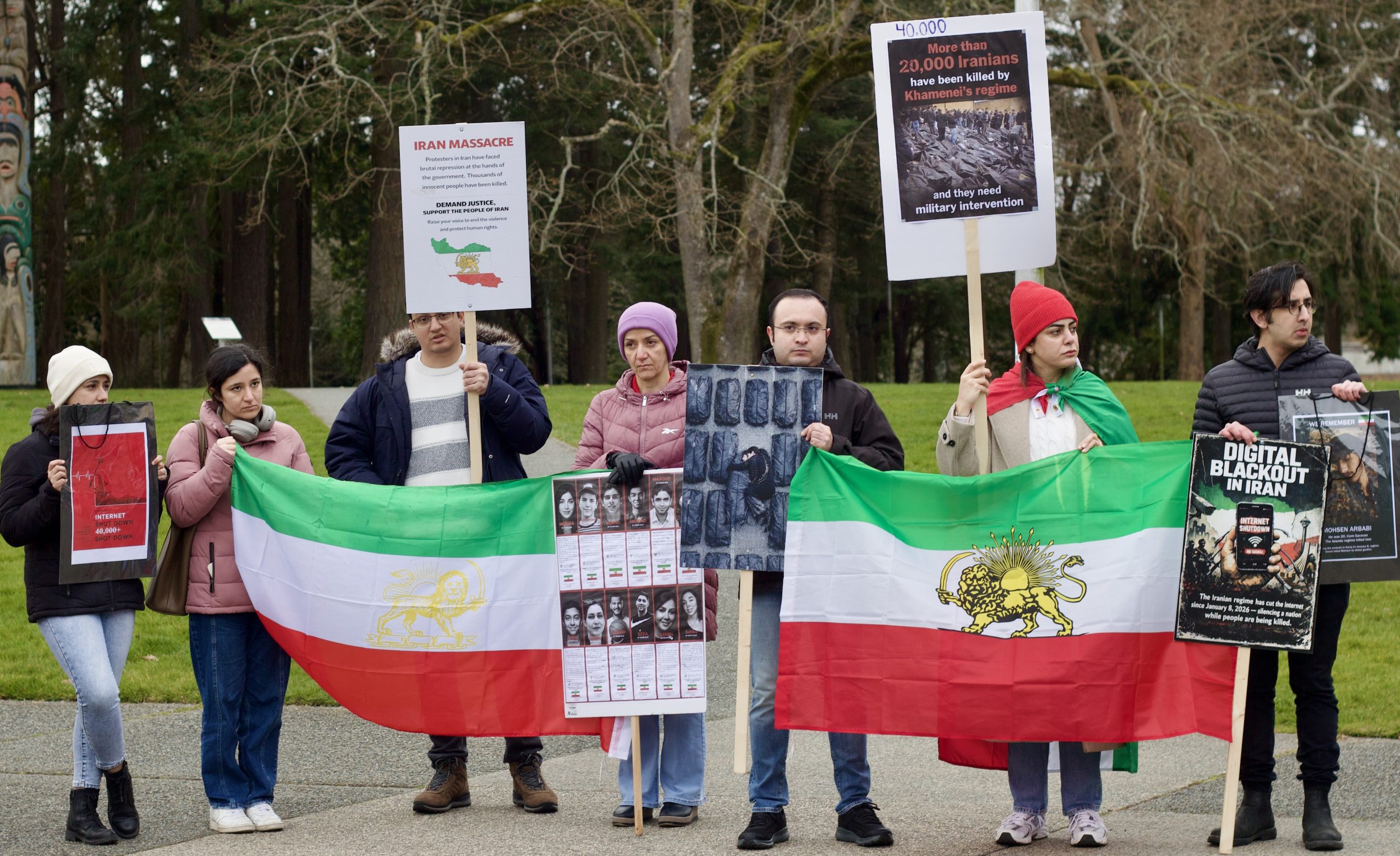
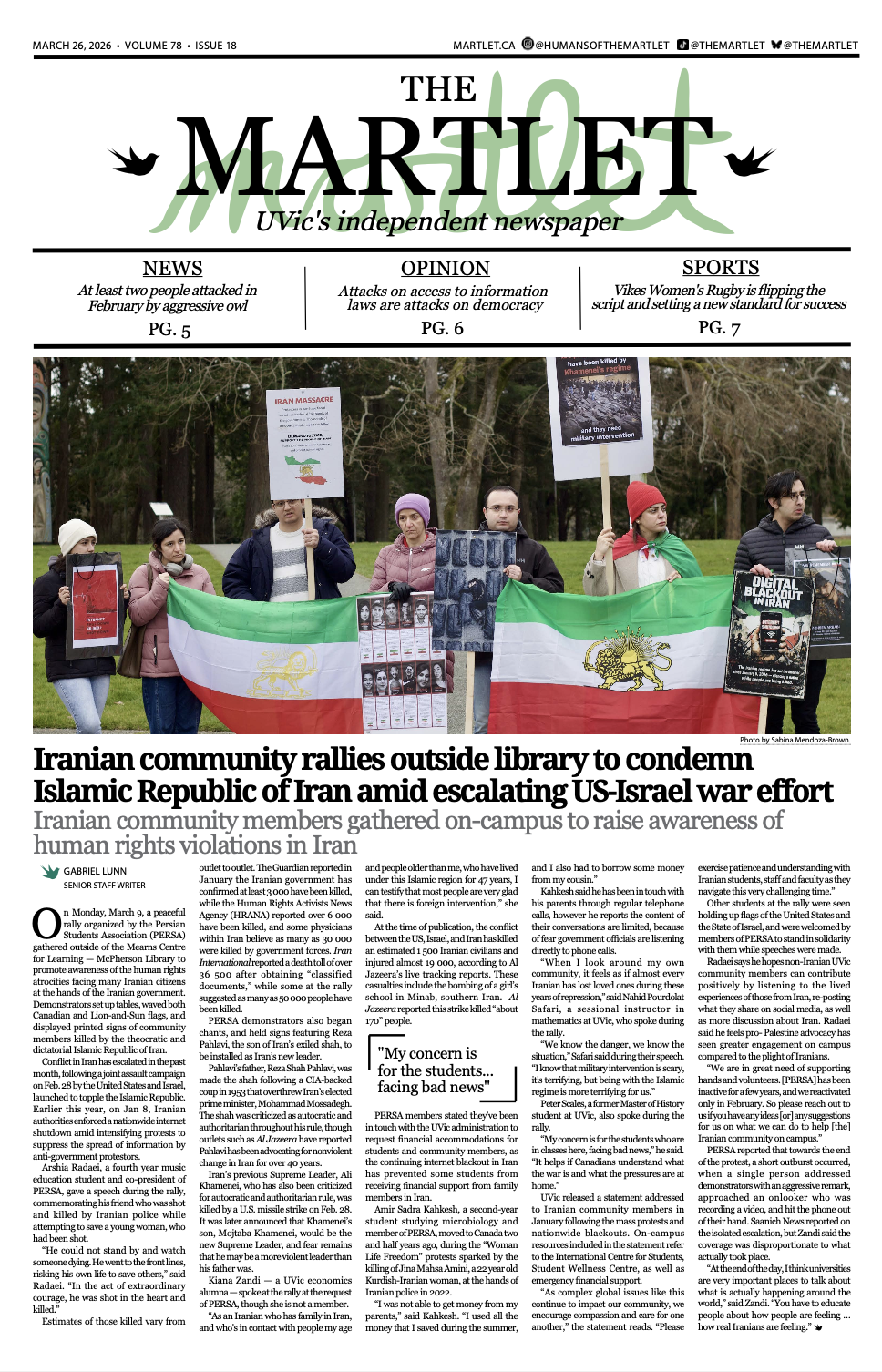
Photo by Sabina Mendoza-Brown.
On Monday, March 9, a peaceful rally organized by the Persian Students Association (PERSA) gathered outside of the Mearns Centre for Learning — McPherson Library to promote awareness of the human rights atrocities facing many Iranian citizens at the hands of the Iranian government. Demonstrators set up tables, waved both Canadian and Lion-and-Sun flags, and displayed printed signs of community members killed by the theocratic and dictatorial Islamic Republic of Iran.
Conflict in Iran has escalated in the past month, following a joint assault campaign on Feb. 28 by the United States and Israel, launched to topple the Islamic Republic. Earlier this year, on Jan 8, Iranian authorities enforced a nationwide internet shutdown amid intensifying protests to suppress the spread of information by anti-government protestors.
Arshia Radaei, a fourth year music education student and co-president of PERSA, gave a speech during the rally, commemorating his friend who was shot and killed by Iranian police while attempting to save a young woman, who had been shot.
“He could not stand by and watch someone dying. He went to the front lines, risking his own life to save others,” said Radaei. “In the act of extraordinary courage, he was shot in the heart and killed.”
Estimates of those killed vary from outlet to outlet. The Guardian reported in January the Iranian government has confirmed at least 3 000 have been killed, while the Human Rights Activists News Agency (HRANA) reported over 6 000 have been killed, and some physicians within Iran believe as many as 30 000 were killed by government forces. Iran International reported a death toll of over 36 500 after obtaining “classified documents,” while some at the rally suggested as many as 50 000 people have been killed.
PERSA demonstrators also began chants, and held signs featuring Reza Pahlavi, the son of Iran’s exiled shah, to be installed as Iran’s new leader.
Pahlavi’s father, Reza Shah Pahlavi, was made the shah following a CIA-backed coup in 1953 that overthrew Iran’s elected prime minister, Mohammad Mossadegh. The shah was criticized as autocratic and authoritarian throughout his rule, though outlets such as Al Jazeera have reported Pahlavi has been advocating for nonviolent change in Iran for over 40 years.
Iran’s previous Supreme Leader, Ali Khamenei, who has also been criticized for autocratic and authoritarian rule, was killed by a U.S. missile strike on Feb. 28. It was later announced that Khamenei’s son, Mojtaba Khamenei, would be the new Supreme Leader, and fear remains that he may be a more violent leader than his father was.
Kiana Zandi — a UVic economics alumna — spoke at the rally at the request of PERSA, though she is not a member.
“As an Iranian who has family in Iran, and who’s in contact with people my age and people older than me, who have lived under this Islamic region for 47 years, I can testify that most people are very glad that there is foreign intervention,” she said.
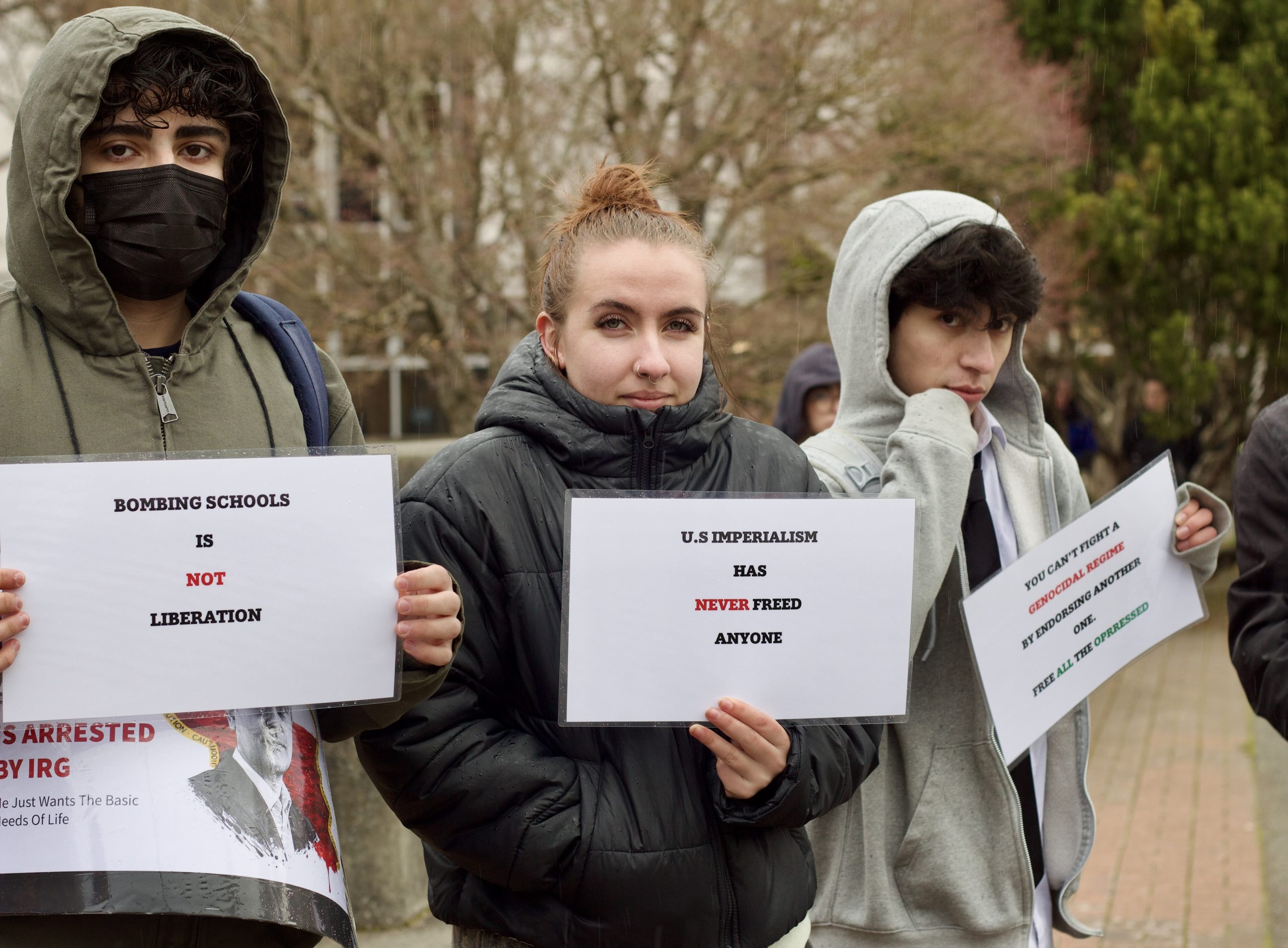
Photo by Sabina Mendoza-Brown.
At the time of publication, the conflict between the US, Israel, and Iran has killed an estimated 1 500 Iranian civilians and injured almost 19 000, according to Al Jazeera’s live tracking reports. These casualties include the bombing of a girl’s school in Minab, southern Iran. Al Jazeera reported this strike killed “about 170” people.
PERSA members stated they’ve been in touch with the UVic administration to request financial accommodations for students and community members, as the continuing internet blackout in Iran has prevented some students from receiving financial support from family members in Iran.
Amir Sadra Kahkesh, a second-year student studying microbiology and member of PERSA, moved to Canada two and half years ago, during the “Woman Life Freedom” protests sparked by the killing of Jina Mahsa Amini, a 22 year old Kurdish-Iranian woman, at the hands of Iranian police in 2022.
“I was not able to get money from my parents,” said Kahkesh. “I used all the money that I saved during the summer, and I also had to borrow some money from my cousin.”
Kahkesh said he has been in touch with his parents through regular telephone calls, however he reports the content of their conversations are limited, because of fear government officials are listening directly to phone calls.
“When I look around my own community, it feels as if almost every Iranian has lost loved ones during these years of repression,” said Nahid Pourdolat Safari, a sessional instructor in mathematics at UVic, who spoke during the rally.
“We know the danger, we know the situation,” Safari said during their speech. “I know that military intervention is scary, it’s terrifying, but being with the Islamic regime is more terrifying for us.”
Peter Scales, a former Master of History student at UVic, also spoke during the rally.
“My concern is for the students who are in classes here, facing bad news,” he said. “It helps if Canadians understand what the war is and what the pressures are at home.”
UVic released a statement addressed to Iranian community members in January following the mass protests and nationwide blackouts. On-campus resources included in the statement refer to the International Centre for Students, Student Wellness Centre, as well as emergency financial support.
“As complex global issues like this continue to impact our community, we encourage compassion and care for one another,” the statement reads. “Please exercise patience and understanding with Iranian students, staff and faculty as they navigate this very challenging time.”
Other students at the rally were seen holding up flags of the United States and the State of Israel, and were welcomed by members of PERSA to stand in solidarity with them while speeches were made.
Radaei says he hopes non-Iranian UVic community members can contribute positively by listening to the lived experiences of those from Iran, re-posting what they share on social media, as well as more discussion about Iran. Radaei said he feels pro- Palestine advocacy has seen greater engagement on campus compared to the plight of Iranians.
“We are in great need of supporting hands and volunteers. [PERSA] has been inactive for a few years, and we reactivated only in February. So please reach out to us if you have any ideas [or] any suggestions for us on what we can do to help [the] Iranian community on campus.”
PERSA reported that towards the end of the protest, a short outburst occurred, when a single person addressed demonstrators with an aggressive remark, approached an onlooker who was recording a video, and hit the phone out of their hand. Saanich News reported on the isolated escalation, but Zandi said the coverage was disproportionate to what actually took place.
“At the end of the day, I think universities are very important places to talk about what is actually happening around the world,” said Zandi. “You have to educate people about how people are feeling … how real Iranians are feeling.”