
Get to know a local grandfather and grandson musical duo
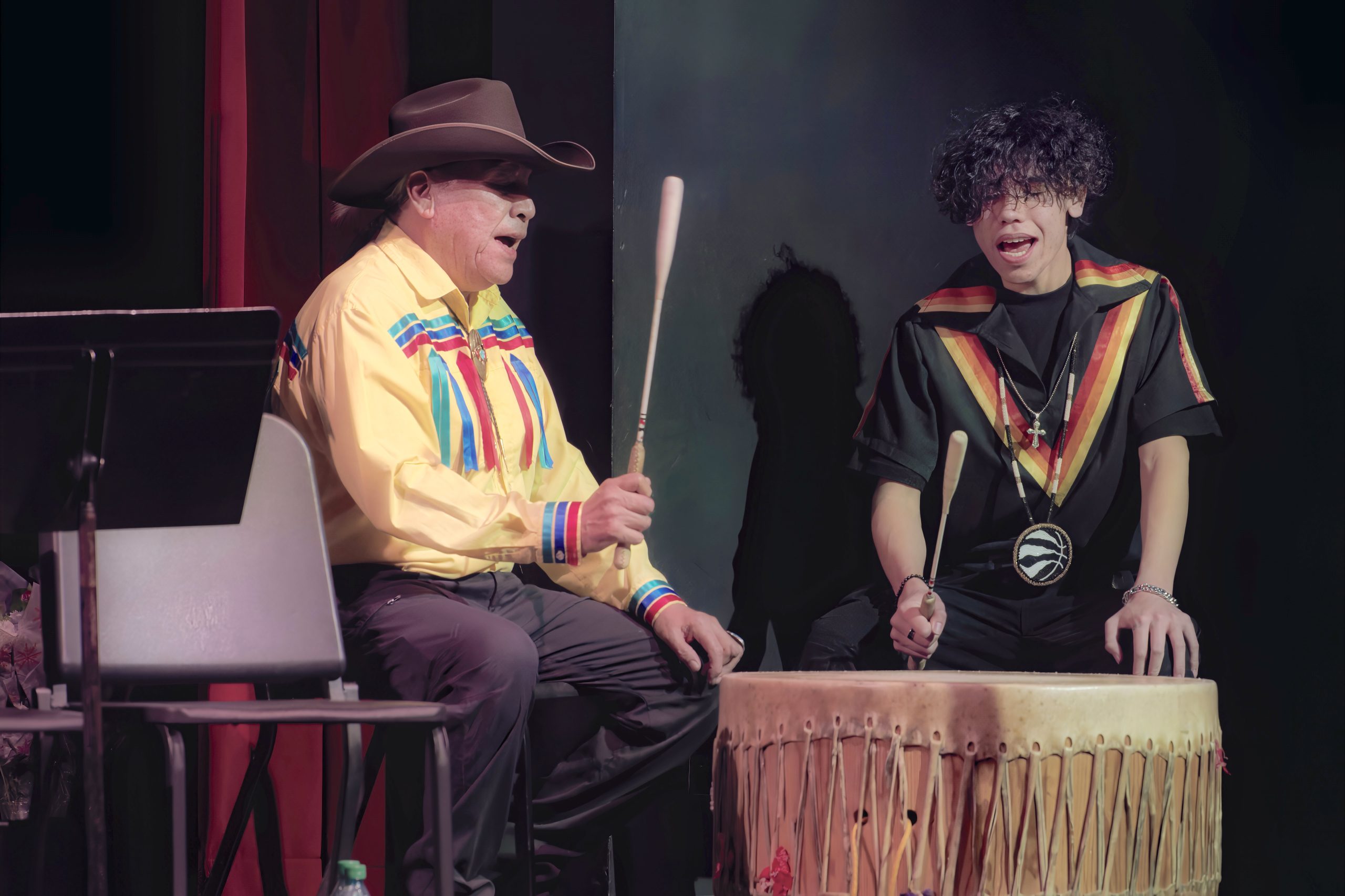
Photo by Brad Edwards Creative.
The JUNO Awards will take place on March 29, and will celebrate dozens of talented musicians from across Canada.
In light of the upcoming awards show centred around recognizing Canadian musical excellence, there is no better time to highlight up-and-coming talent from the local community — they’re not JUNO nominated, but they’re worth knowing anyway.
Cree Dubreuil, 17, has been playing at powwows with his grandfather’s drum group, Love Medicine, since 2024, but his drumming experience started long before that. He told the Martlet he started on the big drum — a large drum that sits on the floor and is played from a seated position — by sitting at it on his grandfather’s lap when he was younger.
Dubreuil belongs to the Moosomin Cree First Nation. I was first introduced to him and his grandfather — or “Mussom,” the Cree word for grandfather — Irvin Waskewitch, when they sang and drummed at a concert in December with Victoria’s young adult choir, Sing Your Joy.
Dubreuil told the Martlet that performing with the choir was a meaningful experience for him, and that it was unusual for him to play outside of a powwow setting — a setting he has played at across B.C. and Canada.
Powwows are Indigenous events with roots stretching back centuries, featuring drumming, singing, and dancing. Modern powwows are celebratory community events that can be just for Indigenous folks, or open to the public.
“I have always liked music. It makes me feel good,” Dubreuil said in a statement. “It is part of my culture and I just like doing it.”
Drumming is significant in Cree culture, and, according to the Canadian Encyclopedia, the beating of the drum represents the beating of a heart.
“It takes a lot of effort to sing and drum for a long time,” Dubreauil said. “It can hurt your body all over. But I like being with everyone at the big drum. You can focus there, and it’s quieter there than at the larger powwow around you.”
Cree’s Mussom, Waskewitch, has played music around the world with his drum group Red Bull. The group received a JUNO nomination in 1996 for their album Dancing Around the World.
Waskewitch now plays at powwows with Love Medicine.
When Dubreuil was around 16, Waskewitch started to notice his desire to sing. Now, whenever they see each other, they practice singing together.
“I want to inspire him,” Waskewitch said. “I’ve seen this little guy grow up all these years. I want him to experience what I saw with my own eyes. I want him on this trail — to sing. A beautiful life.”
In the past year, Dubreuil has taken on the important role of caring for the big drum that he plays at powwows. “In June 2025, I was given responsibility for caring for the big drum between powwow nights,” Dubreuil said. “I keep it tuned by warming it up in front of our wood stove. I also care for twenty drum sticks.”
Dubreuil’s godmother, Jane Miller, told the Martlet that Dubreuil enjoys seeing non-Indigenous people drum and dance at powwows as well. “Everyone is welcome at powwows,” Dubreuil said.
A blog post on the JUNO’s website quotes Raven Kanatakta, “one-half of the JUNO-winning husband and wife duo ‘Digging Roots’” as saying, “If you look at cultures around the world, music is such a big part of it. For us, in our home communities, music is a huge part of who we are … Even before modern Powwow, all of our ceremonies had music in them. There’s always food, dance, and there’s music.”
The post goes on to acknowledge that “the path to freely express Indigenous cultural identities through music has been marred by a painful history. For many decades, the Canadian government enforced assimilation policies that aimed to eradicate Indigenous languages and cultural practices including music.”
Today, Indigenous music is widely celebrated across Canada. Dubreuil and Waskewitch are two of the many talented Indigenous artists whose music touches people at powwows and beyond.
“Through that song, we pray, the Creator hears us,” Waskewitch said.
When asked if there are any musicians whose music is especially important to him, Dubreuil named his Mussom.
“I have known his voice all my life,” Dubreuil said. “He has taught me many things.”