
Rocky Point Bird Observatory has banded over 16 000 Northern Saw-whet owls since they started the program in 2002
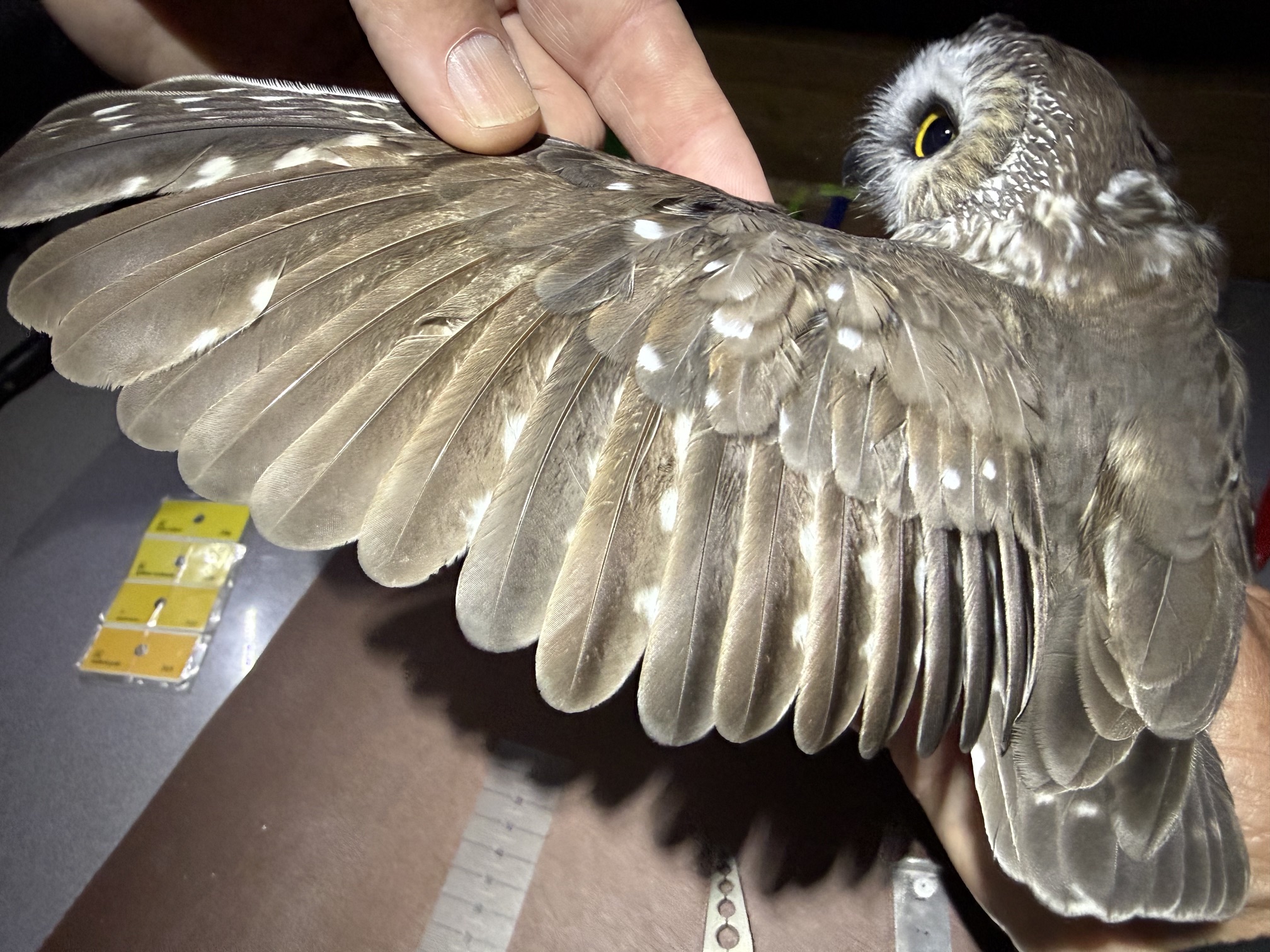
Photo by Mark Byrne.
All eyes were on the small rustling drawstring sack on the wooden banding table when out came a hatch year male Northern Saw-whet owl. Weighing in at just 75.6 grams, this remarkably small creature marked the first banding of the night. Hatch year owls are owls born during the past calendar year, and have recently left their nest.
The banding season for Northern Saw-whet owls occurs once a year at Rocky Point Bird Observatory (RPBO), running from Sept. 15 till Oct. 31, starting at sunset and continuing for the following six hours.
Non-standardized bird banding has been taking place at RPBO since 1994, with their first standardized banding starting in 1999 and their Northern Saw-whet banding project started in 2002, and have successfully banded 16 000 Northern Saw-whet owls.
In a statement to the Martlet, Mark Byrne, operations coordinator and one of the RPBO’s banders, said they have been averaging 41.7 owls per night, beating their 2017 record average of 41 per night.
Banding owls is the process of safely capturing owls, and placing a band with a unique number on their ankles to monitor and track them. For the Northern Saw-whets, the banders are focusing on their migration patterns, as Northern Saw-whets are nomadic owls, and don’t follow a specific course each year.
Banding plays an important role, both in determining the owls age and their migratory routes. “They move at night; they hunker down in the bushes in the daytime,” said Byrne. “We’re trying to understand their migration or nomadic routes because their dispersal using tracking devices doesn’t follow any typical migrating routes,” he continued.
While this year’s daily average is currently higher, the RPBO would have to continue beating the average every day to set a new record. Still, the RPBO is on track to band 1 200 to 1 400 owls before banding season comes to an end on Oct. 31.
The nets used at RPBO are 12 meters long and 10 feet high, using a very fine mesh, to ensure the safety of the owls. The banders use a machine to mimic a Saw-whet call to lure the birds into the nets, and have used the same call sound for the last quarter decade.
However, the calls infrequently draw in more than just Northern Saw-whets.
“We have also caught seven Long-eared owls, three Barn owls, and one Western screech owl,” said Ann Nightingale, who works on the Fall Migration Monitoring Project Committee with RPBO. “We do catch a few other birds, but not very often, it’s very rare,” she continued.
The banders start by weighing the owl. Then, they will band the owl, take the owl’s wing and tail measurements, check the owl’s body condition, the owl’s moulting (shedding and replacement of old feathers) progress, and the colour of the owl’s eyes, feet, and bill. The banders check these markers to determine the health of the owl, and to log information into their banding system.
One of the volunteers or banders then carries the owl to their release box (an open faced box), places the owl inside, closes the hatch on one side, allowing the owl to fly away freshly banded from the other side.
99 percent of the owls they have caught were born in the last calendar year, “telling us it was a really good breeding season,” said Byrne.
Banders determine the age of the owl by looking at their wings under a black light, which causes the owl’s baby wings to glow magenta as a result of an organic compound they create called porphyrin, or by checking the bird’s band. However, after the owls turn three, it becomes difficult for the banders to tell how old they are. If the owl has not been previously banded, the owl is labeled as an “after second year,” because they can’t determine their age.
In the next few years, the RPBO intends to upgrade the banding devices on the owls to better track their migration patterns and improve our understanding of the creatures. “We don’t know where our owls are actually coming from,” said Byrne. “Cellular bands … will give us real-time data,” he continued.
More information on the RPBO, including volunteer opportunities and details of banding can be found here.