

The production is tight and well-acted, but is lessened by the unnecessary inclusion of AI vocals and music in scene transitions.
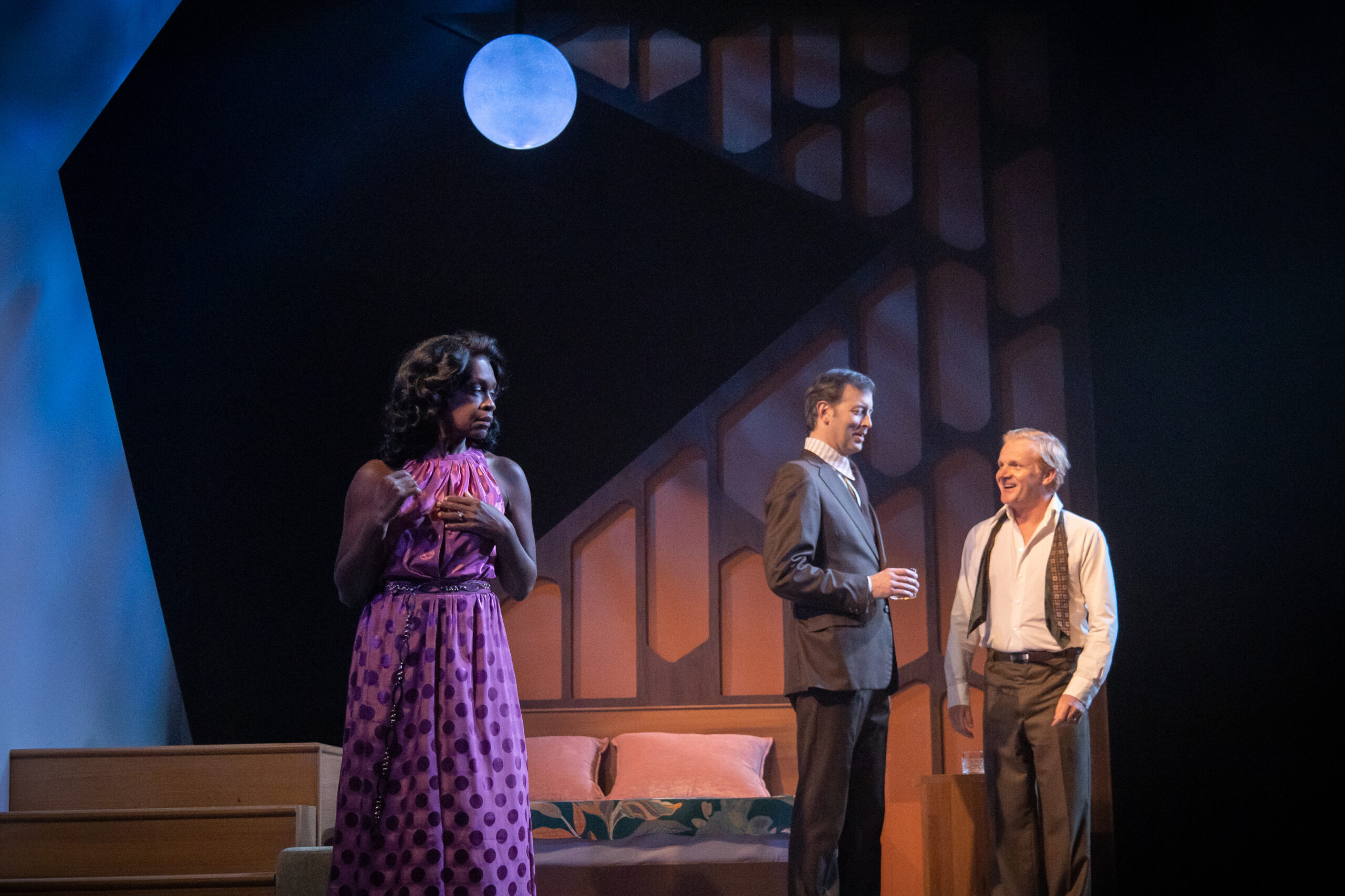
Photo courtesy of the Belfry Theatre.
The Belfry’s latest production is Harold Pinter’s Betrayal, which follows the seven-year relationship of Jerry (played by Matthew MacFadzean) and Emma (played by Yanna McIntosh), who were involved together in an extramarital affair.
Their story is told in reverse chronological order, challenging conventional structures of plot while still surprising its audience, so the play begins at the end of the relationship. Over the course of an hour, the audience discovers why the relationship fell apart, how it began, and the outcome of attempts to hide it from their respective spouses.
And despite the seriousness of the premise, the dry British brand of humour makes the play funny as well as sad.
What makes Betrayal structurally effective is how revelations and twists are built on dramatic irony. The audience always knows something the characters don’t. As the story travels back in time, the audience has a unique understanding of the tension between the characters, and who knows what. Despite knowing what ultimately happens, each scene is rich with quiet revelations.
Betrayal is also compelling in its exploration of straight men who hate women.
Despite the affair, Jerry seems to care more about maintaining his relationship with his best friend — and Emma’s husband — Robert (Jonathan Watton). He clearly enjoys the physical aspect of the affair, and gets a thrill out of being in a secret relationship with Emma, but still schedules dinners and squash games with Robert.
In a very telling scene, when Robert and Jerry plan a squash game and dinner afterwards, Emma offers to come along. Robert immediately shoots her down, essentially saying that it’s a “boys night,” and her mere presence would ruin it. Jerry doesn’t say anything to refute him.
Emma, in both of her relationships, is frequently depicted as off to the side — either making dinner or taking care of the kids, while the men have lives that she has to work around and balance. But when she starts asking for more, suddenly it’s too much.
Despite Jerry’s claims to the contrary, the flat he and Emma bought for their liaisons is “for fucking” and not much else.
The acting of all performers works remarkably well for the play’s subtle back and forth, hinting at secrets and encouraging reading between the lines. While everyone does a fantastic job, the standout performance in the small cast is Watton as Robert.
Watton plays Robert as clearly holding back a well of misogynistic rage that the audience never sees explode. It allows for some really tense scenes, as the audience watches him glare down Emma and Robert. The audience is always left wondering if that latent violence will erupt, and the fact that it never does (at least on stage) makes it feel all the more threatening.
However, this production of Betrayal suffers chiefly from its sound design. During each scene transition, a song will play, singing the year (and sometimes the season) in which the scene takes place.
The dialogue makes explicit when each scene is taking place, and the characters shift across time, going from cold and distant to warm and loving. Even the poster makes the reverse chronological structure of the play obvious with a backwards clock. Having an AI voice announce that we’re moving back in time, especially when the dialogue alone conveys the information perfectly fine on its own, is eyeroll-inducing. Its inclusion is unnecessary at best, and insulting to the audience and the script at worst.
Despite this flaw, Betrayal is a tight, short, and well-acted play. It is an engaging exploration of saving face, the men who hate the women they claim to love, and the nature of betrayal.
Betrayal runs until November 22nd. Tickets can be purchased at the Belfry’s website.