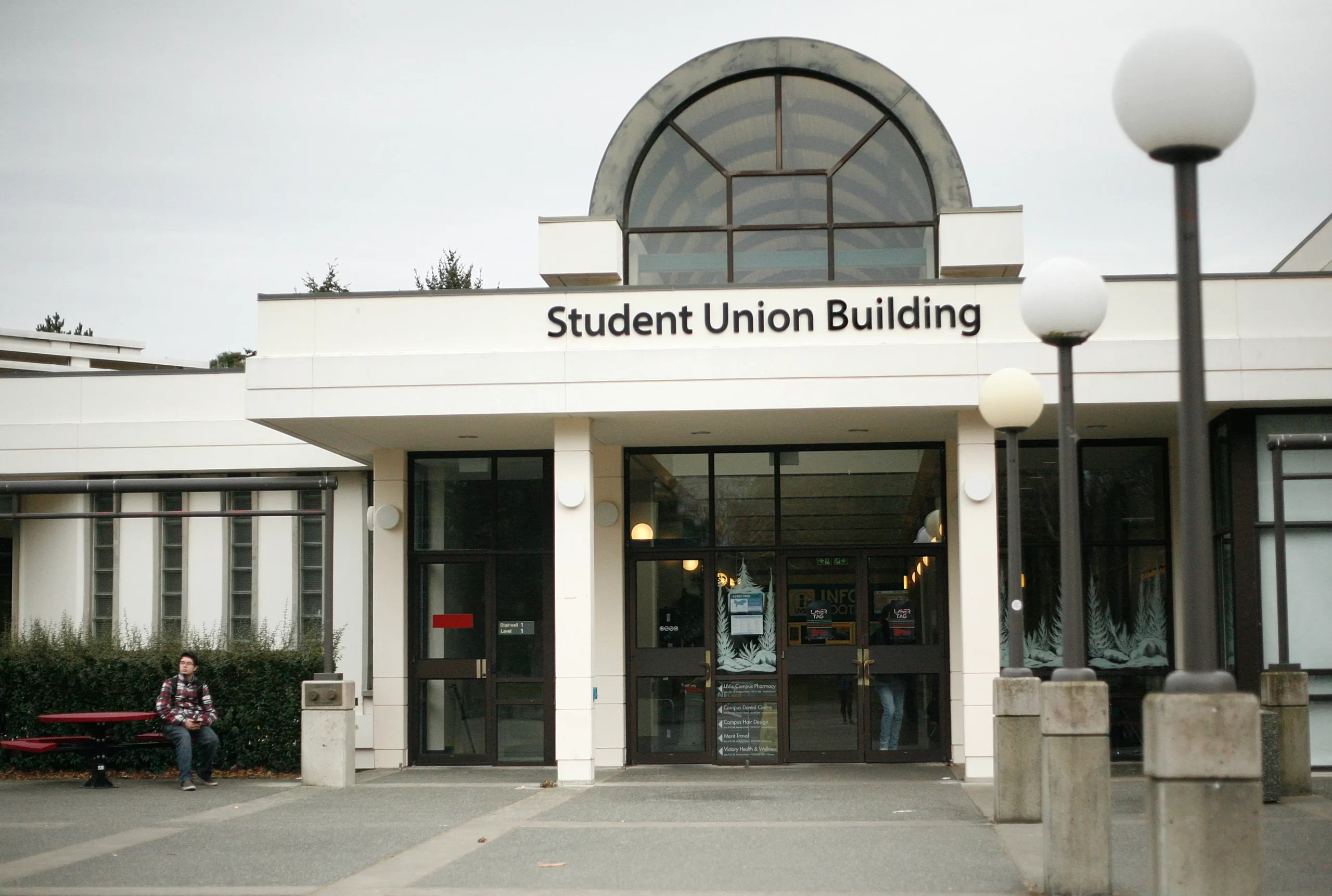

The College’s Board of Governors is set to meet Thursday to decide whether these programs will be suspended for two years

Photo via nic.bc.ca.
On Feb. 5, the North Island College (NIC) Board of Governors will vote whether to suspend 15 programs offered by the college, citing the findings of an expedited program impact assessment (EPIA) by the college that began last fall. Many students, faculty, and community members are pushing back, seeking greater transparency and consultation from the college’s administration.
The areas on the chopping block are wide-ranging, including digital design and development, global business management, coastal forestry, the marketing stream of their bachelor of business administration degree, and the college’s much-loved fine arts diploma.
The proposal is only the latest instance of a trend facing many postsecondary institutions in B.C., and particularly on the island, and comes in the midst of a turbulent period for B.C.’s postsecondary sector. Last year, Vancouver Island University (VIU) announced the cancellation of 14 programs and the suspension of six more. In November, the province announced an approximately four-month-long review of the public postsecondary system, which was criticized by student organizations over its short timeline and the province’s unwillingness to consider additional funding.
In a written statement, Tony Bellavia, NIC’s vice president academic, said the EPIA was a response to “significant declines in enrolment and revenue as a result of federal government policy changes affecting international students.”
“The result for NIC, and postsecondary institutions throughout Canada, has been a significant drop-off in international student applications and enrolment.”
An email circulated among students by the college — which has campuses in the Comox Valley, Port Alberni, Campbell River, and Port Hardy — said the goal of the review is to ensure their programs remain relevant, innovative, and viable. However, students, faculty, and members of the community alike are expressing concern about the loss of these programs and what they see as a lack of adequate consultation from the college.
Student leaders have also voiced concerns about the impact these program suspensions may have on specific campuses, such as Port Alberni, which offers a furniture and joinery certificate not available at other NIC campuses
“That’s a big impact for that smaller campus, and that community, to lose a program like that,” said Carissa Wilson, the executive director of the North Island Students Union (NISU).
Fine Arts Diploma
However, the potential suspension making the most waves among the community, according to Wilson, is the college’s fine arts diploma, which is offered at the Comox Valley campus.
“That’s a really big deal for this community and this campus community,” Wilson said “[It’s] a really big shift in what NIC is going to deliver as education. We have a whole fine arts building … and a huge arts economy and community, all in the North Island. So it’s a big deal to have that one up for this consideration of suspension.”
If approved, the suspension of the fine arts diploma will not be the first time the college cut fine arts programming. NIC used to offer an external Bachelor of Fine Arts program with the Emily Carr University of Art and Design, which allowed students in the Comox Valley to complete the third and fourth years of the program without leaving the valley. The college cut the program in 2013, citing declining enrollment.
Like Wilson, Ana-Iris Luyben, community director for the NISU, said she has heard particular pushback from the community over the fine arts program. “The Comox Valley is like a super region for artists. The larger community is very embedded with the arts here, and so this program means a lot to people in this community,” she said.
Luyben recalled receiving approximately 80 letters from community members about the suspensions as of the time of the interview. Half of them, she said, were about the arts program. Jen Wrye, president of the NIC Faculty Association (NICFA), said the college had also received more than 30 letters opposing the suspension.
Following the announcement on Jan. 13, students created a petition to “Save NIC Fine Arts,” demanding the Board of Governors vote against suspending the 15 programs. The petition says there were numerous issues with the decision-making process, including short notice, a lack of consultation with students, faculty, and the community, and accuses the college of selectively using data to justify suspensions.
Suspending the diploma, the students behind the petition say, would mean the loss of the only fine arts credential offered north of Nanaimo.
In a written communication, the creators of the petition said they have reached 990 signatures and expect to pass 1 000. Among the signatures, they said, are alumni from across the world.
The students are organizing a rally outside the Komoux Hall at the Comox Valley campus beginning at 8:30 a.m. in advance of the Board of Governors meeting.
Wrye said that NIC’s fine arts instructors are “fighting to keep this credential alive…. The faculty are thrilled by the community response and the outreach, [but] they are worried about the impact of cutting this credential on the local art scene [and] on local arts training.”
Members of the Comox Valley’s arts community have also pushed back on the proposal. Jennifer Casey, executive director of the Comox Valley Community Arts Council (CV Arts), said the suspension of the fine arts diploma would have a number of knock-on effects for the valley as a whole.
“NIC is attracting artists [and] keeping artists here that grow up and want to go to NIC,” Casey said, as well as artists that may use the college’s program as a stepping stone to other universities, like Emily Carr and UVic.
“We’re [potentially] taking that away from the valley.”
At the time of writing, NIC still advertises the ability to complete the diploma, or use it as a stepping stone for further study at Emily Carr, VIU, and UVic, as one of the program’s features.
Casey said CV Arts, as well as the Comox Valley Art Gallery, often hire arts students from the college over the summer through the Canada Summer Jobs program. “As an organization, we will not have as many summer students to pull from. We won’t be able to provide those entry level summer opportunities for kids in the valley,” she said. “We’ll have to figure out a new way of filling those roles.”
“A lot of folks are moving here because they are retiring, but we also have younger families that are moving here … looking for places to land,” Casey said. “I think that NIC is an attractive thing, but, arts and culture is huge in terms of what attracts people. It’s all about vibrancy and creating that sense of place. And when you strip that away, they don’t have the soul, in a sense,” she said.
15 programs up for suspension
Luyben echoed the petition’s concerns about transparency. “We hope that the college votes no … because we feel that there hasn’t been adequate enough consultation with faculty and the community at large, and also we hope that there is a better financial legitimization for these cuts, because so far, they don’t seem to be as effective as they might want them to be on paper,” she said.
Documents prepared for the Board of Governors meeting agenda outline the specific reasons for suspending each program, ranging from limited interest in that specific stream, in the case of the business administration marketing degree, to no longer being on the Immigration, Refugee, and Citizenship Canada (IRCC) list of programs that qualify for post-graduation work permits.
Notably, the documents pertaining to the business administration degree cites the availability of business administration programs at other institutions on Vancouver Island. Luyben, however, said that the proposed suspensions pose accessibility issues for students in the North Island, who may lack the financial means to attend institutions located elsewhere.
The agenda documents relating to the fine arts diploma note “satisfactory enrolment” in the program, but also cite “high operational costs” for the program and notes that many students transfer out of the program rather than completing the diploma.
Wrye said that, in conversations about the postsecondary sector, enough attention is not paid to the social value of these institutions. “Postsecondary institutions create social good. They foster belonging. They are places where [communities] can come for social and cultural and intellectual enrichment. Like universities, we are core community infrastructure, and we create prosperity, but we also create a sense of belonging, and we’re at risk of eroding that.”
Wrye also said that the suspensions will “absolutely” lead to layoffs, but that instructors’ primary concerns remain the impacts on students and the broader community.
“Instructors are relaying their number one concern is the loss of access for students, and that’s what we hear the most, but their number two concern is for local and regional employers and the loss of graduates, that people will leave to get training and may never come back,” she said. “Instructors are, of course, concerned for themselves in their own jobs, but really they’re looking at the long term community short and long term community impacts, and trying to trying to communicate those concerns first and foremost.”
If suspended, the college will not accept new students into the programs for a period of two years. College policies state that suspended programs will be reviewed within two years of suspension. The college has said it is “committed” to helping students complete their studies, though Wilson has expressed concern about part-time students’ ability to complete their studies in a suspended program.
Wrye said it “does not seem realistic” that these credentials might return as they exist currently in the future. “Suspensions last up to two years, and I don’t see a budget outlook in two years that allows for these programs to be supported,” she said. “In many cases, the college is mandating or calling for re-envisioning of the credentials.”
In the documents prepared for the Board of Governors meeting, multiple make reference to the suspension allowing the college to “revamp” or “reimagine,” programs, as well as the possible future development of “relevant new programs,” referencing examples at other community colleges where similar credentials have been restructured into shorter versions.
Both Wilson and Wrye suggested that the solution to the college’s woes, however, lies with the B.C. government, which is currently in the midst of reviewing the province’s postsecondary sector.
Wrye said the NICFA would like to see the college seek savings elsewhere, but “what we’d really like to see is the province step in. The funding formula has not worked for rural and small colleges for a long time,” she said. “We have been measured against metrics that are not appropriate for our region.”
“The college could do better, but the ultimate fault lies with our provincial government,” Wilson said. “The province has the ‘build better B.C.’ campaigns, but I don’t understand how they expect that to happen without quality funded education.”