
The confiscations on April 21 primarily impact Victoria’s disabled community, advocates say
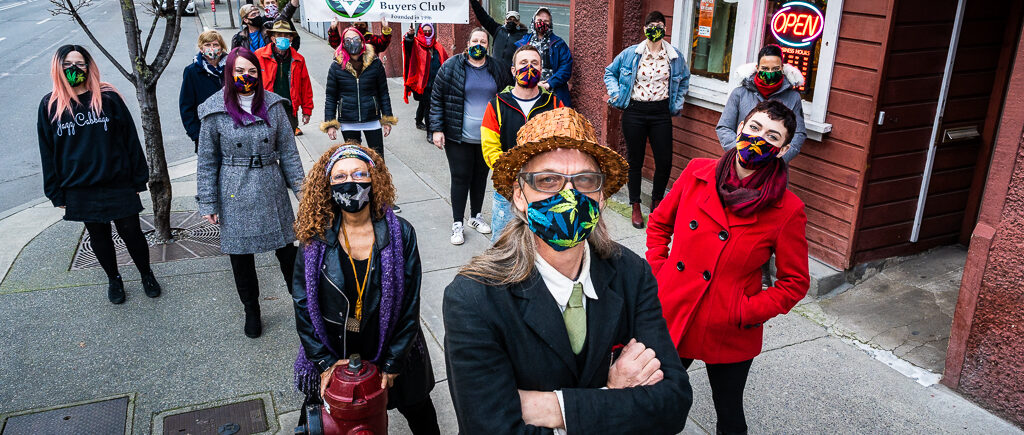
Photo by Zenon Kozak via www.victoriacannabisbuyers.club/
On April 21 the Victoria Cannabis Buyer’s Club (VCBC) was raided by B.C.’s Community Safety Unit (CSU), supported by Victoria Police. Shortly after the “compassion club” opened their doors, CSU officers entered the Johnson Street storefront and confiscated approximately 30 000 to 40 000 cannabis products, said Club Founder and President Ted Smith.
The club had just recently celebrated its 30th anniversary in January. Smith described the three decade journey like “climbing a series of mountains.” He established the group in 1996, inspired by the San Francisco Buyers Club and Victoria activists’ work providing cannabis to AIDS patients.
Smith said the club’s mandate is to “provide the highest quality products possible at the lowest prices possible” alongside as much “information and support” as patients need. VCBC sells edible and topical products containing THC above legal limits, often below-market prices.
He described the club’s over 9 000 members as individuals suffering from incurable health conditions and mental health struggles, like cancer or PTSD, and said the club requires documentation of a medical diagnosis.
In comparison to VCBC services, Federal medical cannabis programs are mail-only, and single packages of edibles are limited to a maximum of 10 milligrams of THC, a cap that Smith says is far below the typical effective dosage for their patients.
Additionally, recreational stores must also comply with regulations around dosage, which Smith argues prices out vulnerable populations. “It’s typically about $10 for a 10 milligram [THC] cookie in the legal market,” he said, compared to the 75 milligram cookies VCBC sells for around $3.
Smith also stressed the importance of cannabis education, saying the VCBC has recently “hired a pharmacist to help us out both with screening new members but also drug interactions.”
Such advice may be absent, he said, when people purchase cannabis from retail stores and mail-order programs.
As a result of the VCBC’s long-standing noncompliance with B.C.’s Cannabis Control and Licensing Act and Canada’s Cannabis Act they’ve faced repeated enforcement actions by the province.
In a statement to The Martlet, the Ministry of Public Safety and Solicitor General confirmed the CSU’s presence at VCBC on April 21.
“To sell cannabis legally in B.C., retailers need provincial licensing — and for any products that fall outside standard federal limits, they would need an authorization from Health Canada. VCBC applied for that federal exemption and was denied by Health Canada in 2023,” the Ministry said.
The Ministry also stated “the aim has been to achieve voluntary compliance,” but Smith says it would be impossible for the club “to comply without causing serious and immediate harm to a lot of our most vulnerable and ill patients” creating what he called an “immediate … humanitarian crisis.”
While the VCBC has faced four previous raids since the legalization of cannabis, Smith said he observed an increased police presence this time, compared to previous enforcement.
As Smith assisted officers a small crowd voiced their frustrations outside. Former Club Manager Jax Kittel joined onlookers protesting. “She really helped keep it together out there,” said Smith.
He added “I understand the Victoria Police officers that were there felt quite uncomfortable at certain points.”
It wasn’t long ago that the UVic campus served as a hotbed for cannabis activism in Victoria. Students may recognize Ted Smith as a figurehead of the former campus club Hempology 101. Founded in 1995, the group staged smoke-ins on the quad in the name of cannabis education and activism.
The Hempology 101 club has been inactive since 2016, with the onset of legalization. Still, Smith said he believes it’s important for young people to remain engaged in cannabis activism before they themselves experience medical conditions which could require support.
“I struggle with chronic pain, particularly sciatica, which onset during my first year of studies,” Solace, an upper-year student at UVic, said in a statement to the Martlet.
He said that the one medication that’s brought relief, with fewer side-effects, is medical cannabis.
“Given the consistency of my cannabis consumption, I have a high tolerance … VCBC has provided me with the medicine I need at a fraction of the price –– and of greater quality,” he said.
He added, “Our government’s approach to this issue is directly harming the lives of disabled people … a population who often lives near the poverty line and therefore cannot afford their medicine from government stores.”
The VCBC’s landlords are now facing civil forfeiture action from the province, seeking to seize the property. Smith spoke at a Victoria City Council meeting on May 14th, urging the mayor and councillors to protect the club and their services from provincial interventions.
Smith told the Martlet that he believed “cannabis truly saves lives,” and the “true potential” of medical cannabis has yet to be realized.