
UVic students can drop in for free to learn about Shirley Moorhouse’s thought provoking wall-hangings, artistic process, and engage in the conversations her work inspires
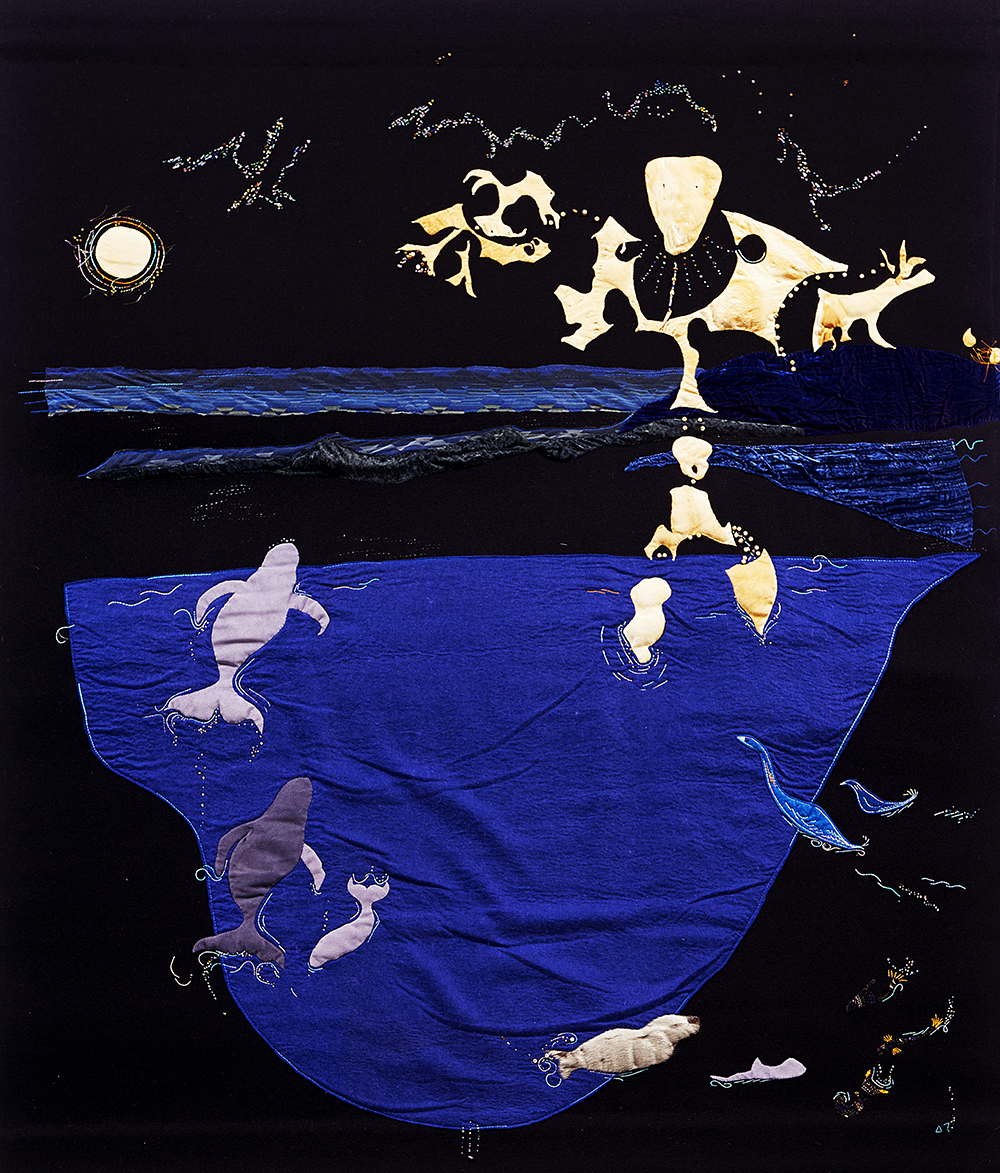
Pure Energy by Shirley Moorhouse
Shirley Moorhouse, an Inuk artist born in Happy-Valley-Goose Bay, Labrador, is the newest artist in residence (AIR) at UVic’s Taqsiqtuut Indigenous Research-Creation Lab (room A134 in the Visual Arts Building).
This residency is run by Canada Excellence Research Chair in Decolonial and Transformation Indigenous Art Practices, Dr. Heather Igloliorte, and provides the AIR with lab space, some project-relevant equipment, such as cameras, software, printers, and access to a computer, as well as connecting the artist to visual arts and Indigenous cultural events throughout campus.
Moorhouse was longlisted for the Sobey Art Award in 2025, one of the most prestigious art awards in Canada, for her wall-hangings — a type of textile art typically created through hand appliqué and embroidery, stitching cut-outs and materials to a larger piece of cloth for display, a process that Moorhouse says can be “very simplistic” and can be done by anyone with a needle, thread, pair of scissors, and imagination.
Moorhouse’s project is a time-lapse digital project based on her wall-hanging practice, and will transform “stitch movement into new media art.”
Through her art, Moorhouse hopes to create conversations. “Art is the conversation. The artist starts that conversation from the factors that come into their lives,” she said.
“I think it’s quite important to keep the dialogue open between Indigenous people, all of the Indigenous peoples, but also all the non-Indigenous people [and] all of the other Canadians here…. I’m so proud to be here in the University of Victoria, because it opens up conversations that not very many students are aware of early Canadian history, because Indigenous history [and] Indigenous art [were] not one of those subjects that was deemed necessary.”
“Every piece is a different conversation,” she said, and the materials help shape the narrative. “Every different material [has] a different texture, and every texture has a different tale.”
Moorhouse’s work is largely made through upcycled and repurposed materials, as she finds use and beauty in imperfect materials. “An imperfection is not an imperfection. It’s just life. Life is not perfect.”
Moorhouse crafts her pieces to have a level of ambiguity for observers to discover the “multiplicity” of meanings. Her pieces are all hand made, without the use of any digital embroidery or beading. One piece, Pure Energy, took her almost a year to make.
Moorhouse’s current project, which you can see if you drop into the Taqsiqtuut Indigenous Research-Creation lab, is a time-lapse piece, showing the process and effort that goes into making one of her wall-hangings. Moorhouse told the Martlet she started this piece this past August, and that it will be the main piece of her PhD thesis.
She said she chose this project because she wanted to go into the digital realm of art, and because she wanted people to see the time and effort it takes to make one of her wall-hangings. She called the process “meditative,” which she hopes translates through the piece and to the observer.
“I try to offer gifts of spaces, of contemplation, and peace for yourself, because that’s the frame of mind that I work in…. So when I create my piece, I feel whole with the world. I feel good with the world. I try not to take any negativity with me. I try to let people have a space to find their own way. And then move on to the next conversation.”
Students and community members who wish to talk to Moorhouse about her art can drop into the Taqsiqtuut Indigenous Research-Creation lab from 10 a.m. and 4 p.m. Mondays through Thursdays until March 27. Moorhouse is also giving her Living Artist, Living Art talk at Sŋéqə ʔéʔləŋ (Sngequ House, RSN 133) on March 28, at 5 p.m., for those who want to learn more.
Moorhouse’s work will also be shared at The Work Yet to Come art exhibition, at The Hourglass (1101 Yates Street), open 7-9 p.m. from March 26-29. The Work Yet to Come is a contemporary art exhibition by local, early career Indigenous artists. The exhibition will also have music, food, and drinks.