
An average of 1 095 birds die from window collisions in fall and winter on campus, making fall deaths significantly higher on average than at many other institutions
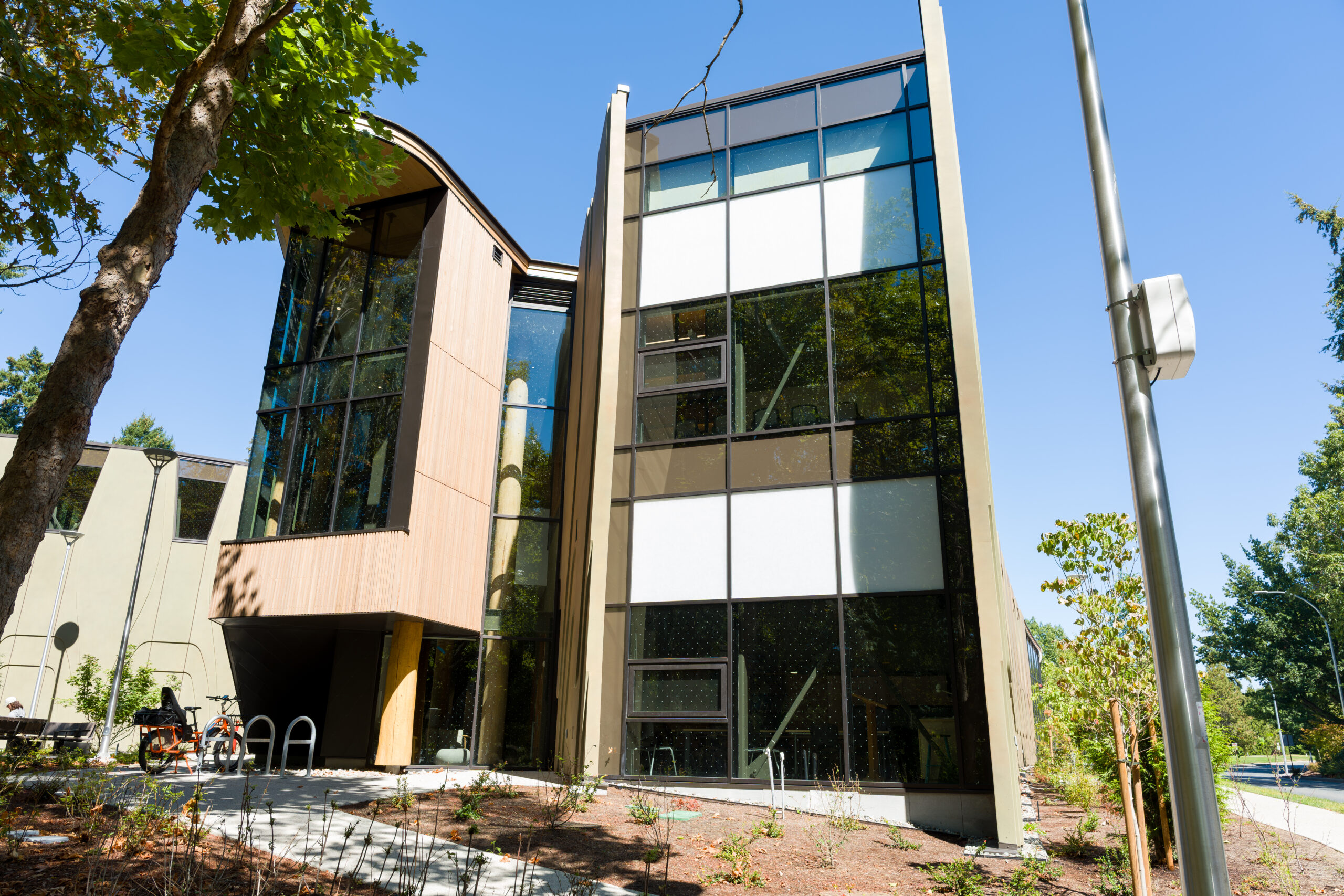
UVic’s Indigenous Law Wing, which features bird dots. Photo by Declan Snowden.
Since 1970, North America’s bird populations have declined by approximately 30 per cent (roughly three billion), and window collisions are often cited as a significant risk to avians.
A 2025 study examining window strike fatalities among birds at UVic estimated that an average of 2 651 collisions occur between Sept. 15 and Feb. 10 each year, with an estimated 855–1 342 (1 095 average) fatalities.
The study, which featured UVic’s Dr. Louise Blight, an adjunct associate professor in the School of Environmental Studies, as an author, surveyed six buildings across campus for six 21-day periods in fall, early winter, and late winter from 2019–2022, looking for evidence of window collisions. The researchers surveyed the buildings for a total of 149 days.
The study notes that building glass has been estimated to kill between 16–42 million birds per year in Canada. However, these estimates are based on the number of buildings that existed over a decade ago, according to the study. By 2060, building floor area is expected to double, potentially posing an even greater risk to bird conservation.
Golden-crowned kinglet, hermit thrush, American robin, and varied thrush were species found to be more vulnerable to collisions in fall. Dr. Krista De Groot, one of the authors of the study and a research coordinator with Environment and Climate Change Canada, told the Martlet that one possible explanation for their higher vulnerability was that many of these birds are seasonally frugivorous (switching to eating fruit depending on the season), and that, during the colder months, fruit can start to ferment. As a result, the fruit will contain higher ethanol content, potentially causing the birds to be “flying around drunk.”
The study found that collisions were highest during the fall migration period.
The study only looked at the fall and winter period. “We know mortality is happening in [between March and August],” Blight said. “[But] we decided not to extrapolate to the rest of the year because we didn’t have data for the other half of the year.”
“Bird-window collisions are a significant and growing threat to birds, but the issue is still understudied in many geographical areas and stages of the avian annual life cycle,” the study says.
“There is increasing urgency to address this growing conservation threat.”
Other universities in the province, such as UBC, have their own struggles with window collisions. At UBC, roughly 10 000 birds die per year colliding with clear and reflective glass. UBC has developed bird friendly design guidelines as a result.
UVic’s new Indigenous Law building has bird-safe windows, which have “bird dots” to deter birds from colliding with them. The Martlet asked the university if this was a required design element or an optional add-on. In a statement, Mike Wilson, director of campus planning, said, “the University of Victoria considers bird safety as part of all new capital projects on campus. The recently completed Indigenous Law Wing as well as the Engineering and Computer Science Expansion, which is planned to open this fall, both feature bird-friendly glass.”
The statement confirmed that, unlike other campuses such as UBC, UVic does not have any formal guidelines for bird-friendly glass. Despite this, Wilson said bird safety is “considered in the planning of new buildings, and our Facilities Management teams regularly monitor for troublesome spots on campus for birds, particularly those located near forests with large windows.”
According to his statement, UVic maintains a yearly budget for retrofitting problem areas with a “special film to help prevent bird strikes.” The District Energy Plant has received post-construction retrofitting, and the Fraser Building has been identified as a priority this year, Wilson said.
Though UBC’s bird deaths from window collisions per year are much higher than UVic’s from September to February, the study suggests that mortalities at UVic in the fall are much higher on average. “Standardized to 21 days [looking] at collisions per building, UVic is actually [two] times higher than UBC in the fall,” De Groot said. “We used the same methodology as a large study that took place across North America … [where] they looked at [40] campuses….”
“The average for fall per building at UVic was eight times greater.”
Blight said that, while working on the study, many people in the UVic community said they were glad the research was being done, and that they hoped it would contribute to fewer bird deaths on campus. On campus, the UVic Sustainability Project (UVSP) has started a “bird-safe campus” campaign, hoping to raise awareness of window strikes on campus.
“Window collisions are a serious source of mortality for birds, for some species much more than others … and we have a bit of a crisis of conservation for birds in North America,” Blight said, referencing a 2019 study that found that, since 1970, bird populations have decreased by approximately 30 per cent (roughly 3 billion) in North America.
“To me, it’s kind of incredible that we have a system where we essentially build death traps for these wild animals that are around us all the time.”