
The penultimate meeting saw heated debate over two proposals, both of which were struck down for further revision
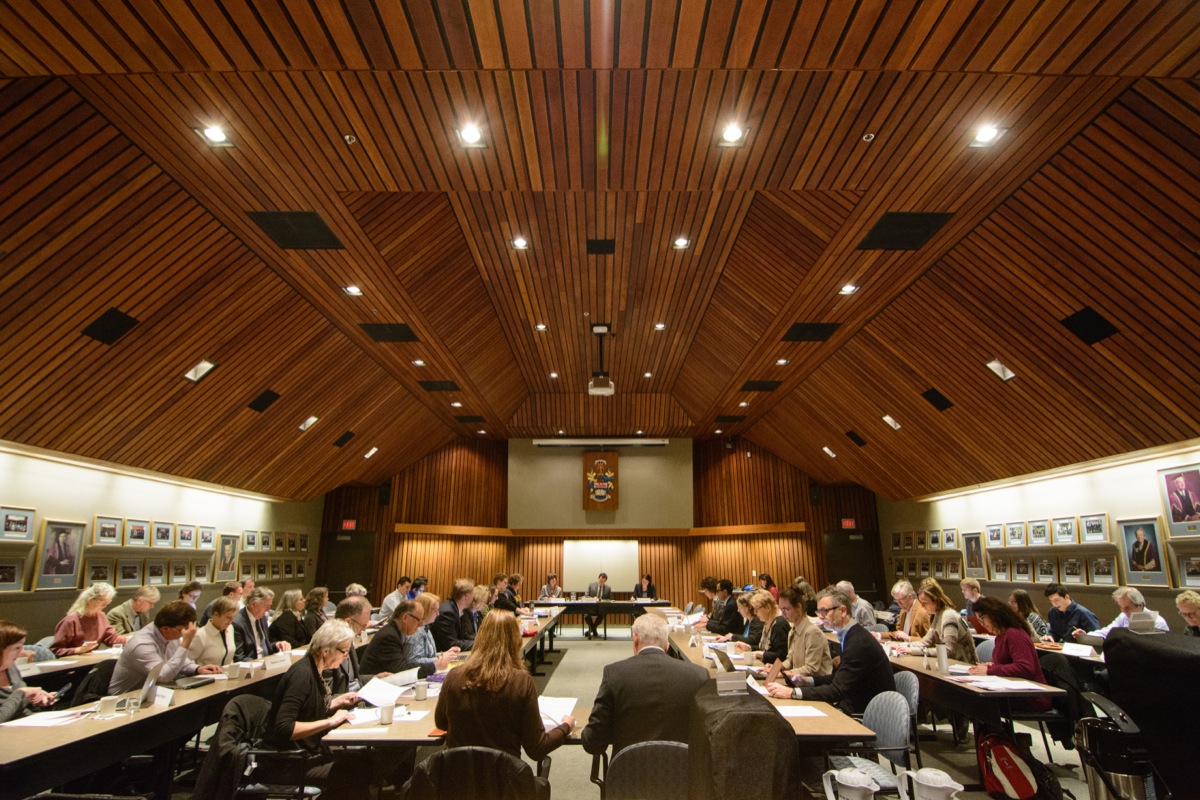
Photo by Hugo Wong.
UVic Senate’s penultimate meeting on April 10, 2026 passed small motions, but saw heated debate over two key items — revisions to UVic’s Policy on Academic Integrity and the establishment of a Core Writing & Research Requirement to replace the current Academic Writing Requirement (AWR) — which were both shot down by Senate and sent back to their respective committees for further work.
The full agenda of the meeting is accessible here.
Academic integrity policy
UVic’s academic integrity policy governs what actions are considered academic misconduct at the university — such as plagiarism, multiple submissions, and unauthorized use of an editor, among others — and sets out procedures and penalties for academic integrity violations.
The policy aims to “ensure that the university’s standards are upheld in a fair and transparent fashion.”
The submission to Senate from the Senate Committee on Academic Standards about the revisions says the existing policy was last revised in 2017, and was determined by a sub-committee to be “no longer reflective of current issues and present[ing] a series of liabilities.”
Proposed revisions include expanded definitions and scope, distinction between academic dishonesty and academic fraud, an escalating penalty structure, and a dedicated set of provisions for graduate students, among others.
The motion on the table was to approve the revisions to the Policy on Academic Integrity in the Academic Calendars, effective September 2026. This item was the subject of considerable discussion, much of it to do with the proposed revisions of “disciplinary academic suspension,” defined as the “penalty for an instance of serious academic integrity violation (normally a culmination of five or more instances) that result in a student’s permanent suspension from the university.”
One senator suggested the threshold of “normally a culmination of five or more instances” should be reduced to “three or more instances,” arguing that catching a student violating the integrity policy five separate times would be so difficult as to make the entire policy redundant.
The senator was told the threshold of five was intended as a progressive discipline measure, and the senator responded that intention could be maintained by retaining the phrasing “normally a culmination of” while lowering the threshold to three instances.
The senator tried to introduce a motion to lower the threshold, and when told that the correct Senate procedure here would not be to suggest amendments in the moment, but rather to vote on the changes as proposed, the senator initiated a motion to challenge the chair’s ruling, to be voted on by secret ballot. The senator’s motion was narrowly defeated, 21-23, with one abstention.
The senator also said the proposed revisions should be amended to include a section denoting certain criminal activities, and alluded to an instance of such activity in a graduate committee meeting that would soon reach national news.
A senator later raised a point of order that Senate Rules and Procedures do not contain measures for overturning the rulings of the chair (Senate does not follow Robert’s Rules of Order), so this vote should not have happened in the first place, and encouraged Senate to consider the precedent that had been set by allowing this vote at a future meeting.
Other concerns raised by senators included the lack of a statute of limitations on academic integrity violations, with one senator asking if this could lead to revocation of degrees if violations are discovered once a student has graduated (they were told that this was intentional) and another asking if the policy took into consideration that newer students might accidentally commit numerous violations in a short span of time (they were told that this possibility had been taken into consideration).
Senators also asked questions about specific circumstances, such as uploading course materials to generative AI programs and using them to generate answers, and uploading course materials to text-to-speech readers (a common academic accommodation) and was told that the initial example would depend on circumstances, but the latter would not be an integrity violation.
After lengthy discussion, Senate voted not to accept the proposed changes to the policy, and sent it back to the Senate Committee on Academic Standards for further work.
Core writing & research requirement
Replacing the Academic Writing Requirement (AWR) with a Core Writing & Research Requirement (CWRR) is a project that has been in the works for some time, and has been mentioned at previous Senate meetings.
The proposal before Senate on April 10 was to replace the AWR with a CWRR.
One senator said there was a lot to like in this proposal, but that certain standards for establishing a “requirement” had not, in their view, been met, and the proposal lacked clarity on issues like data collection and class sizes.
An invitee responded that the proposal was to establish the requirement, not specific courses. Another Senator raised a point of order, saying it was inappropriate for the invitee (who is not a member of Senate) from lecturing a senator on what they are/are not able to consider with regards to the motion at hand.
Another invitee present to answer questions about the proposal said putting specific requirements on course delivery in this proposal would violate the autonomy of other units, such as departments and faculties, from making the specific decisions on course delivery they are enabled to make.
As the CWRR is designed around six “core competencies” — written and multimodal communication, active reading and listening, information and digital literacy, critical thinking, research skills, and academic integrity — one senator moved to send the proposal back for further revision, with key changes including placing reading and writing as the most important competencies, and a mandated 3-year review led by external experts.
A senator speaking for the committee responded that introducing hierarchy would go against the vision of the policy, which is to allow individual units to determine how the six competencies are evaluated, and stated the intention was for the CWRR to be evaluated after three years, then after five and seven years.
The University Secretary then asked the senator who requested the revisions if they’d be comfortable sending the policy back for further evaluation with those recommendations noted, rather than calling for Senate to vote on the policy with those changes in the current session, as they’d be asking Senate to vote on the spot on a motion they’d only heard about once.
Following several points of order and one senator saying they were “appalled” by the way a non-Senate member spoke to a senator earlier, Senate voted 22–20 via a secret ballot for the second time this session in favour of returning the CWRR proposal to the Senate Committee on Academic Standards for further revision.
Other items
Senate heard four other items which saw significantly less discussion. These included a vote to approve, and recommend the Board of Governors approve, a list of new and revised academic awards, and approve a list of proposed changes to the Major and Honours programs in Art History and Visual Studies.
Senate voted to approve both items.
Senate also received the Annual Report on Course Delivery Modes, which was an information item only and required no action from Senate. Senators were, however, able to ask questions about the report, but none chose to do so.
Lastly, Senate was consulted on proposed changes to the Resolution of Non-Academic Misconduct Allegations Policy (AC1300), which included a short presentation outlining key themes, proposed changes, and a set of discussion topics to receive feedback from Senate on.
Senators raised a number of concerns, including ones about overly broad definitions, such as that of “administrative penalty,” which was not strictly limited to Canadian law and could potentially be abused, and a request for greater clarity when “issues related to discrimination, harassment or sexualized violence” were managed under AC1300 and when they were managed under either the discrimination and harassment prevention and response policy, or the sexualized violence prevention and response policy.
Another Senator raised concerns about a lack of differentiation between student misconduct and other groups on campus, and encouraged greater clarity in the naming of the policy.
The meeting ended with a comment from the University Secretary about the “difficulty” of the meeting and the importance of remaining respectful during Senate discussions.