
Penultimate meeting of the 2025–2026 academic year saw approved program and admissions changes, debate over changes to “Special Access First Nations, Métis and Inuit” calendar entry
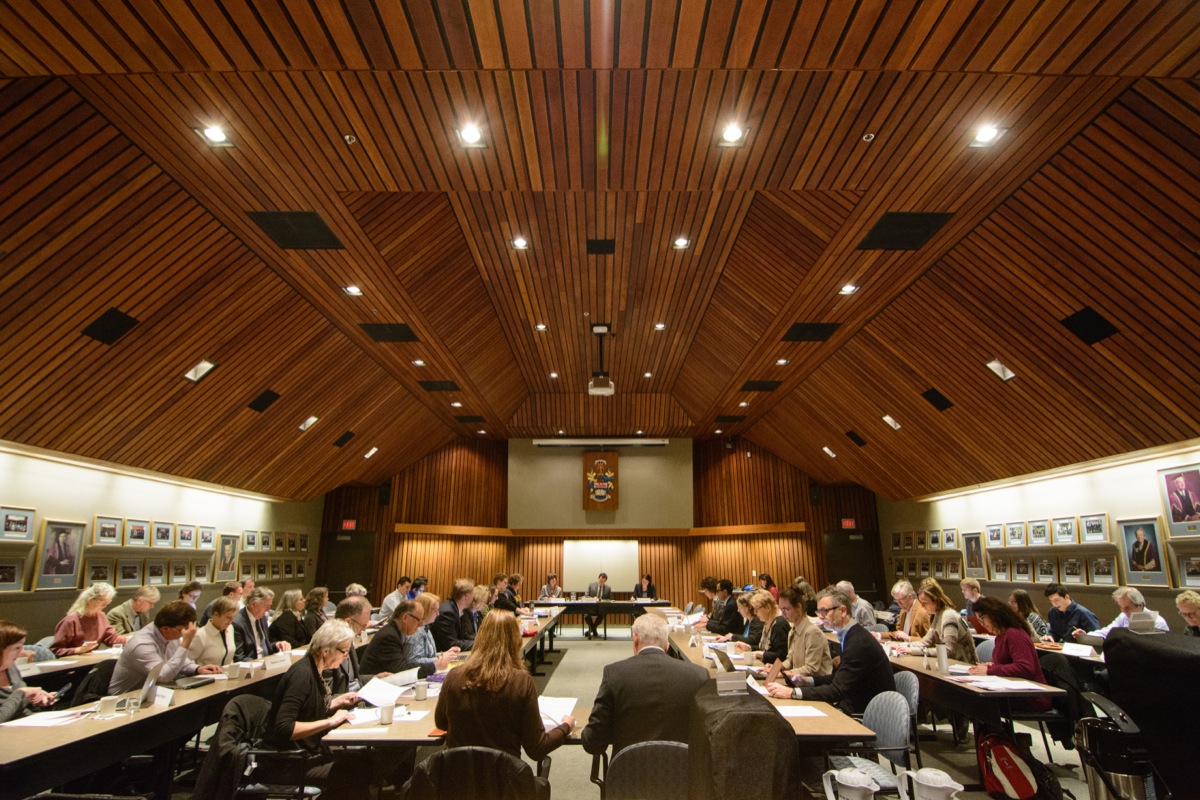
Photo by Hugo Wong.
In a short meeting on March 6, UVic Senate met to approve many changes and discontinuations of programs, program options, and admission requirements.
The full agenda of this Senate meeting can be accessed here.
Program changes
Senate voted on a large set of program revisions, put forward by the Senate Committee on Planning.
The programs changed included the Master of Arts in Community Development program, the Master in Management program, and the Business Minor program.
Senate voted to approve, and recommend to the Board of Governors that it also approve, proposed changes to the Master of Engineering – Biomedical Systems program.
Senate also voted to approve a proposal to establish a Professional Specialization Certificate in Teaching English to Speakers of Other Languages (TESOL), and recommend that the Board of Governors do the same.
The Committee also put forward the discontinuation of a number of Computer Science Major program options, and the Bachelor of Science in Nursing Post-Diploma program. The options Senate voted to discontinue include:
- Computer Science Major Option in Computer Graphics and Gaming
- Computer Science Major Option in Computer Communications and Networks
- Computer Science Major Option in Theory
- Computer Science Major and Honours Options in Software Systems
In documents attached to the agenda, the rationale for discontinuing these programs includes scheduling constraints and administrative overhead, low or uneven uptake across options, and a shift towards “flexible clusters” to allow directed study without formally declaring an option.
The documents state that several of the options require annual delivery of specialized upper-year courses, which are “unsustainable” given current faculty resources, and would allow the Faculty to redirect resources towards more “attractive” programs for incoming students, such as the variety of combined major options that pair a computer science degree with other disciplines.
Admission requirements
The Senate Committee on Academic Standards proposed new or changed admission requirements for some programs, including the TESOL Professional Specialization Certificate proposed earlier, and the Bachelor of Science in Nursing, effective September 2026. Senate approved these proposals.
Senate also voted to approve changes in the graduate academic calendar to the non-thesis option in the Master of Arts stream for Holocaust Studies.
Most of these proposals passed without debate or opposition. One motion, to approve changes to the “Special Access First Nations, Métis and Inuit” entry in the undergraduate calendar, saw significant debate among senators.
The undergraduate calendar is part of UVic’s larger academic calendar. Despite the name, the calendar is not just a schedule of courses and dates. It is UVic’s “official guide to all programs, courses, services and regulations of the University,” and is the official source of curricular information, important academic dates, registration and course requirements, and contains policies and regulations UVic students are required to observe.
The academic calendar says the “special access” option reflects the university’s interest in “extending university-level learning opportunities” to those who may not qualify for admission under usual conditions.
Proposed changes to the “First Nations, Métis and Inuit” category include replacing the term “Aboriginal” with “Indigenous,” changing the area responsible for reviewing these applications from the Senate Committee on Admission, Reregistration and Transfer Appeals (SCARTA) to Undergraduate Admissions, and the addition of some other language.
The rationale for the changes included in the documents presented to Senate includes that the Office of the Vice President Indigenous has “formally exempted this admission category” from the Indigenous Citizenship Declaration (ICD) policy, except when an admission offer is for a “reserved seat where ICD eligibility is a requirement for acceptance.”
UVic’s ICD policy deems that additional supporting information is required to access “Indigenous-specific opportunities that result in material gain,” such as employment opportunities, awards and grants designated for Indigenous Peoples.
One senator inquired about this, and was told that following their own consultation with the ICD team, ICD declaration was deemed to be an unnecessary barrier to prospective students at the applicant stage. The respondent also said that going through the ICD process, which involves uploading documents of a “sensitive nature,” using a Netlink ID, and being connected to the UVic virtual private network (VPN), would present challenges for applicants, who would be applying from off-campus.
Another senator asked why self-declaration is sufficient for “special access,” but documentation is required for Indigenous scholarships. The respondent said they were not speaking for the ICD team, but that “monetary gain” was the distinguishing factor that had been articulated to them.
The senator then said they were not convinced by that answer, asking why the university would accept a student on the basis of self-identification and then doubt it later, and was told this question had more to do with the ICD policy itself than the proposed changes to Special Access.
A student senator said they were concerned that the proposal takes decision-making power away from a Senate committee and puts it in the hands of Admissions.
The senator said they’d have liked to see it “piloted with a more thorough report back to Senate, instead of just making the decision right now, and not having a proper way to assess the impacts of it.”
The respondent said they would “commit that if this proposal if approved, that we will monitor it and evaluate it, and if things are not working as well as intended, we would bring it back to Senate for further review and consultation.” Senate heard further debate whether a complete proposal on how changes to “special access” would be evaluated would be preferable before seeking Senate approval, whether students could appeal a decision they were unsatisfied with, — they were told students could — and how potential harms to students caused by the lack of an evaluation process would be rectified afterwards.
The respondent said what was important about the proposal is “right now, these students are refused admission and then have to appeal to the [SCARTA]. I don’t think that this is a practice that is in keeping with our commitments as a university.”
Another senator expressed support for the proposal and said they were having difficulty “imagining harms that might arise from this process, especially given that … applicants will still have access to SCARTA,” and encouraged senators to “keep in mind … the harm is actually in declining the student and forcing them to appeal to have access to this.”
Senate then heard further discussion about the interpretation of “material gain” in the ICD and whether admission to university should not be considered “material gain,” as a degree can be seen as a “pathway to financial gain.” The respondent said their understanding of “material gain” was access to “limited opportunities” like designated seats in a program, whereas admission to the university is non-limited.
“We let in more students that arrive, right? But if a student is looking for an Indigenous-designated seat in a program, they will have to do the ICD,” they said.
The senator who expressed these concerns remained unconvinced, and said that because the university rejects some applicants, there is inherent competition in the process.
After this discussion, Senate voted to approve the proposed changes, with some members abstaining, and the meeting adjourned. The next UVic Senate meeting will be held April 10, 2026.