
Criticisms include failing to consult marginalized groups on key policies, disabling the chat function, and their handling of a controversial club
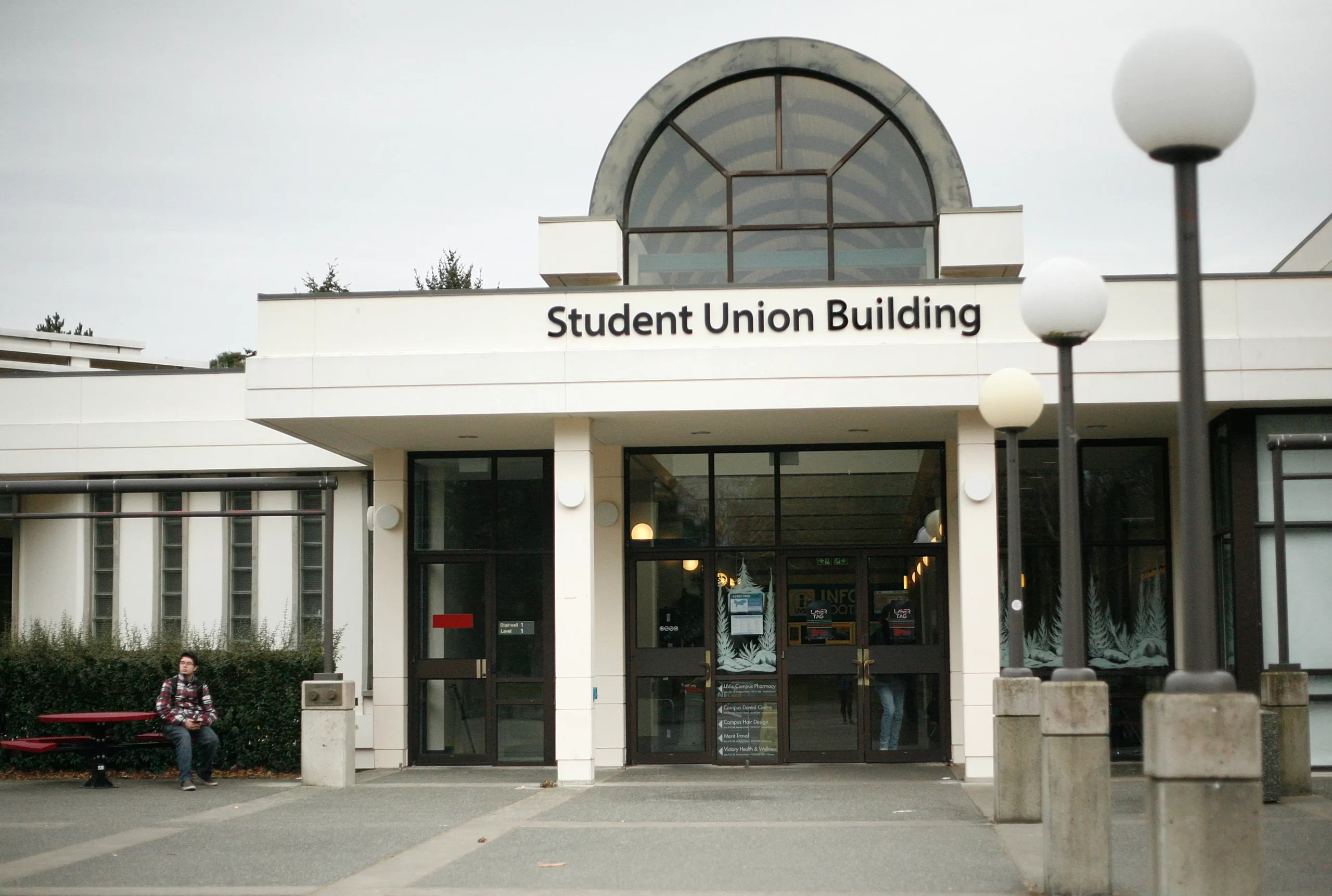
Photo by Ethan Barkley.
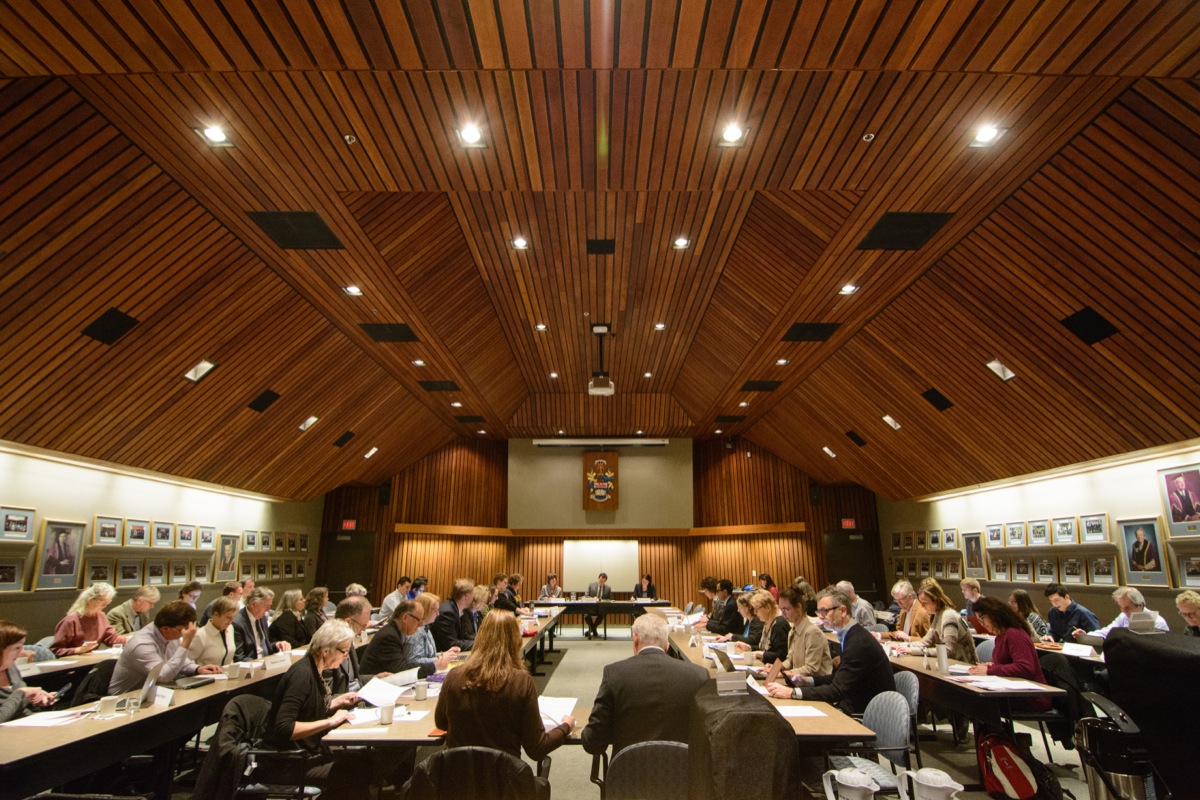
On Oct. 28, 2025, the UVSS held their annual general meeting — a yearly meeting where all undergraduate students get to vote on motions, rather than just members of the Board of Directors. The meeting agenda had five special resolutions, and two financial motions.
To hit quorum — the minimum attendance for votes to occur — the UVSS needed 0.6 per cent of undergraduate students to be present. According to the AGM’s chair — John O’Brian — quorum for this meeting was 112 students.
This year’s AGM significantly exceeded quorum, at one point hitting 264 attendees, potentially due to the significant controversy surrounding the meeting and the proposed motions.
In a statement attributed to Griffin Foster — Director of Outreach and University Relations — the UVSS had not reached a similar quorum since around 2016.
The Presidential Policy
One controversial motion, put forward by Foster, was to change the UVSS Board of Directors positions to President and Vice-President positions. Foster withdrew his motion due to concerns from “his constituents.” A vote was held at the AGM to remove Foster’s motion, which passed with 52 per cent in favour, and 48 per cent opposed.
This was the only vote during the meeting where results were made public. Foster told the Martlet in a statement that the results were shown mistakenly, and votes for AGMs are intended to be blind.
Mickey McDonald, who ran for the Director of Events position earlier this year, told the Martlet they felt that the presidential policy was incongruent with the UVSS’ stance on decolonization, as an attempt to reinstate colonial and hierarchical governance structures.
However, this motion was not the only source of controversy at this year’s AGM. Both the decolonization policy and the anti-racism policy sparked concern from attendees.
The Decolonization Policy
The decolonization policy — put forward by Director of Student Affairs Katie King — received criticisms from an attendee, who alleged the policy was not written with consultation from Indigenous students or student groups.
This policy was a carryover from the Semi-Annual General Meeting (SAGM), held in February 2025 under the previous Board of Directors, because that meeting failed to meet quorum. Lindsey Andrew — Director of Events — said that Bunni Williams, the previous Director of Outreach and University Relations, wrote the policy.
Andrew said that Williams is Métis, and alleged that some consultation was done with the Native Students Union (NSU) Firekeeper.The attendee who criticized the motion, however, said she had spoken with the Firekeeper, who alleged they were not consulted on the policy. Andrew then apologized for the “misinformation.”
The motion was then voted on and defeated, and the policy was not adopted.
The Martlet reached out to the NSU for clarification on their consultation on this policy. In an emailed statement, the NSU said the decolonization policy was shared with the NSU after it was already written by Williams. The Firekeeper was in the initial discussion surrounding the policy prior to its presentation at the SAGM in February, but according to the NSU, there was no further collaboration between them and the UVSS on the policy.
The NSU said that they do not feel the policy is representative of them.
“Meaningful consultation with the NSU on policy needs to be a priority and not an afterthought, and [needs] to involve prior, informed consent.”
“The NSU works closely with the UVSS, and we feel the development of the decolonization policy has highlighted space for further development in the relationship between our two organizations. “
The Anti-Racism Policy
Foster also brought forward a motion to update the UVSS’ anti-racism policy., which was also primarily developed by the last board, and claimed that the Students of Colour Collective (SOCC) Board Representative was consulted on the policy.
However, Roven Brooks-Stephenson, who currently serves as the SOCC Board Representative, said she has been the SOCC representative for the past two years, and was not consulted by the last board. She also said she currently is the only person in SOCC who was consulted by the current board.
She alleged that other SOCC members, the NSU, and UVic’s Equity and Human Rights office (EQHR) were also not consulted on this policy.
In a statement to the Martlet, Cassbreea Dewis, UVic’s Associate Vice-President, Equity and Human Rights, said:
“To my knowledge, EQHR was not approached for consultation on the UVSS’s proposed policy changes this fall.
The UVSS has its own governance, separate from UVic, and is not required to consult with EQHR. However, anti-racism and decolonization are important priorities for our university. We would welcome an opportunity to provide advice and input on the proposed UVSS policy changes, including how they intersect with UVic’s institutional policies.”
SOCC told the Martlet in a statement that their board representative was consulted for approximately five minutes for the development of the anti-racism policy, and alleged that the suggestions made by the SOCC representative were not acted upon.
SOCC noted issues with the policy, such as the removal of the term “whiteness” from the document. According to SOCC, Foster did not return the policy to the Policy Development Committee for review, and said it was the representative’s responsibility to raise these concerns at a board meeting. In their statement, SOCC said that this “shift[ed]responsibility unfairly” onto their board representative.
In an interview with the Martlet, Foster said that he was informed that the anti-racism policy update — which was primarily drafted by the last board — underwent an extensive consultation process, and that he had no reason to doubt that information.
According to Foster, he reached out to the SOCC board representative after he made adjustments to the policy’s preamble, and said and she did not raise concerns with that section of the policy. Foster noted she did raise concerns with the policy removing the definition of “whiteness.” Foster claims he encouraged the SOCC representative to voice her concerns and any proposed amendments to the policy at the Sept. 22 board meeting.
Foster told the Martlet that as chair, he could not raise her concerns himself, since the chair has a duty of neutrality. He also said he didn’t think it would have been appropriate for him to bring a private conversation with the SOCC representative public.
“At the [Sept. 22] board meeting I offered the opportunity to all board members to raise questions, concerns, or propose amendments… All board members voted unanimously in favor of the policy, [the SOCC representative] included,” Foster said.
“Clearly, the initial consultancy process from the last board was not comprehensive enough,”
“I do think that more warning could have been [given]. I will say that everything relating to the AGM had to be done on a rather tight deadline…. The B.C. Societies Act imposes pretty strict limitations on when we have to set our agenda items for them to be sent out and made public… Appropriate opportunity to raise these concerns [was] given.”
The Martlet asked the UVSS what degree of consultation occurred with affected communities before the decolonization and anti-racism policies were proposed, but they were unable to respond by publication time
SOCC told the Martlet that consultation should be transparent, with more timely scheduling, better consultation with a variety of stakeholders, and an active effort to bring marginalized students into the Policy Development Committee meetings. They noted that consultation needs to be a continuous process, not a brief discussion.
“SOCC has concerns about the lack of communication, transparency, and accountability in UVSS’s approach to anti-racism work. Poor communication can lead to situations where policies that have not undergone adequate equity review are brought to a general vote. This process sidelines marginalized voices and risks reinforcing structural harm rather than addressing it.
SOCC believes that anti-racism work must be ongoing, consultative, and community-led.”
Students Supporting Israel
During discussions about the anti-racism policy, multiple attendees raised concerns over the UVic Students Supporting Israel (UVic SSI) club, which was ratified by the UVSS earlier this fall.
Foster confirmed that he would be handling questions relating to UVic SSI instead of King, who is typically in charge of inquiries related to clubs.
McDonald, who attended the AGM, raised concerns over mandate H, subsection g, which calls for opposing genocide, slavery, apartheid, and crimes against humanity. They asked how this policy aligns with the UVSS allowing “some groups” to operate on campus. McDonald had to reiterate their question, as it was not initially answered. The second time, they explicitly mentioned UVic SSI.
“What is this policy for? How much thought is being put into this policy, and how effective is this policy going to be if clubs are allowed to receive funding to promote and give voice to people who do not believe that there’s a genocide happening [in Palestine]?” another attendee asked.
The Martlet previously obtained screenshots from a group chat associated with UVic SSI, in which one group chat member said that “Pure authenticity would be ‘death to Hamas and Palestinians.’”
“I would like to suggest that any club receiving funding to [call] for [the] death [of] a specific ethnic minority is probably in violation of this policy,” an attendee at the AGM said in reference to the Martlet’s past article.
Another attendee asked the UVSS for details regarding their handling of UVic SSI, and how hate was “being moderated”.
In response to the criticisms surrounding UVic SSI and the anti-racism policy, Foster said, “I can’t speak to any specific action taken or decisions arrived at. That’s just not up to me. I can say that it is in progress. ”
“According to pre-existing policy, we do not have standards for what ideas or statements are embraced by an organization or a club before we approve them, we really only act upon complaints, and those complaints have to result in revealing that something’s happened in direct violation of a specific policy … oftentimes there is a level of complexity in nailing down exactly if a written policy has been violated,” he said.
Foster told the Martlet that the complaints process is confidential and that there are limitations to how much the UVSS can currently share regarding UVic SSI. Foster said the Board fully intends to comment on what actions they have taken when they are able.
Following a vote, the motion to update the anti-racism policy failed, and the policy was not updated.
“The UVSS is committed to decolonization and reconciliation, and we want our policies to reflect that. As we begin to reassess the policies brought forth at the AGM and consider students’ feedback, we will work with our advocacy, affiliate, and service groups wherever possible to ensure we are making everyone’s voices heard,” Foster said to the Martlet in an emailed statement.
Disabling of the chat
During question period, near the end of the meeting, an attendee who identified as disabled said the disabling of the chat during the online AGM was an accessibility issue, and alleged that it went against the Canadian Charter of Rights and Freedoms.
During the meeting, Foster apologized, and said it represents a “significant oversight in policy” and was something they would work on for the SAGM.
Foster later told the Martlet in a statement that the chat was disabled due to attendees using it “inappropriately” and “for reasons unrelated to the meeting,” and said the UVSS is looking into how they can improve accessibility for the SAGM.
The next day, Foster told the Martlet in another statement that the chat was enabled by accident and was not supposed to be turned on in the first place.
The Martlet asked the UVSS if they could provide specific examples of the chat being used inappropriately, and what they consider inappropriate use of the chat.
In response, Foster told the Martlet that the UVSS considers inappropriate language, harassment, and harmful language as inappropriate use of the chat, but said that he could not point to specific instances, as he no longer had access to the chat.
A full breakdown of the AGM, including what motions passed and details of the meetings technical difficulties can be found here