
The showcase included their soon-to-be-launched MARMOTSat satellite and the MIMIQ-25 quadcopter
On Wednesday, April 29, members of UVic’s Centre for Aerospace Research (CfAR) set up in front of the B.C. Legislative Assembly to showcase some of their recent work.
Displayed on tables outside of their van were a quadcopter drone and two satellite modules, but due to specific flight regulations near the Parliament buildings and the Victoria harbour, they could not demonstrate the drone in action.
The drone in question was CfAR’s modular inertia matching quadcopter, or MIMIQ-25, which CfAR’s General Manager Jay Matlock said the centre is currently using for “a couple of different experiments,” including a hybrid electric onboard power system.
When the MIMIQ flies “fully electric,” Matlock said, it can only fly for “about half an hour.” But, he said, CfAR is working on a system to use an onboard generator, converting gasoline to usable power, enabling it to fly for more than three hours. Under a different configuration CfAR is working on, he said, the MIMIQ could fly for “about 10 hours.”
“We have a project with Island Health, and we’re looking at seeing if we can use autonomous aircraft to help connect some remote communities,” Matlock said. “The idea is using these aircraft to do medical supply delivery … and [we’re] looking at remote communities where it makes the most sense.”
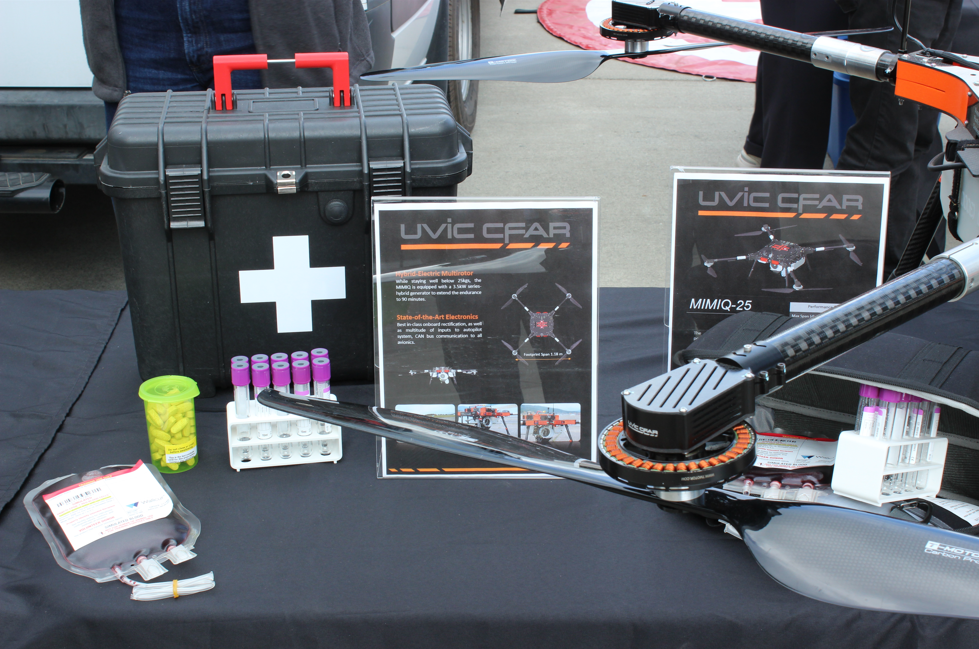
Photo by Ethan Barkley.
Matlock said these aircrafts could be used to connect smaller, remote communities in B.C. to larger medical hubs, and perform tasks like collecting blood samples and transporting them autonomously to the “hub.”
In January, CfAR performed a demonstration at North Island Hospital in the Comox Valley using an electric hexacopter drone, simulating medical supply deliveries.
Also on display were two satellites, the Optical Reference Calibration Satellite (ORCASat) designed in-house by CfAR and launched in 2022, and the more recent Mission for Atmospheric Radio Measurements with Open-source Technology Satellite (MARMOTSat), which CfAR expects to launch on July 1, 2026.
Written on the ORCASat and MARMOTSat are the names of the many CfAR team members who worked on the satellites, including Ground Station Lead and Electrical Designer Stefan Bichlmaier and Electrical Designer Blake Baldwin, meaning that, when MARMOTSat launches in a few months’ time, both of their names will have been in space.
The ORCASAT, Baldwin explained, carried a laser that could be pointed at an observatory on Earth and used to calibrate their telescopes by providing a point of reference for light in orbit. As the observatory knows the exact specifications of the laser, they could determine the loss of light, or attenuation, as the light passes through both the Earth’s atmosphere and the telescopes’ optics.
Attenuation poses a problem for Earth-based observatories, as they can only measure how bright astronomical objects appeared to be (after the light had passed through our atmosphere), not how bright they actually are.
Determining the absolute brightness of these objects, ORCASat’s online mission says, can aid scientists in understanding how quickly the universe is expanding by measuring the brightness of Type 1a Supernovae, their distance from the Earth, and how quickly they are moving even further away.
ORCASat launched in November 2022 from the Kennedy Space Centre and deployed to a low Earth orbit on Dec. 29, 2022. The ORCASat mission lasted 195 days, during which it completed 2990 Earth orbits, and it completed atmospheric re-entry on July 7, 2023.
MARMOTSat, also designed and built in-house at UVic, focuses on radio instead of light, and aims to support the UVic Propagation Laboratory’s ongoing ionospheric research. The ionosphere is part of Earth’s atmosphere, where Extreme UltraViolet and solar radiation ionizes the atoms present, creating a layer of electrons, and affects the transmission of radio waves.
According to the MARMOTSat’s mission page, the satellite will aid the Propagation Lab’s research into the correlation between human-made climate change events and the ionosphere’s composition and structure.
MARMOTSat is set to launch in June 2026 aboard Transporter 17, a “dedicated rideshare mission” by SpaceX, from the Vandenberg Space Force Base in California, USA.
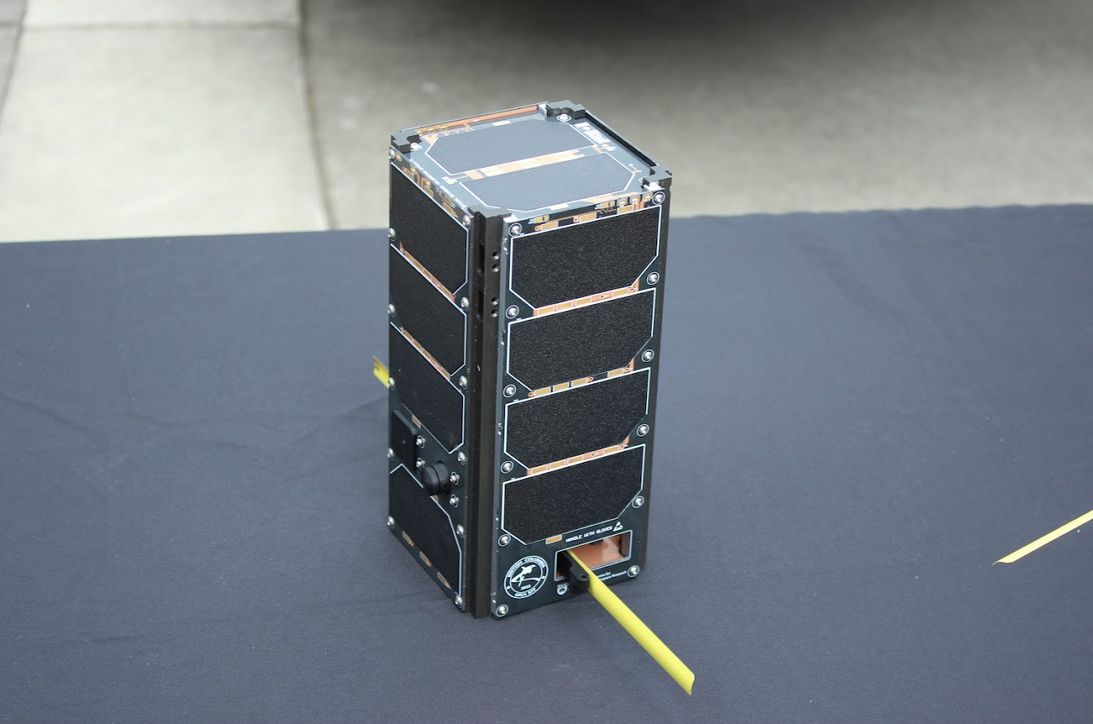
Photo of ORCASat by Ethan Barkley.
Their latest project, Baldwin said, is a satellite called PolarLink, which aims to explore high-speed, low-latency communications for the Arctic. CfAR did not have this satellite on display, but Baldwin said they expect to launch it in 2027.
Bichlmaier spoke about his ongoing work with CfAR, aiming to establish satellite development infrastructure at UVic, funded by the federal development agency Pacific Economic Development Canada (PacifiCan).
“The goal of it is to establish the infrastructure that is necessary to support the development of satellites like these,” he said, explaining that the facilities they need for the extensive environmental testing process are not available here on the west coast.
Environmental testing, he explained, involves vibration testing and simulating both launch conditions and the space environment. Essentially, “they make sure that the satellite you build isn’t going to fall apart, [that it’s] still going to work once it’s up there.”
“You have to go to Ottawa and pay quite a bit of money for access to that. So we’re motivated to establish those kinds of facilities at UVic to support our projects, but also to provide access as a service to other teams like us, other universities, or even other small businesses who are trying to get into the new space market,” Bichlmaier said.
He added that, on top of environmental testing facilities, they’re working on establishing a satellite rail station — essentially “a large antenna on a motorized map” which is installed in a remote location and connected to the campus over the internet.
This “opens up a wider variety of frequencies that we can access, so we can do higher capability data down links,” he said.
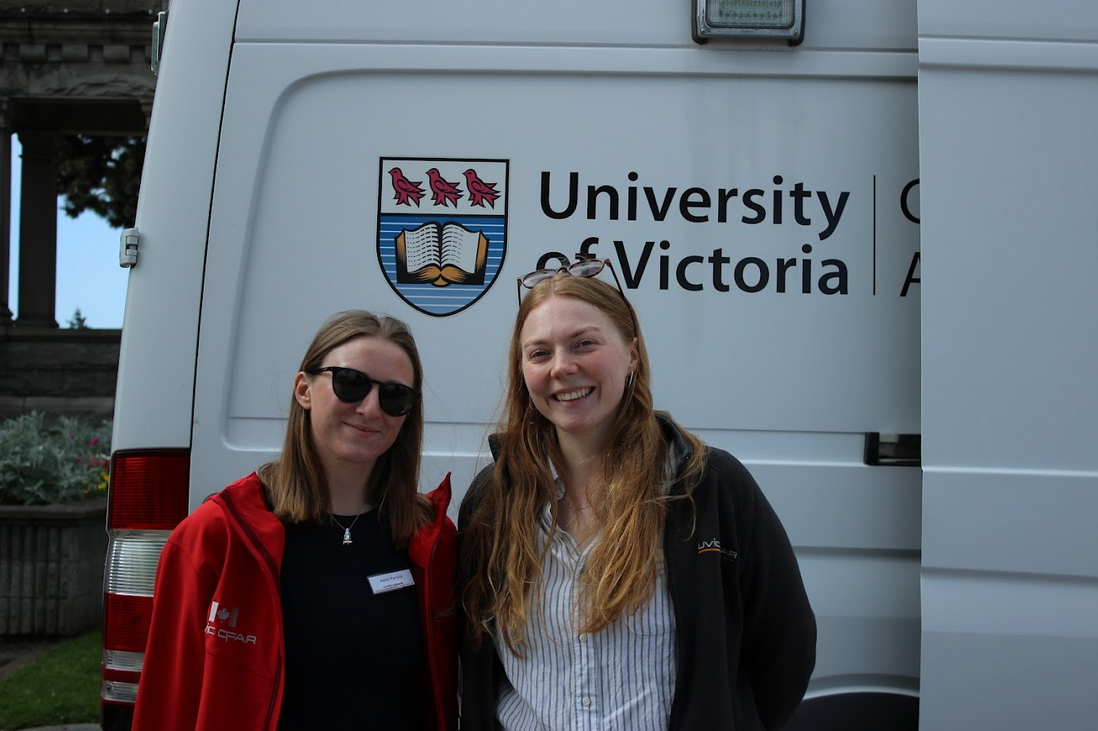
Photo of Anna Parolin and Maddy Roach by Ethan Barkley.
CfAR hosts a number of students every year, including co-op students like third-year student Anna Parolin, as well as sponsoring graduate students. They also hire students post graduation. Both Baldwin and Bichlmaier started working with CfAR during their undergrad.
During her co-op, Parolin said she’s printed circuit boards, done wiring, and learned more about the aerospace sector than she’d ever known previously.
“We’re really lucky at the centre that we don’t really have work that we make up for co-op students, they do real engineering work on our real projects,” said Maddy Roach, who works as an electrical designer and operations assistant with CfAR.
“Since their first day … they get assigned a project under their specific team needs, and they get the chance to actually do real work under subject matter experts in the fields, which I think is a really unique opportunity,” Roach said.
Roach encouraged any students interested in pursuing a co-op with CfAR to reach out to the centre and apply.
“I have learned so much through this co-op. It’s been really, really great,” Parolin said.