
The Media Studies program is expanding and will now be offering a major, minor, and general degree, in addition to the original certificate
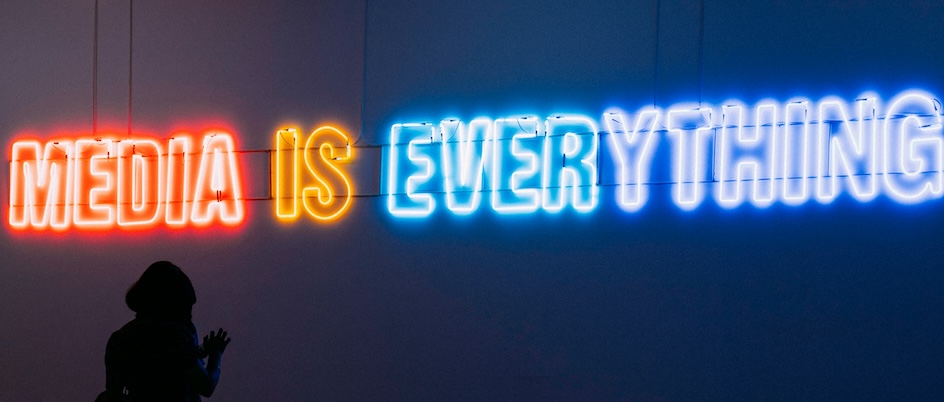
Photo by Lu Ming-Te.
Starting this fall, UVic students will be able to declare a major, minor, or general degree as part of a Bachelor of Arts (BA) in Media Studies.
Students can take a variety of different courses to get an interdisciplinary education through media studies, said Dr. Jentery Sayers, the director of the program, who also teaches as an associate professor in the Department of English.
The first media studies cohort was in September 2023, originally offered as a certificate made up of 10.5 units. The certificate is still available, but the program will simultaneously offer a full BA due to the program’s growth.
Sayers told the Martlet that there have already been three groups of graduates with the certificate. “That growth was incredible, and it moved much faster than we anticipated.”
The interest in a media studies program at UVic first emerged in 2017. “We saw a need in that area to bring that research together, and one way to do that is to formalize it as a unit that offers a credential in some way,” said Sayers.
Two years ago, Sayers said, the program conducted a survey to get a better understanding of what students wanted as the certificate program grew. The survey question asked if students would be interested in a Media Studies major if it was available. Out of 51 responses, Sayers said, more than 70 per cent of respondents said they would be interested.
According to Sayers, one of the appeals of the program from the point of view of a student might be the long list of approved courses offered. “There’s a lot of space … within the program,” he said.
Media Studies is best suited for individuals who have an interest in the overlaps of culture and communications, Sayers said, and those who want to combine creative and critical work for communicative purposes.
Sayers clarified that it is not a technical or an arts program. “Media Studies is slightly distinct … from literary studies that you find in English. Because you’re developing competencies that would be grounded in the multimodal,” he said.
Jacob Maddison, an instructor in the Media Studies program, joined UVic this past spring. He taught MDIA 350: Cultures of the Book this past semester and will be doing the same again this coming fall. He said the course is designed as an experiential bibliography course.
According to Maddison, Media Studies offers a combination of a creative and critical lens.
“Unlike a history course, which is backwards looking, I feel like media studies is very forward looking through historical lenses. That opens up a really lovely way of thinking about the media we’re looking at,” he said.
His course is set in the Farallon Book Arts Lab in the basement of the Mearns Centre for Learning – McPherson Library. Students spend time participating in quill writing workshops, and experimenting with letter press and book binding equipment, among other activities.
The course is based on a creative, physical plan that allows participants to understand how things are created, said Maddison.
Sayers said that Maddison’s class is really popular because it lets students work offline and learn about media preservation. “With the emergence of generative AI … people are looking for ways to be offline,” he said.
Students can take the course if they have their Academic Writing requirement (AWR) satisfied. Most of the courses in the Media Studies program are available to students any pre-requisites, except for the AWR.
In the next school year, three new courses are being introduced: Haunted Media, Health and the Internet, and Media Activism.
According to Maddison, there are plenty of opportunities for students with a degree in media studies to pursue, ranging from information sciences, library sciences, administration, or research.
Sayers said that a lot of the program’s graduates are freelancers, but individuals with a background in media studies can also go into fields like public media and community archives.
“At UVic … we were already doing, and had been doing for some time, such interesting, compelling, timely work in the space of media: people working with a variety of audio, images, text interfaces,” said Sayers.
By participating in the program, students would gain “the people skills of media, communication, and culture,” he said.
“It did seem like it was a shame not to bring that together somehow more formally.”
Editor’s note: An earlier version of this article mistakenly referred to a “Department of Media Studies.” Media Studies is classified as a program, not a department.