

Municipalities from across B.C. are calling on the province to reinstate the Community Housing Fund ahead of dual municipal and provincial elections
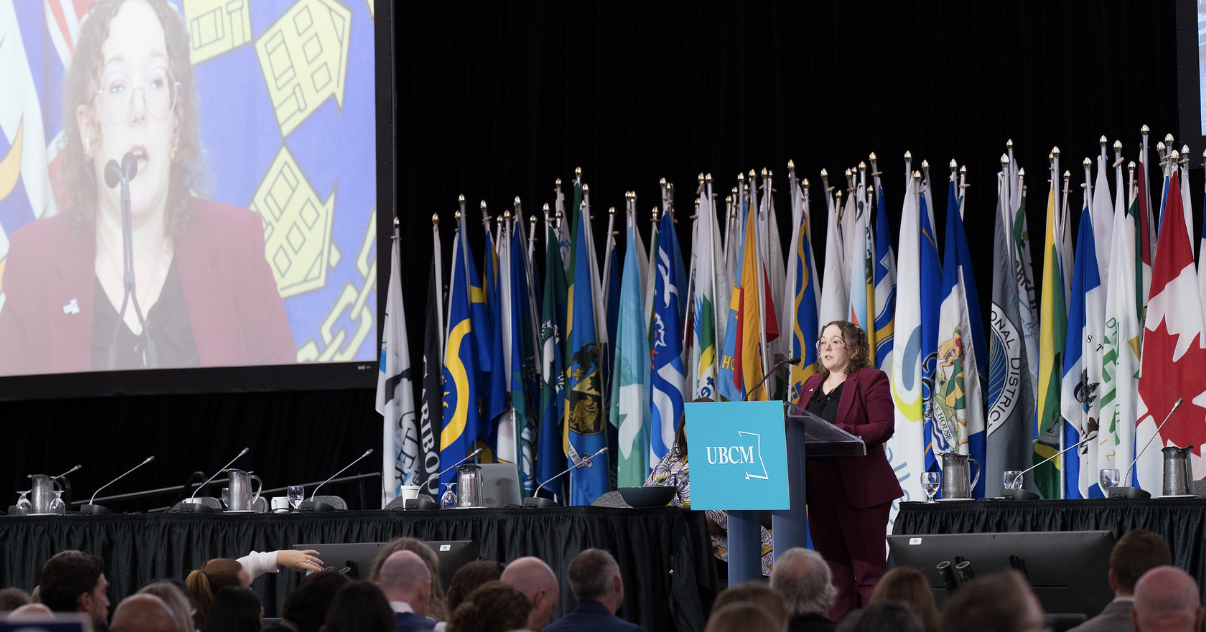
Photo via UBCM.
From Sept. 14 to 18, municipalities from across the province gathered in Vancouver for the annual Union of British Columbia Municipalities (UBCM) convention, where representatives vote on resolutions to advocate to the province.
At the UBCM, municipalities voted to advocate the province reinstate the Community Housing Fund (CHF). The CHF, which started in 2018, was a $3.3 billion program that sought to build over 20 000 affordable rental homes for people with low or moderate incomes including families, seniors, and people with disabilities.
In the 2026 provincial budget, the B.C. government announced it would be slowing delivery of its housing commitments, reallocating $1.4 billion from its housing strategy. Some of that reallocation came from the CHF, with the (then) current funding intake cancelled and future funding intakes postponed indefinitely. As a result, housing projects for B.C.’s most vulnerable have taken hits across the province.
Teale Phelps Bondaroff, a councillor in the District of Saanich, told the Martlet the CHF is a critical tool in bringing affordable housing to the province.
“The Community Housing Fund fills a structural gap in non-market and below-market rental projects that makes them financially viable. Private developers are not delivering this type of housing. It has to come from [senior] government,” he said.
“In Saanich, we have 4 610 units we need to deliver, of which, 1 161 are supposed to be below market.”
Phelps Bondaroff criticized the decision, saying municipalities now face the challenge of hitting their housing targets without this crucial funding for affordable housing, and that the suspension of the CHF has already impacted “shovel-ready” projects throughout the province.
In Saanich, The Garth Homer Society’s Centre for Belonging, a redevelopment that would provide 90 new homes (30 for market housing units, 30 low-income housing units, and 30 units for people with developmental disabilities), is now facing funding challenges as it won’t receive an anticipated $16 million provincial grant. Similarly, the District of Squamish spent over $500 000 on pre-development work for a 100-unit non-profit housing project, which may never materialize due to the suspension of funding from the CHF.
“The Province cannot set housing targets that include affordable units with one hand and pull away one of the main tools for delivering affordable housing with the other,” said Phelps Bondaroff in a press release. “Municipalities can update zoning, expedite approvals, reduce fees, and offer land, but deeply affordable housing also needs serious provincial investment. Today, local governments have delivered a clear call to restore that partnership.”
In the same press release, current city councillor and mayoral candidate Zac de Vries said, “We cannot tackle the housing crisis without the Community Housing Fund. Over the last several years the CHF has been the province’s best tool to partner with local non-profits to deliver deeply affordable homes for the residents who need it most.”
At the UBCM convention, representatives from the municipalities voted in favor of “[urging] the Province of British Columbia to reinstate the Community Housing Fund, providing funding to support cancelled or stalled projects.”
Beyond the resolution to urge the province to reinstate the CHF, several student advocacy resolutions were in the UBCM resolution book. At the Association of Vancouver Island and Coastal Communities (AVICC) convention — a smaller regional meeting of municipalities — several student advocacy resolutions including resolutions urging the province to create a student food bank grant, to provide $10 per day flat rate ferry fares for post-secondary students, and to address a broad list of student issues received support and were sent to the UBCM.
While they were deemed outside of the scope of the UBCM, they still appeared in the UBCM’s appendix, meaning they were not debated at the convention and the union won’t directly advocate to the province for these issues. Still, their inclusion in the appendix sends a signal that students across the province are pushing for change.
“The fact that they’re included shows that students are pursuing multiple avenues of advocacy to advance these goals…. The one lesson I’ve learned, having done advocacy my entire adult life, is you can’t just put all of your eggs in one basket,.” Phelps Bondaroff said.
“One petition [or] one letter writing campaign isn’t going to do. It needs to be protracted [effort] across multiple avenues, and you need to adjust based on the changing landscape … I know that the UVSS, AMS, and other students will continue to lobby for these in other ways and I think it sends an important signal.”
In a statement to the Martlet, Tam Aljundi, director of campaigns and community relations, said he intends to keep advocating for these issues throughout his term including raising these issues with MLA candidates, pushing for campus food security programs, and continuing to push for more affordable access to ferries for post secondary students.
“The support these resolutions received at AVICC showed there is broader recognition of the affordability pressures students are facing…. While the resolutions did not receive a vote at UBCM, that does not mean the advocacy ends there,” he said.