
AVICC delegates voted to support student food bank grant, $10 ferry fares for post-secondary students, and 13 other student-led policy pushes
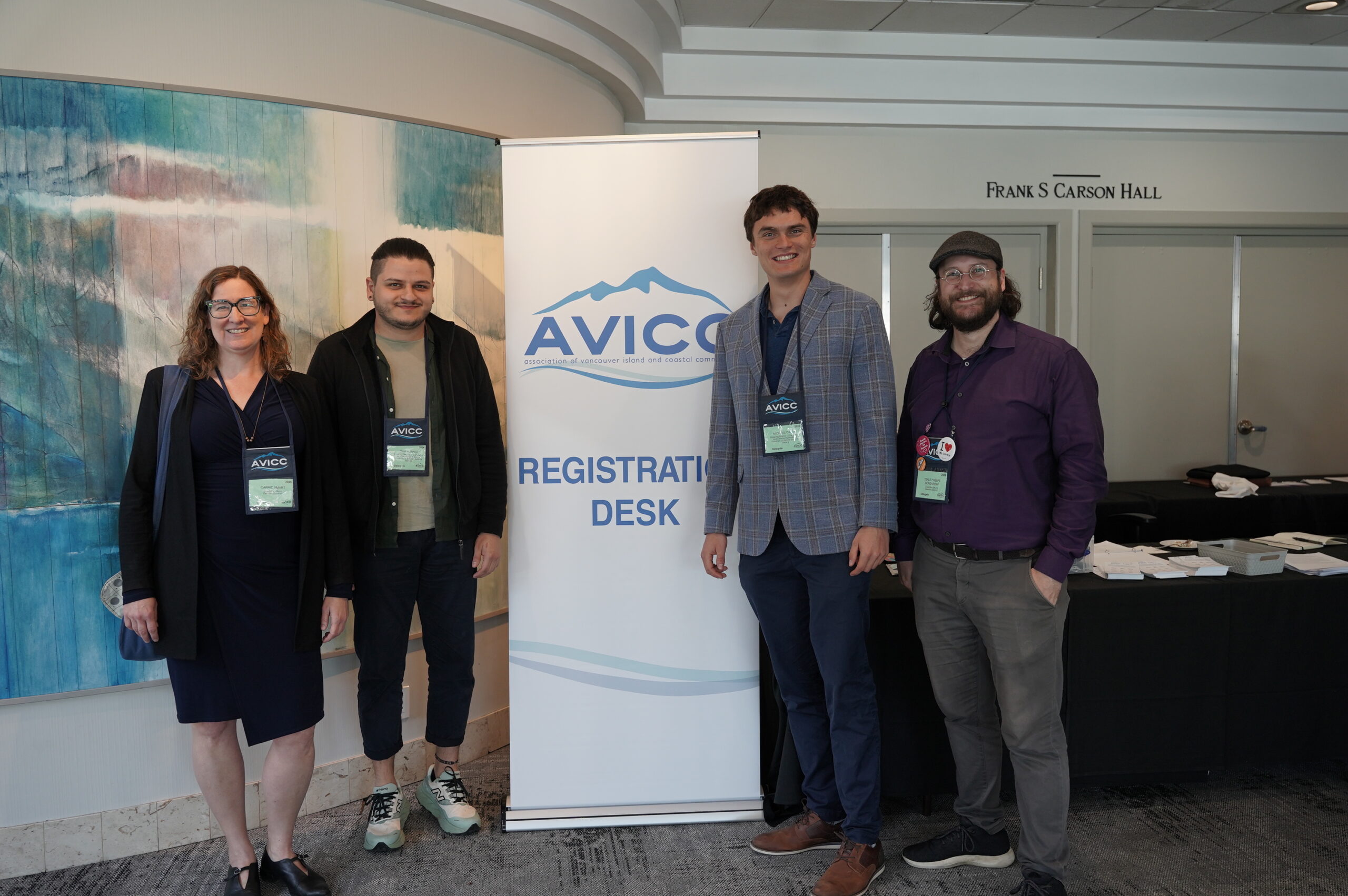
Carrie Smart, Tam Aljundi, Michael Caryk, and Teale Phelps Bondaroff. Photo by Declan Snowden.
The Association of Vancouver Island and Coastal Communities (AVICC) — an organization comprised of 54 municipalities, regional districts, First Nations, and Trust Areas — voted to support several student advocacy resolutions at this year’s convention, including the BC3’s student food bank grant, $10 flat rate ferry fares for post-secondary students, and more.
This year’s AVICC convention received high student involvement, with Ben Geselbracht, the association’s outgoing and now former president, acknowledging participation from the incoming and outgoing UVSS directors of campaigns and community relations, student delegates, and the Martlet in his opening speech.
Several student advocacy resolutions were taken to AVICC this year. On Saturday, April 25, the delegates debated supporting the establishment of a student food bank grant, which would provide post-secondary student unions with $1.50 per student from the province to support food banks on campus, as well as the Alliance of BC Students “Student Issues Backgrounder,” which asks the province to work toward 15 projects to improve student life across the province.
Projects featured in the backgrounder include protecting tuition increase caps, extending tuition increase caps to international students, creating a sexualized violence prevention and response fund, amongst others.
On Sunday April 26, debate resumed, with delegates discussing a resolution regarding $10 flat rate B.C. ferry fares for post-secondary students.
All three resolutions received majority support at the convention, however, that does not mean the province will implement them. Rather, it means AVICC will advocate for them to the province. Vanessa Craig, president of the AVICC, told the Martlet the exact nature of this advocacy is unknown at the time of the convention.
Although the three resolutions all received majority support, some resolutions were subject to more debate than others.
Food bank grant
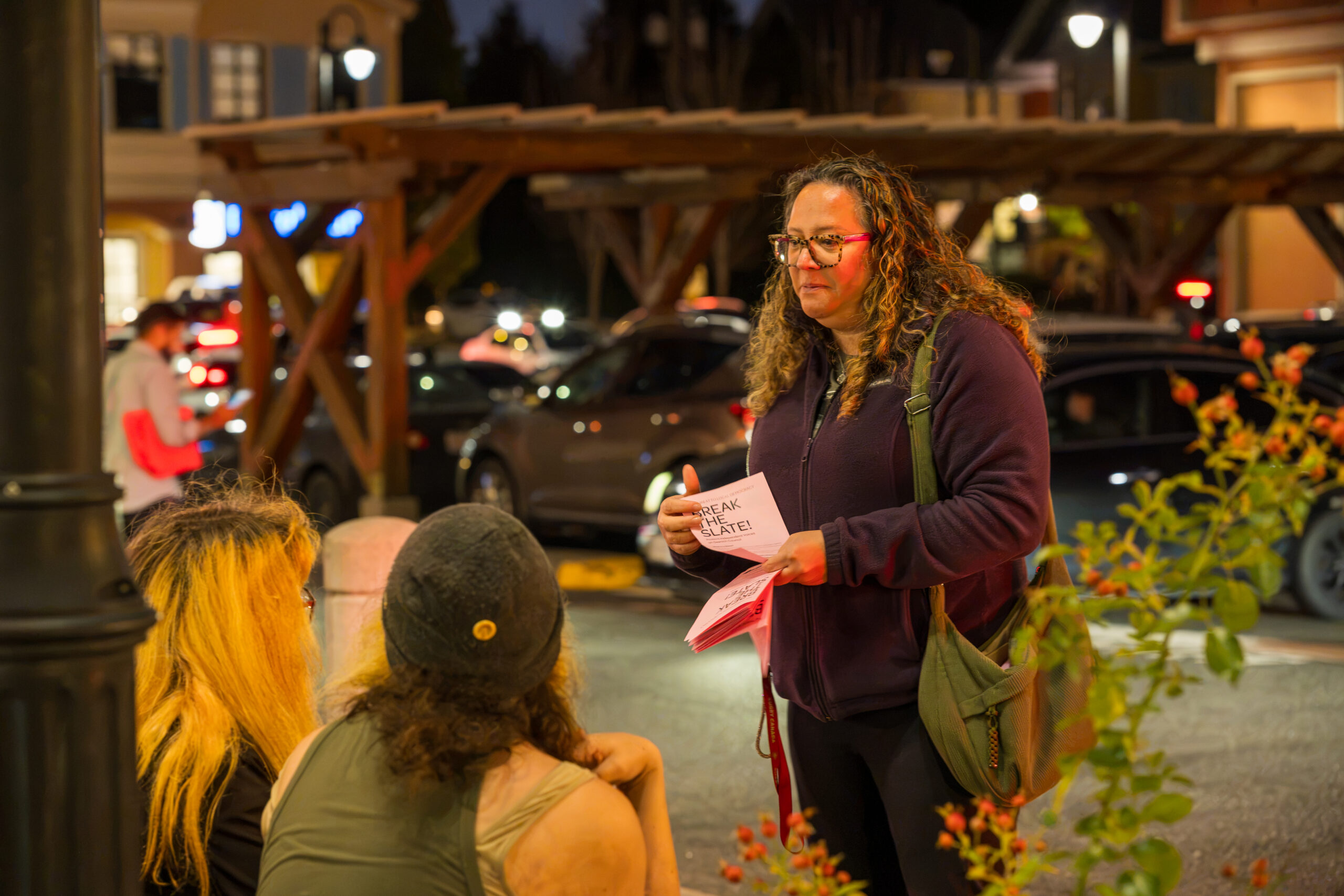
The student food bank grant resolution had no one speak against it. District of Oak Bay Councillor Carrie Smart, who, while working with student advocates, wrote both the student food bank grant and $10 ferry fare resolutions, spoke in favor of it at the convention.
“The influx of inflation [has] created significant cost of living pressures across B.C., and these pressures have deeply affected our post-secondary students, who often face high tuition fees, housing shortages, and limited income opportunities. One visible result of this crisis has been a dramatic increase in the demand of our campus food banks,” she said.
The resolution regarding the Student Issues Backgrounder saw slight criticism, with one delegate arguing it “fell apart a little bit” due many of the issues being focused on UBC and the mainland, such as the request for the province to fund a SkyTrain expansion to UBC’s campus.
Another delegate said they were likely to support it, but that the solutions were “band-aid” fixes and the root causes needed to be addressed.
Still, the resolution was carried. Councillor Dave Thompson, from the City of Victoria, motivated the resolution at AVICC.
“Students are the workforce for tomorrow. They’re the future of our communities. And housing unaffordability, food insecurity and long and expensive commutes are not just a campus problem. When they can’t afford to stay within our communities, we lose the next generation of workers and residents and community contributors,” he said.
Thompson also applauded the work of student advocates, saying they had estimated costs for the issues, and that “organized, evidence based advocacy by students deserves a response from the provincial government.”
$10 flat ferry rate
The $10 flat rate ferry fare for post-secondary students resolution, however, received significant debate at the convention. Smart, who also sponsored this resolution, spoke to the “increasing cost of living pressures, including housing shortages, rising food and transportation costs and limited access to affordable travel for students … in our coastal communities.”
Smart said the cost of several round trips for school can act as a barrier to education, and that Indigenous students and those from rural coastal communities who rely on ferry routes to stay connected with their families and culture are disproportionately impacted by high ferry costs.
Leonard Krog, mayor of Nanaimo, spoke against the resolution. Krog said that he “enjoyed seven years of post-secondary education” in the province, which was “heavily subsidized by the good people of British Columbia, for which [he is] eternally grateful” for, but that he disliked the concept of a resolution targeted specifically for students, while “so many families are struggling, so many young people are trying to make it in the workforce, let alone [to] have the privilege to get to university.”
“It just seems to me that as a group, we shouldn’t be specifically supporting a group of young people who already are going to enjoy the benefits of a larger community while a whole bunch of kids out there are struggling to make their way in the world without the benefit of post-secondary education,” he carried on.
One delegate, Donna McMahon from the Sunshine Coast Regional District, said she applauded the intent of the resolution, but that it needed to “go back to the drawing board” since it was designed for Vancouver Island ferry rates, and some other routes have fares below $10.
She also said that BC Ferries needs to reconsider how they determine who gets free ferry rides.
“I recently started getting free ferry fares as a senior, and frankly, I don’t need it. The free fare should be based on income, not on age, so I would like to see them completely revamp that and that could potentially include students as deserving of low or even free fares at non-peak times.”
Saanich Councillor Teale Phelps Bondaroff, who tried to jointly sponsor the student food bank grant and $10 ferry fares resolutions, but was not supported by a majority of Saanich council, spoke in support of the motion at AVICC as well. He noted that the resolution is intended to be a pilot program, rather than a broad reaching change, that investing in students’ abilities to seek education is also an investment in the province’s respective communities, and that reductions to fare costs for other forms of transportation have increased student usage in the past.
Another delegate, Troy Therrien from the Village of Cumberland, introduced an amendment to the resolution, seeking to change the resolution from providing $10 ferry fares for post-secondary students, to $10 ferry fares for anyone under 25 years of age.
He, and other delegates in support of this amendment, argued this would be more inclusive than just post-secondary students.
Those against the amendment, such as Councillor Susan Kim from the City of Victoria, argued that this would exclude demographics like graduate students and senior students returning to school who, alongside the costs of school, may have families to support and other notable expenses. The amendment ultimately failed.
The original resolution, regarding $10 flat rate ferry fares for post-secondary students, was then supported by a majority of delegates.
“A student ferry rate is a practical way to help students in Saanich and across BC access more opportunities in the face of rising costs. A discounted student ferry fare pilot would help remove barriers to education, employment, and community connection, and it is exactly the kind of affordability measure the province should be advancing,” Phelps Bondaroff said in his press release following the convention.
What comes next?
Michael Caryk, the outgoing UVSS director of campaigns and community relations — who has been advocating for these resolutions throughout his term — said he is “feeling really optimistic about the future” of the campaigns portfolio following the success at the convention.
“The most successful things that end up happening to make things better for students are advocacy efforts that have had a continual push between different boards,” Caryk said. “I’m very excited for what’s going to be some great continued advocacy with Tam [Aljundi] and his new term.”
Aljundi, the incoming director of campaigns and community relations, said he intends to keep pushing for these resolutions throughout his term and “bridging on all the good ideas that the previous UVSS directors have had.”
“It makes me very optimistic and happy to see people in leadership positions caring for the younger generation,” Aljundi said. “It makes me very, very proud.”