
The Vancouver Island Visual Arts Society has occupied the building since 2022, and has been subleasing sections of it to other arts collectives
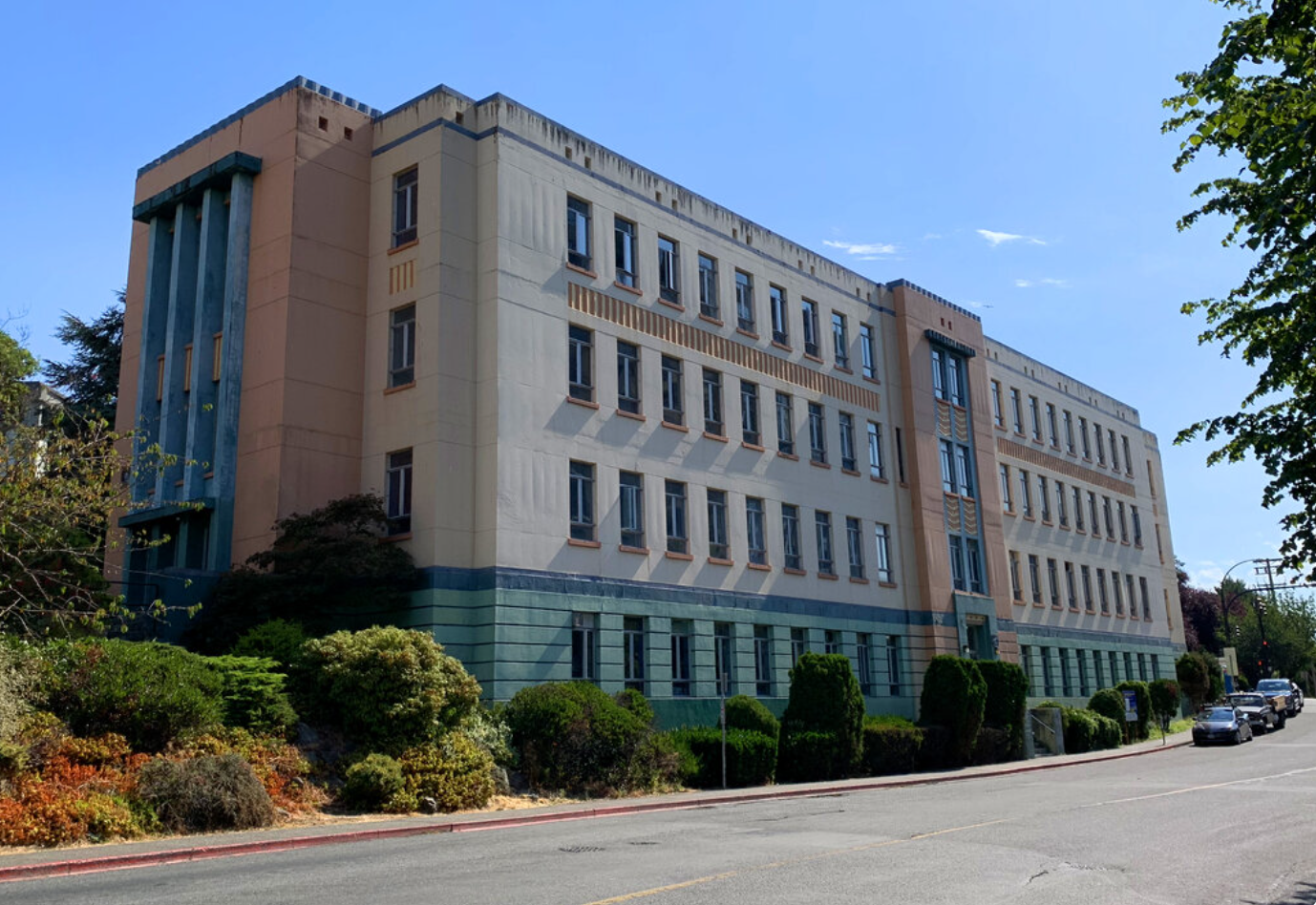
Photo courtesy of Logan Ford.
In 2022, the formerly empty property of 780 Blanshard Street became the home of the Vancouver Island Visual Arts Society (VIVAS), where it has hosted over 90 artists. On Oct. 1, 2026, Victoria council voted unanimously to support plans by Reliance Properties, who own the property, to restore and convert it into a hotel.
Built in 1949 to house the BC Power Commission, the building has heritage value for its Art Deco architectural style and ornamentation
While this decision feels to some like yet another loss for art spaces in Victoria, it didn’t come as a surprise to VIVAS, or the artists who used the space.
In 2021, Logan Ford, the founder and Executive Director of VIVAS, received notice that his previous arts hub was due to be demolished. When Ford was searching for a replacement building, Reliance Properties, the owners of 780 Blanshard Street, offered Ford a below-market lease on the bottom two floors.
“Within a couple months, both floors were completely occupied, and demand for affordable studios was still sky high,” he said.
“By mid-2022 I had leased the entire 40 000 square foot building and filled it with artists. I originally leased it under my own name in December of 2021, and in July of 2022 I founded VIVAS, which has been operating it ever since.”
VIVAS was founded in 2022, as “it had become increasingly difficult for artists to find affordable, long-term spaces to work [in] and exhibit their art,” said Ford. “I wanted to build something that could operate at a larger scale and provide a more sustainable solution.”
VIVAS leased from Reliance Properties with the understanding that the space would eventually be redeveloped. “We originally leased the building for two years, and we’re very fortunate to have been there for five years now.”
VIVAS is the head tenant of 780 Blanshard Street, and subleased space in the building to Rockslide Studio & Gallery, Haus of Owl, the Ministry of Casual Living, and the Victoria Tool Library.
The artists using 780 Blanshard have been kept aware and updated on the building’s future, and it wasn’t a surprise the plan to redevelop it was accepted, Ford said that,
“The owners had made numerous concessions from their original development plans for the property in order to appease city staff and council, so it makes sense that their proposal was approved.”
Matt Dell, a Victoria city councillor, explained that the council created a grants program called the Storefronts Activation program. Through the program, artists are able to move into empty storefronts — be it for one day or for multiple years, like with VIVAS — to keep downtown vibrant and “enhance the city’s appeal.”
The grant enabled VIVAS to move into their second location, an old Volvo dealership at 1101 Yates Street, now dubbed “The Hourglass,” in December 2025.
The Hourglass currently only houses 20 studios, which are fully occupied, according to Ford, with the lease set to expire “sometime in mid-2027.”
VIVAS is also expecting to continue using 780 Blanshard Street until mid-2027. Restoration and construction for the hotel is expected to begin at roughly the same time, Dell said.
“Until then, we intend to continue operating as usual and supporting the artists and organizations there. We want the space to remain active for as long as possible, and we will continue to welcome the public to our exhibitions and events while the building remains available to us,” said Ford.
In an emailed statement, Liya Tensae, a visual arts honours student at UVic and co-founder of the Handout Collective, said “Being an artist is already a very unstable career, not knowing if you will have a space to work out of in the future adds to this instability.”
Tensae said she has not personally had work shown in the building, but has been to “many shows” there put on by peers.
Having a separate space to work on art is often a safety issue, she said. “I work primarily in oil paints. I need a space in which there is adequate air flow and space so that I do not harm my health by breathing in toxins.”
With the expiration of both leases coming around the same time, VIVAS will need to find new accommodations for approximately 120 artists and five galleries, Ford said.
He said the goal is to make sure that the current artists and arts organizations they house will be accommodated in the new locations, though it’s “unlikely” the society will find a single location to accommodate everyone.
Dell said that the closure of 780 Blanshard Street as an arts space has brought awareness to property owners leasing out empty storefronts to artists as a public good, and to the fact that an arts space downtown is wanted by the public at large.
Tensae agrees that a temporary space is better than no space, though there is an issue of inconsistency and instability with temporary spaces. “Additionally, I think there is a lot of power in the notion of ‘legacy.’ If a building is used for decades, or a century even, and is known for supporting and helping to foster a strong arts community then it becomes an attraction for artists and residents more broadly,” she said.
Dell also said that the closure signals the viability of arts organizations as shorter-term occupants to potential property owners and developers to use these spaces for a given term, then move out without incident.
Currently, Ford has said that the best way people for people to support VIVAS is to continue attending exhibitions and open studios, purchasing work directly from the artists, subscribe to their newsletter, follow them on Instagram @wearevivas, and advocate for public policies and partnerships that help protect affordable spaces for the visual arts.