
Dr. Rose-Redwood views Trump’s renaming efforts as more than simply symbolic politics, and has co-authored an open-letter for responsible place-naming in response
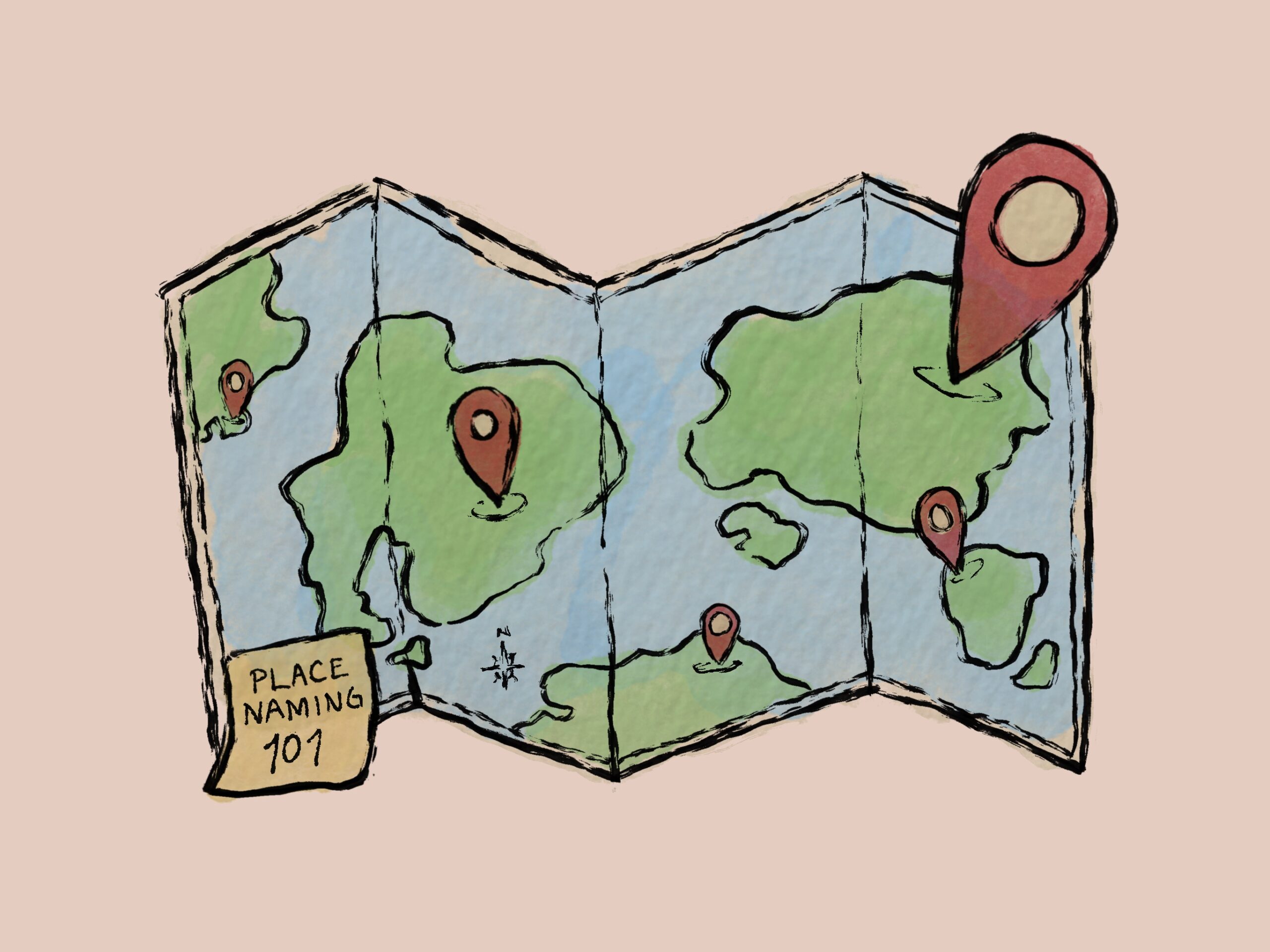
Illustration by Luisa Dela Cruz.
On Oct. 5, seven lead authors, including Dr. Reuben Rose-Redwood, a UVic professor in the Department of Geography, released an open-letter articulating five principles for responsible place-naming, largely in response to U.S. President Donald Trump’s recent renaming efforts.
At the time of publication, the letter has received over 197 co-signatories from over 30 countries, including numerous individuals from the United Nations (UN), a Nobel Laureate, the Executive Director of the Place Name Society of Korea, and more.
The idea began with Dr. Frédéric Giraut, a place-name scholar and the UN Educational, Scientific and Cultural Organization (UNESCO) Chair in Inclusive Toponymy at the University of Geneva. Giraut first reached out to Rose-Redwood and other scholars, suggesting the open-letter after Trump’s “renamed” Lake Ontario to “Lake America” at the end of August.
Giraut, Rose-Redwood, and Dr. Derek Alderman, a professor and scholar of geography and place-names at the University of Tennessee, Knoxville, took lead in drafting the letter, with guidance and input from other authors.
The five principles articulated in the open-letter are to “recognize place names as cultural heritage and a shared public responsibility”; to “ensure meaningful public participation in naming and renaming places”; to “reject the use of place naming as an instrument of political or territorial dominance”; to “approach commemorative place naming with integrity and avoid renaming for self-aggrandizement”; and to “recognize toponymic plurality as a cultural value rather than a problem to be eliminated.”
There is no singular international body that dictates place-names on maps. Rose-Redwood said that the UN has a group of experts on geographical names whose role is to encourage the standardization of place names around the world, but they do not work as an advocacy group nor dictate the terms of place-naming around the world.
“Those of us who studied place-naming felt that we had a role to play in trying to articulate these five principles … those of us who have studied this topic, we’ve seen irresponsible acts of place-naming… and we felt that it’s important to create a culture of responsible place-naming.”
Rose-Redwood said that there is a long-standing history of powerful individuals renaming places in the interests of power, citing the Canadian history of settler colonialism and the dispossession of Indigenous peoples through attempts to erase Indigenous place-names from maps.
“It’s not so much a question of somehow disentangling ourselves from power relations related to place names. We can’t avoid that. But the question is: how do we want to intervene in power relations? Are there any principles just beyond raw power that should inform how we name places?”
Rose-Redwood said that the names we give to places reflect the values of a society or community, citing the “Western practice” of naming places after individuals — often individuals who have committed genocide, oppressed racial minorities, enslaved people, stolen land, and so on.
“If we don’t rename those places, then we as the current generation are complicit in perpetuating the legacy of honouring these historical figures.”
He said that he sees movements such as the wave of renaming in the U.S. following the 2015 Charleston church shooting as “an effort to reckon with the historical injustices of the past and their ongoing legacies in the present.”
He said that some people who support Trump’s renaming efforts argue that these efforts are the same as other renaming efforts, such as those following Charleston. Rose-Redwood said that he sees the values underpinning these renaming efforts to be very different.
While previous renaming efforts were “trying to reckon with the legacies of historical injustice that continue to be perpetuated in the landscape,” Trump’s renaming efforts are what Rose-Redwood has coined as “toponymic narcissism.”
He said that Trump’s renaming is an effort to “glorify himself … inflate his own ego, and also an effort to dominate others.”
Rose-Redwood said that “it’s not simply changing a label on a map, but it’s an effort to reshape our geographical imaginations,” emphasizing that these efforts are more than symbolic politics.
“It’s not merely a symbolic kind of politics going on here because it has real implications for how we understand the world, how we engage with place, people, and cultures, and it’s part of an expression of our values as a people.”