

The documentary about disgraced Theranos founder Elizabeth Holmes encapsulates the challenges of seeking answers in the ‘post-truth’ era.
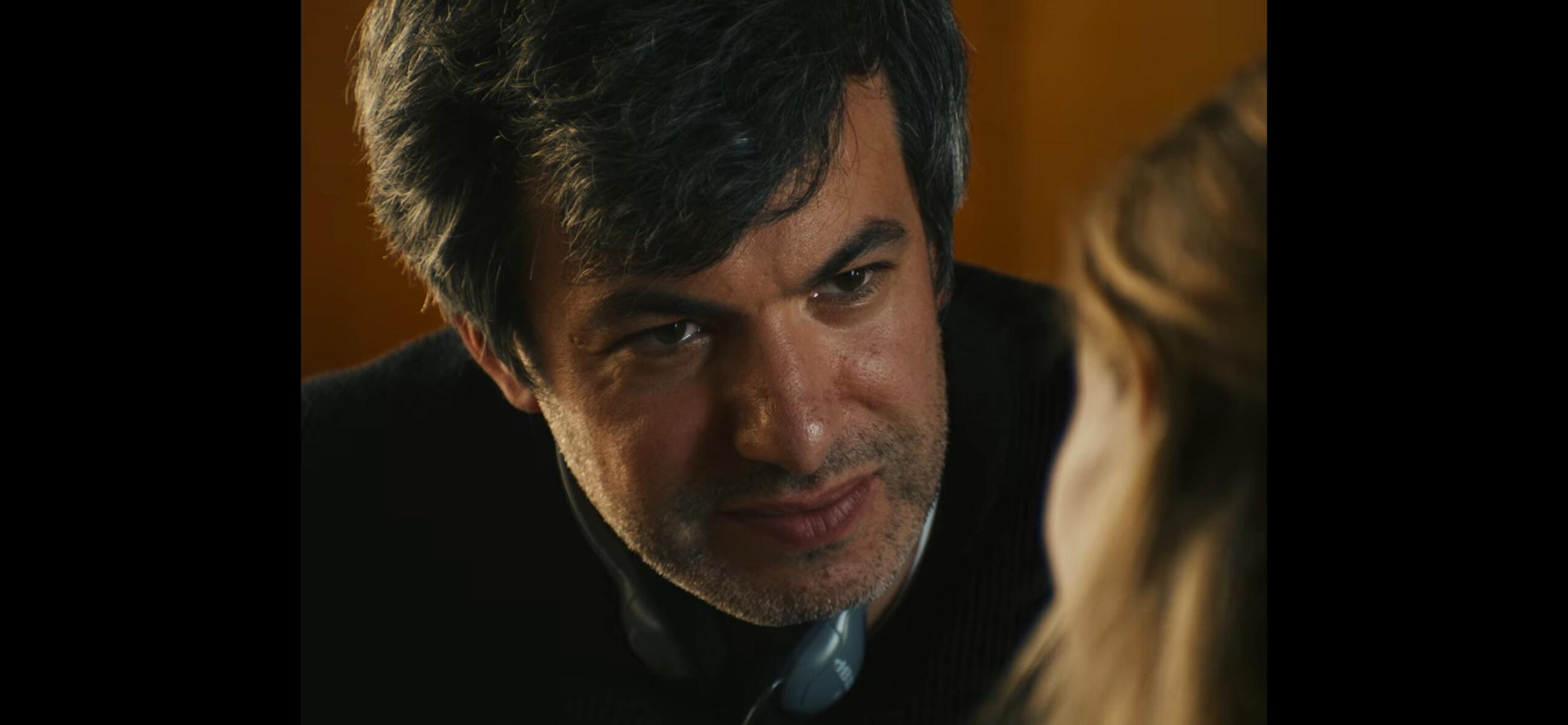
Image via A24 Films.
This review contains spoilers for the film You Can See Everything.
You Can See Everything, the latest documentary venture co-directed by one of UVic’s most famous alums, Nathan Fielder, is well worthy of the incredible hype surrounding its release.
Since its mid-October theatrical release, the documentary, co-directed and produced by Fielder and Lance Oppenheim, already became the top-rated film on film rating and social media site Letterboxd with a record 4.8 out of 5 stars.
But really, what more could you expect from Fielder, a graduate of one of Canada’s top business schools where he got “really good grades”? Since graduating from the Gustavson School of Business in 2005, Fielder has made a name for himself in the entertainment industry through his This Hour Has 22 Minutes segment “Nathan on your Side,” Comedy Central show Nathan For You, HBO series The Rehearsal, and Showtime series The Curse, among others.
At the centre of the film is disgraced Theranos founder Elizabeth Holmes, who Forbes named the youngest and wealthiest self-made woman billionaire in 2015, and her partner, Billy Evans.
Theranos took off in the mid to late 2000s following claims it had revolutionized blood testing with the invention of a device she refers to in the film as the “iPod” of medical testing. She was indicted by a federal grand jury in 2018 for defrauding investors — but was acquitted of defrauding patients — of hundreds of millions of U.S. dollars. She was sentenced in 2022, and her sentence of 11 years and three months in a minimum-security facility in Texas began May 30, 2023.
34 days before her sentence is set to begin, Holmes and Evans invite Fielder, Oppenheim, and their film crew to stay with them at a rented house in Del Mar, California and document the minutiae of their lives in the final month before her sentencing, with the promise that they can “totally see everything.” However, Fielder immediately becomes suspicious that the couple aren’t being as transparent as they promised — a trend that continues throughout the almost three-hour-long runtime.
It’s rare for a film to generate this much pre-release hype and be able to meet it. It’s also rare for a documentary to reach such a runtime while answering almost no questions about the supposedly central subject, and it’s even rarer for this to be the case while producing a film that remains genuinely revelatory.
I was unfamiliar with the Theranos scandal, and Holmes’s fall from grace, before watching You Can See Everything, and came away with an even fuzzier picture of the details. You Can See Everything is nominally about Holmes; Evans remarks in the film that the purpose of inviting Fielder and Oppenheim is for the world to get to see the “real” Holmes, not the version of her they have assembled from news headlines and the Hulu biographical miniseries The Dropout.
But it’s also about the limits of truth and knowledge, and the dynamics between documentarian and documentee in such an intimate setting. It’s as much a psychological profile of Fielder as it is Holmes. This is reflected in the visual presentation of the film, which, through liberal use of zoom shots framed in a 4:3 aspect ratio, viewers become intimately familiar with the details of Holmes, Fielder, and Evans’ faces. During interviews, the camera holds these shots for minutes at a time, often zooming in during periods of silence.
Unlike many documentarians, Fielder isn’t an invisible presence behind the camera, shooting interview footage while the subject sits in the chair. He’s an active presence in the scenes. He moves from room to room, engaging Holmes and Evans directly in their everyday environment. Lingering in the background of shots, and behind corners, he becomes an almost haunting presence in the film — a perception aided by Ari Balouzian’s deeply unsettling, almost horror movie-esque score.
It also throws its own central concept into question in a fascinating way. What does it mean to “see everything?” We see Holmes and Evans play with their children, and cook in their kitchen. We see Evans shower in the nude. But as the film goes on, the intrusions upon the promise to Fielder of “seeing everything” become increasingly overt and frustrating. Evans invites him to their home, then seems to grow increasingly agitated by Fielder’s lines of questioning, at one point stopping him from interviewing Holmes’ father, a former Enron executive.
He later interrupts another scene, demanding they stop shooting, refusing to state the reason for ending the scene until the cameras stop.
Ironically for a film with this name, the latter half is marked by scenes you can’t see — things that happened before production began, or interviews in locations where recording is forbidden. Their solution was to film reenactments of the scenes, with Amanda Seyfried (who played Holmes in The Dropout) as Holmes and Christopher Abbott as Evans.
In doing so, Fielder and Oppenheim break from the documentary framework they’ve been working in. As audiences, we want to trust the version of events shown in the reenactments, but in a film where one’s image and who controls it is such a central theme, the deliberate choice to circumnavigate barriers in this is both brilliant and intensely jarring.
In many ways, You Can See Everything feels like the perfect film for our time — the era of “post truth” and “alternative facts.” It masterfully walks the epistemological tightrope of trying to understand what’s true in a national scandal of such huge proportions while acknowledging that, for many stories like these, we may never know the full truth.
But, as the film shows through Fielder’s own reactions and reflections during the process, it’s intoxicating — even exhilarating — to try.