
Meaghan Buisson, a master’s student at UVic, applied through the Priority Consideration process, says her dog was clearly identified in documentation submitted to Residence Services with her application and afterwards
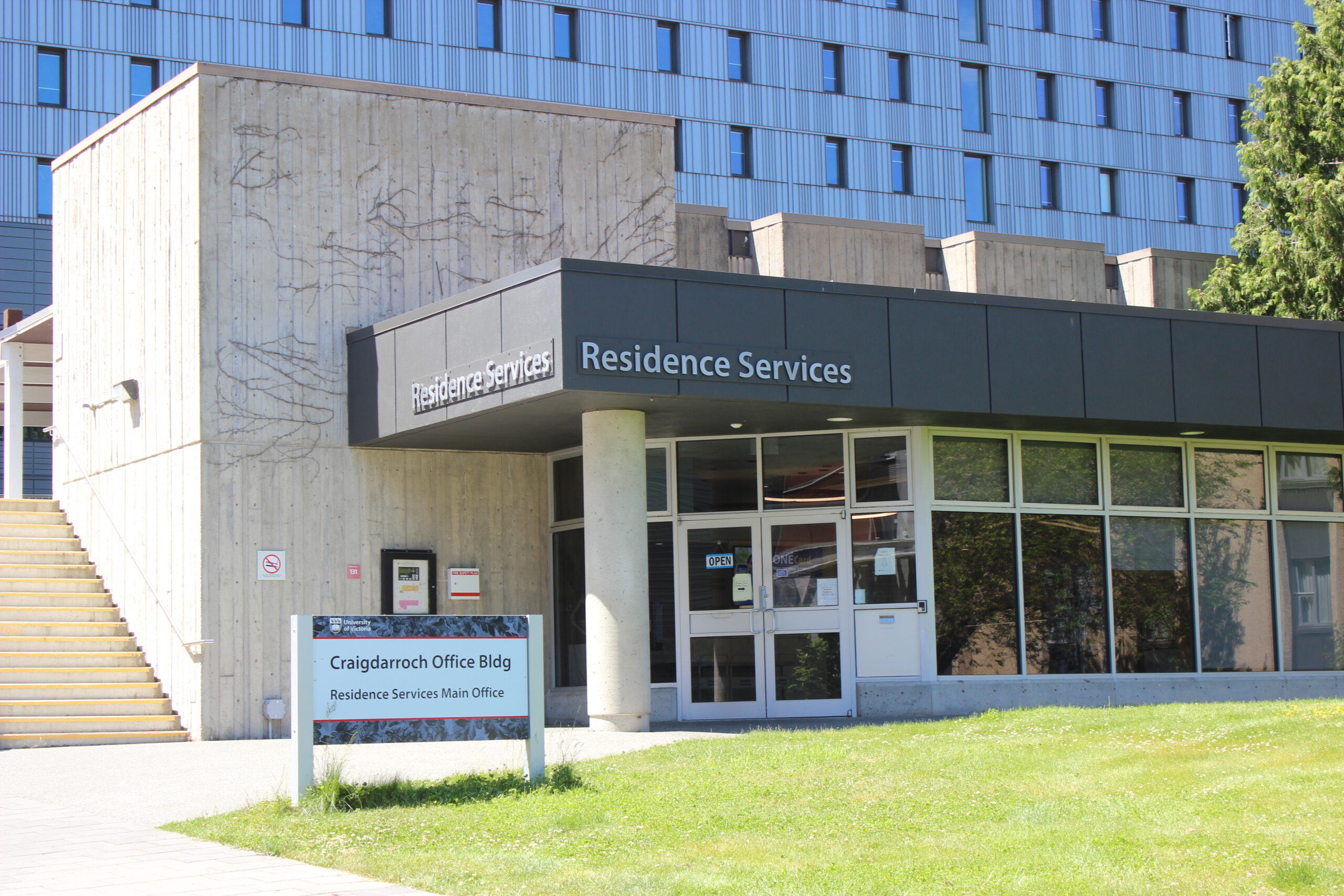
Photo by Ethan Barkley.
Meaghan Buisson, a graduate student at UVic, is facing eviction from her on-campus family housing unit, which she received through the university’s priority consideration process. According to a notice she received, Residence Services made an “administrative” error, mistaking her service dog of over four years, Zoey, for a child.
Buisson is a master’s student in the Social Dimensions of Health interdisciplinary program at UVic, researching service dog policy and the lived experience of women with service dogs in Canada.
The residence services website defines priority consideration as “priority admittance to a specific type of housing in residence and/or priority admittance to housing outside of current admissions practices or eligibility criteria, based on restrictions or limitations resulting from disability or chronic health conditions.”
According to the “transfer review,” in which she was notified she had 30 days to relocate to a single student housing unit on campus or move out, Buisson did “not meet the eligibility requirements” for family housing, despite her being admitted to family housing in late 2025 through priority consideration.
The notice said that because Zoey was recorded as a child, the priority consideration team assumed she was eligible for family housing.
However, Buisson said Zoey was clearly identified in the 22-page document submitted to UVic, in which she says she described Zoey as a spayed, black, female Labrador Retriever. This paperwork was part of her application to family housing — housing normally reserved for families with or without children — as her specific disability accommodation through the priority consideration process.
She also said she clearly identified Zoey as her service dog in correspondence with residence services personnel afterwards, when a staff member requested Zoey’s birth certificate, and she replied by offering her rabies certificate instead.
Buisson said the staff member then apologized for the mistake and said it would be corrected prior to sending her the housing contract.
She said she chose to move to UVic specifically because of the stable housing option provided through family housing and priority access; however, when she arrived at her unit in January, she said it immediately sent up red flags that had a clear and direct link to her functional limitations.
Buisson said she had been requesting a transfer to another unit from February to April, and provided medical documentation supporting the move. She alleges that she was ignored by residence services despite the university having “multiple suitable units available.”
She also said she was told she wasn’t eligible for a transfer into another unit in her building because she “wasn’t in a wheelchair.”
According to the notice, Buisson’s request for a transfer led to a review of her file, where the “error” was noticed. The notice says Residence Services will “honour” Buisson’s priority consideration, and offered a transfer to a one bedroom apartment in single student housing.
However, Buisson says she cannot be in a single dorm on the basis of her functional limitations –– and submitted documentation as part of her application indicating this was the case.
No issues with her eligibility for family housing had been raised, Buisson said, until days after she emailed the Office of the Associate Vice-President Student Affairs, which oversees Residence Services, to escalate her concerns with the transfer. Days later, she received the notice.
B.C.’s Residential Tenancy Act does not apply to accommodations provided by an educational institution like a university, meaning students living in campus housing have fewer rights than students renting from an off-campus landlord.
A UVic spokesperson said in an emailed statement that the university could not comment on the case of an individual student due to provincial privacy laws.
“What we can say is that within our limited housing supply on campus, the university works to place students in residence that is most appropriate for them and their unique circumstances, while also adhering to UVic policies,” the statement reads.
The statement said service dogs are permitted in “many” unit types.
Buisson said she received the notice shortly before she was scheduled to invigilate an exam, and was due to leave the next day for a week to attend a conference outside the country.
The date she was expected to vacate her family housing unit was May 14 –– a week after classes resumed for the summer term. Buisson told the Martlet she had a full course load at the time, and that the courses in her program are only offered once a year.
Buisson is currently still living in residence as she awaits the result of a review process after appealing the decision. She has raised concerns about the process, however, stating that the review is being undertaken by the same team on campus that issued her the notice. Buisson said she has asked residence services multiple times to clarify how they will ensure this process is fair and transparent, but has not received a response.
“So the eviction is now suspended, pending review…. But it doesn’t take away the fact that none of this should be happening. I still have a medical transfer that was pending, that they’ve never actually acknowledged.”
During the process, she said she has been repeatedly asked to “prove” her disability and explain why she needs to be in family housing, despite being approved for this accommodation through priority consideration last year.
Brett Zawadiuk, UVic’s director of residence services, said in a statement that with “on-campus housing at a premium and demand continuously high, it’s incumbent upon the university to ensure we can maximize the number of students in our residence buildings.”
“While we make efforts to support student requests, not every request can be granted, and we recognize how challenging that can be,” Zawadiuk said.
Zawadiuk said UVic is “deeply committed” to accessibility, and would work “diligently” with impacted students in situations like Buisson’s to find suitable alternatives on-campus.
“A mistake of this nature should not result in a disabled student losing access to their safe and secure housing. To me, this raises serious concerns about whether disability-related applications and priority consideration documentation are being properly reviewed and understood,” Bella Jacobs, office coordinator for the Society for Students with a Disability, said in an emailed statement.
Jacobs said Buisson’s case suggests accessibility and accommodation are often not “treated as a genuine institutional priority at UVic,” a pattern she said is experienced by many students with disabilities at the university.
“There are many dedicated staff members who work hard to support disabled students, but too often they are doing so without sufficient backing, resources, or systemic support from the university itself,” she continued.
With the status of her housing at UVic still uncertain, Buisson said she is in contact with a human rights lawyer.
“My program’s core courses are only offered once a year. I’ve had to drop one this term because of this … that has potentially significant impacts to my academic progression,” Buisson said.
Both Buisson and Jacobs expressed concern about the lack of tenant rights students have in on-campus housing in B.C.
“Cases like this raise broader concerns about how well the rights and housing needs of disabled students are being protected in practice,” Jacobs stated. “As campus university housing is not covered by the B.C. Residential Tenancy Act (RTA) it is important students’ rights are protected through university policy.”
Buisson said it’s “appalling” that the university would “unilaterally cancel a contract based on its own administrative error and evict a student on short notice.”
“Students living on-campus have no tenant rights. University policies ignore that power dynamic and take advantage,” she stated.
Jacobs said SSD is “consistently” hearing about the challenges students face finding housing.
“Concerns and conflicts involving residence are becoming increasingly common at UVic…. While there is no simple solution to a problem of this scale, it is clear that more needs to be done to support students, particularly disabled students and other marginalized groups who are often the most vulnerable in housing insecurity situations,” she said.