
The tank is the result of a decades-long vision from biology lab instructor Dr. Rossi Marx to bring marine life closer to students and the public.
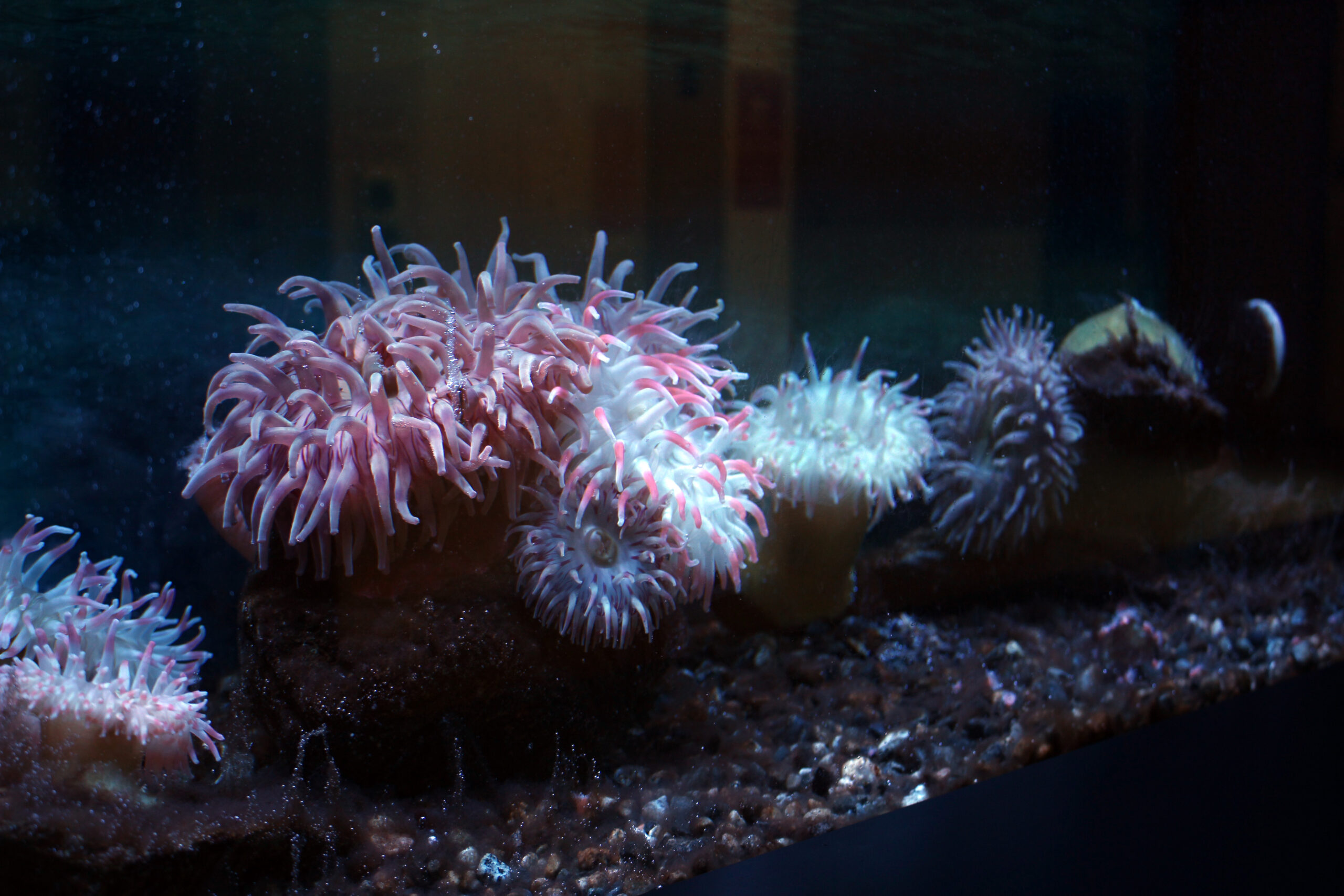
Photo by Isobel Barlow-Busch.
A new saltwater display tank has been built outside the biology department’s marine biology teaching labs in the Petch Building. Located outside room 107, the tank is currently home to roughly a dozen sea anemones.
While the tank is not directly used for teaching, it is intended to draw attention to the department’s marine sciences program and the work happening inside its labs. It was built alongside renovations to the marine biology teaching labs.
Dr. Rossi Marx, a senior lab instructor with the biology department, has dreamed of having a display tank in the department for more than 25 years. Her hope is to inspire students on campus, as well as the general public, to engage with marine ecosystems.
“There are not many universities around the world where you have access to the ocean,” Marx said in an interview with the Martlet. “And I thought, ‘we have to display it.’”
For students, the opportunity to see marine life up close is part of what makes the tank appealing. Martin Liu, a master’s student in botany who took marine biology courses during his undergraduate degree, sees it as a way to draw attention to the department and its programming.
“When you have a display tank, it’s almost like a little teaser,” Liu said.
He sees the tank as both a way of attracting prospective students and providing inspiration for students already enrolled in marine biology courses.
The tank also offers a quiet, personal connection to marine life. Taraneh Abarin, who is finishing her undergraduate degree this summer in biology, with a specialization in marine sciences, finds the anemones in the display tank soothing to watch.
“Watching them calms me down, because I know that a lot of things [are] happening in that quiet, tiny environment.”
The tank was built as part of a broader renovation to update the marine biology teaching labs. The Dean of Science, Dr. Peter Loock, played a role in prioritizing the construction of the display tank alongside the renovations to labs, and says he is pleased with how the updated facilities turned out.
“I think it’s an awesome environment for students. The tank has no teaching functions, per se, but it attracts attention and signals the awesome stuff that’s inside.”
While the tank currently houses sea anemones, its inhabitants are expected to change over time. Marx hopes to eventually build a more diverse ecosystem in the tank, with animals including the shrimp, crabs, tube worms, molluscs, and sea cucumbers that are all permanently housed in the university’s aquatic care facilities.
The department also plans to construct information plaques next to the tank in the 2026 fall term to help visitors identify its inhabitants.
Creating an ecosystem that represents the marine environments around Victoria will take time, however, as each species needs to be safely acclimated to the tank. “It’s a work in progress,” Marx said. “Nature takes a while.”
Additionally, the number of species that can be maintained in the tank will depend in part on the funding and staffing available to the university’s aquatic care team, which has shrunk over the years from three full-time staff to one.
While staffing limitations may prevent Marx from realizing her full vision for the tank, she remains enthusiastic about what already exists.
“This is already amazing, even though it’s just barely the beginning.”