
The club meets weekly on Tuesdays from 4–6 in the Library’s KULA Lounge.
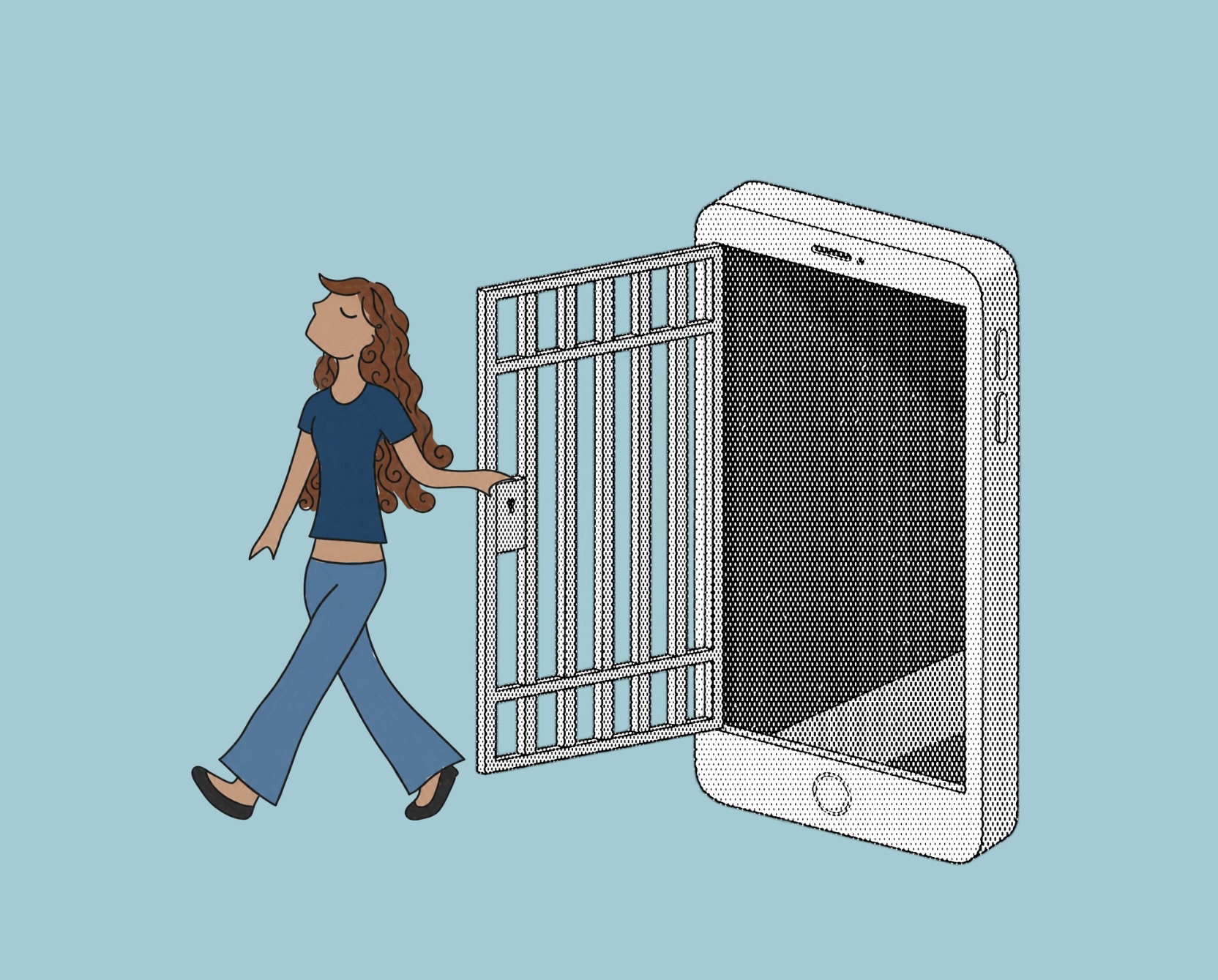
Illustration by Sabina Mendoza.
Students the world over struggle with addiction to their phone and social media, which can significantly impact academic performance and mental well-being. However, solutions to mitigate these addictions are possible — including on UVic’s campus.
The Offline Club was founded last year in 2025 by writing professor Deborah Campbell as an effort to encourage students to unplug, regain our ability to think for ourselves, and to actively engage with others without the crutch of a device in hand.
Currently, the Offline Club offers the only space on UVic’s campus that is completely tech free.
Campbell teaches WRIT 416, an advanced creative nonfiction class where she instructs her students to take 48 hours of no screen time and to document their experience, calling it their “digital cleanse” assignment.
“Even if it’s really hard, it’s still like a vacation,” said Campbell. “Their productivity goes through the roof because suddenly they actually can concentrate, and they realize that they’ve been spending all this time in ways that are actually unproductive and inefficient.”
Studies have shown those who carve out time in their life to disconnect are have increased health benefits socially, psychologically, personally.
The digital cleanse has been a recurring assignment in Campbell’s class for the past 10 years. “I have seen the changes that have been happening over the last 10 years, as people have become much more wedded to their tech and unable to escape it,” she said.
“The utter loneliness that many [students] experience, the psychological toll it takes to not have anyone to talk to, and the way that tech corporations have infiltrated every part of their lives…. II decided that it would be useful for the university to have one space for two hours a week that was tech free.”
In recent years, offline clubs have been popping up around the globe, however, many of these groups require attendees to be members, or only offer paid events. Campbell wanted the opposite; “I wanted there to be somewhere on campus that was free and open to anyone, no barriers. The only restriction being that it’s no tech.”
One of the ironies of the Offline Club lies in how they’ve reached their audience. The first few meetings of the offline club were only attended by students who saw the physical posters around campus, Campbell said. It wasn’t until the club partnered with UVic Libraries, which posted about the club on Instagram, that they started to gain more traction.
A recurring topic of discussion in the Offline Club is social media, in particular the ostracization that can come with most campus events only being publicized on social media. Students on campuses where events are primarily publicized on social media (such as UVic) have trouble feeling like a part of the university’s community if they are not online.
As of Aug. 19, “Meta is facing allegations for knowingly designing Instagram and Facebook to keep children and teenagers hooked, even as it learned about the potential harm to their mental health,” as reported by PBS.
“As an institution, we’re complicit in forcing students who want something other than an Instagram addiction to be on Instagram if they want to join a sports team, or be part of a club,” said Campbell.
“We’re up against the richest corporations in the world who know more about us than anyone ever could, more than we know about ourselves, and these are not people that we should trust with our lives,” she continued.
However, the club is not all existentialism and doom. The club plays cards, has snacks, and drinks, and plenty of lively conversation.
“The offline club is also just hanging out and having fun,” Campbell said. “We’re not always talking about Elon Musk and Mark Zuckerberg, and how often they dine at Mar-a-Lago.”
The Offline Club runs every Tuesday from 4–6 p.m., starting Sept. 29 in the KULA lounge in the Mearns Centre for Learning – McPherson Library.