
The recent Canada Post strikes remind us how fragile letter writing has become, and how easily it could disappear without public postal service
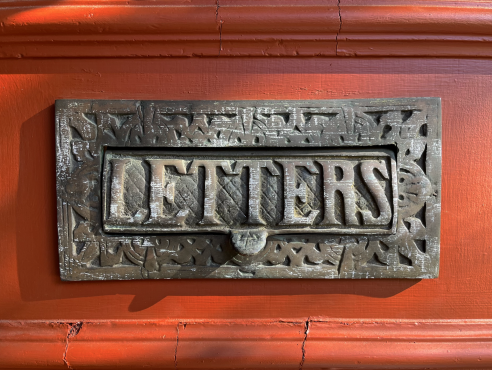
Photo by Sage Blackwell.
In the digital age, writing letters — once an essential way to keep in touch with loved ones living far away — has instead become an art. The act of planning, writing, decorating and mailing a letter is a deliberate choice, filled with intentionality and intimacy. We rely on our postal system as a crucial step in this process. But what happens when Canada Post stops delivering?
For most of us, we aren’t fazed when we see headlines reading “expect delayed deliveries.” When we need to mail something, we can rely on courier services like UPS and FedEx. Over the past decade, private couriers have increased their deliveries, whereas Canada Post’s has decreased.
However, I believe these companies cannot replace Canada Post’s accessibility, affordability, and community service. I was met with that reality earlier in October, when I wanted to mail a letter internationally to Denmark. What cost me $3.83 with Canada Post ended up costing $100.57 with UPS. That’s when I realized that to couriers, a letter isn’t a letter — it’s a document.
Private shipping couriers don’t recognize letters in the traditional postal sense, but rather treat them as document shipments — no different than a business invoice or a legal document. With a private courier, my piece of paper with heartfelt, handwritten words became a trackable premium package with a high price tag. Private couriers are designed with business transactions and urgent shipments in mind — not the slow, sentimental act of sending a letter.
I wasn’t the only one mourning what felt like a quiet loss. For some Canada Post workers on strike, they have noticed the fragility of written letters long before the impact was felt by us. For the workers I interviewed, striking wasn’t just about pay or policy, but also protecting a community service that connects people across distance and time.
Scott, a striking Canada Post letter carrier, told me there’s a “larger [feeling] that people are ready to move on from Canada Post, which is a terrible thing to say, because it’s been such a backbone of the community for so long.”
The art of sending a letter begins with thinking of what to say, writing it down, and trusting someone else to carry it the rest of the way. “It comes down to a mailman putting a piece of paper in your box that is so integral” to the art of information transfer, Scott said, reminding us that the delivery finishes the circle of intention that begins with the writer’s hand.
For some, letters are not just about telling your inner feelings to someone you love, but they are also a quiet way of checking in, of making sure someone is alright, and they fill an important social function beyond interpersonal communication. Scott said that letter carriers see this firsthand. “We notice things about houses,” he explained. “We notice mail building up in the box, [which] may make us concerned for an elderly [person].” In that small act, letter writing and delivery becomes more than just communication, but also care.
With private couriers operating as a business not a community service, we lose the humanity behind mail: the hand, the thought, and the intention that once carried every message.
Another striking worker, Troy, described letters as creating “something that moves the energy of the world.” The intentionality of handwriting cannot be replicated digitally. In his view, writing online loses the “societal behaviour of having deep thought,” a result of our quick and impermanent digital habits.
There is art in patience. “The patience of waiting to hear from someone,” Troy continued, “the patience of collecting your own thoughts.” With digital messages sent in an instant, and private couriers prioritizing speed, we lose yet another chance to create stillness between people.
That is, at least, until we lose Canada Post — which one striking employee, Denise, predicts could be another “ten years away.”
“We might see,” she said, “a complete disappearance of letter mail.” As more people move down a digital path, Denise said that many “people don’t think they need the post office anymore.” In a way, she said, this costs us our “humanity, not just in letter mail, but in our society.”
The possible loss of letter writing demands our attention. Pick up a pen with someone in mind, and write to them. Go to the post office and hand that small piece of humanity to a person who will pass it to the next, until it reaches your person. The art lives in that chain, in the connection, the patience, and the shared act of care.