

An Offbeat by CFUV Review
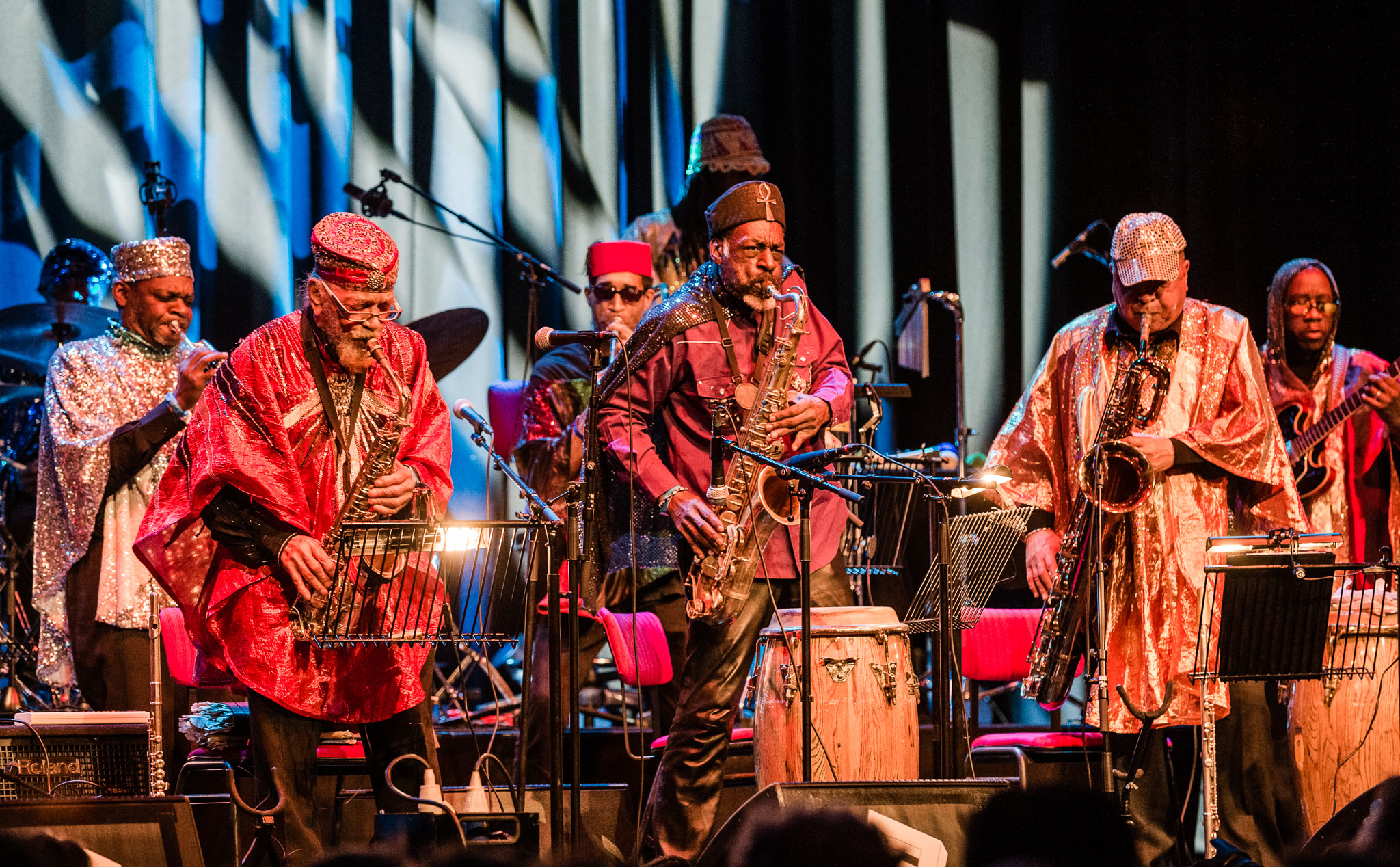
Photo by Ben Houdijk via www.myscena.org.
Last week I saw the Sun Ra Arkestra, an American jazz group who are considered pioneers of the genre Afrofuturism, at The Pearl in Vancouver. They came out in sparkling capes, sequined fabrics, and patterned robes. Pretty quickly, I forgot I was on Granville Street and felt somewhere between Egypt and outer space.
In the days since the show, I’ve been reflecting on who thinks about the future and who doesn’t, why I used to, and why I don’t as much anymore. Maybe this is nostalgia talking, but it feels like there used to be more room for speculation. Flying cars. Big aspirations. What our MTV Cribs house might look like.
And I’m guilty! This year, my only resolution was to have more routine. I stand by it, but it’s not exactly a utopian vision. No jetpacks. No world-building. Just getting through the week.
But who can blame us? Who can blame anyone for not dreaming about the house they want someday (that one in Fernwood with the bay windows and the front-yard stoop) when everything feels so expensive and unstable? When everyone is tired? When jobs are scarce, and the ground keeps shifting beneath our feet?
Still, I think imagining a future matters. Not in a hustle-culture, five-year-plan way, but more in a two-kids-on-a-swing-set way.
The Arkestra is currently led by Marshall Allen. He’s 101 years old, Black, and was born in the American South. When I think about the eras he’s lived through, the violence, the erasures, the constant narrowing of possibility, I can see why Sun Ra’s work was so committed to imagining other worlds. This act of imagination, which is a muscle that has to be trained, does not only serve as escapism, but as survival and an exercise in hope.
That muscle feels underused now, at least in me.
It might take more than one spiritual jazz show to rebuild a vivid imagination. I still raise my eyebrows thinking about long-term plans, and staking too much on a future that feels uncertain. But I can start somewhere: what my apartment might look like by the end of the year, what the radio station I work at could become, or what little trips my pals and I could take.
A couple of weeks ago, I shared with a friend that I was going to the Sun Ra show. His first response wasn’t about the music, but about how much he’d love to bring his kids to something like that someday. His comment reminded me that imagining futures isn’t something we do just for ourselves; imagined futures are something to be shared and carried forward.
The Arkestra concert also has me thinking about the stories, symbols, and myths that are used to make sense of our world today. I’m currently reading The Message by Ta-Nehisi Coates. In it, he talks about Egypt, and the effort made by some in the West to whitewash its history, to erase the fact that there were African kings and queens, and to erase the fact that a systemically oppressed population could be descended from Pharaohs. Coates talks about how different stories lead to different lenses to view our current moment. In the chapter I’m currently on, he compares the story, claiming that the U.S. was founded on principles of freedom and democracy with the contrasting understanding that it was founded on genocide and slavery. I can’t help but think that if you believe the former, you might not question another warship in the Persian Gulf.
To say the Arkestra moves in their own lane would be an understatement. They claim to be from another planet, and they invite us there! At the same time, they nod towards stories that have been swept under the rug.
And did they ever look good doing it! Ripping sax solos in sequined headdresses. Stomping their feet through the crowd in a mix of striped platform oxfords, space boots, and open-toe sandals. Nothing about it was ironic. Nothing was assembled for an algorithm. Every pocket watch, every piercing — every detail felt like it carried a decades-old story.
As someone perpetually trying to find my own style while wondering if such a thing even exists, I’ve since been looking to understand where the Arkestra got their taste from.
What I’ve gathered is that it comes from a world they built themselves.
It appears to be a kind of taste that takes time, that doesn’t try to conform, and also doesn’t perform its rebellion. Sun Ra doesn’t just make music; they share a way of seeing, a sensitivity to patterns, and a belief that meaning lives in overlooked corners.
Sun Ra lived with his interests long enough to understand them; he lived with them long enough to let them change him and manifest from the inside out. Maybe that’s what taste is — understanding why you like what you like. This way of understanding taste is very different from the way I sometimes feel trained to ignore my own reactions and instead regurgitate whatever hot take I saw on Letterboxd, or from Anthony Fantano (no shade to my fellow needledroppers!).
As Sun Ra said in one of their songs: “There are other worlds they have not told you about.”
Every day we’re offered different visions of the future. Is it one where we order BOGO Freshii to our apartments, or one where we sit outside Italian Food Imports with a panini, watching people pass by? Is it corporatism dressed up as convenience? Or is it something slower and stranger? Can it be the one we saw take centre stage at Bad Bunny’s halftime show, full of family, community, food stalls, and house parties at the 50-yard line?
As I sit on the BC Ferry writing this on the way back from the Arkestra show, that’s what is sticking with me. It’s not the solos or the spectacle, but the feeling that the world might be rearranged differently than it currently is.