
Voting on the policy was polarized, with a majority of faculty and graduate student senators voting for it, while undergraduate senators largely opposed it over a number of concerns
Photo by Ethan Barkley.
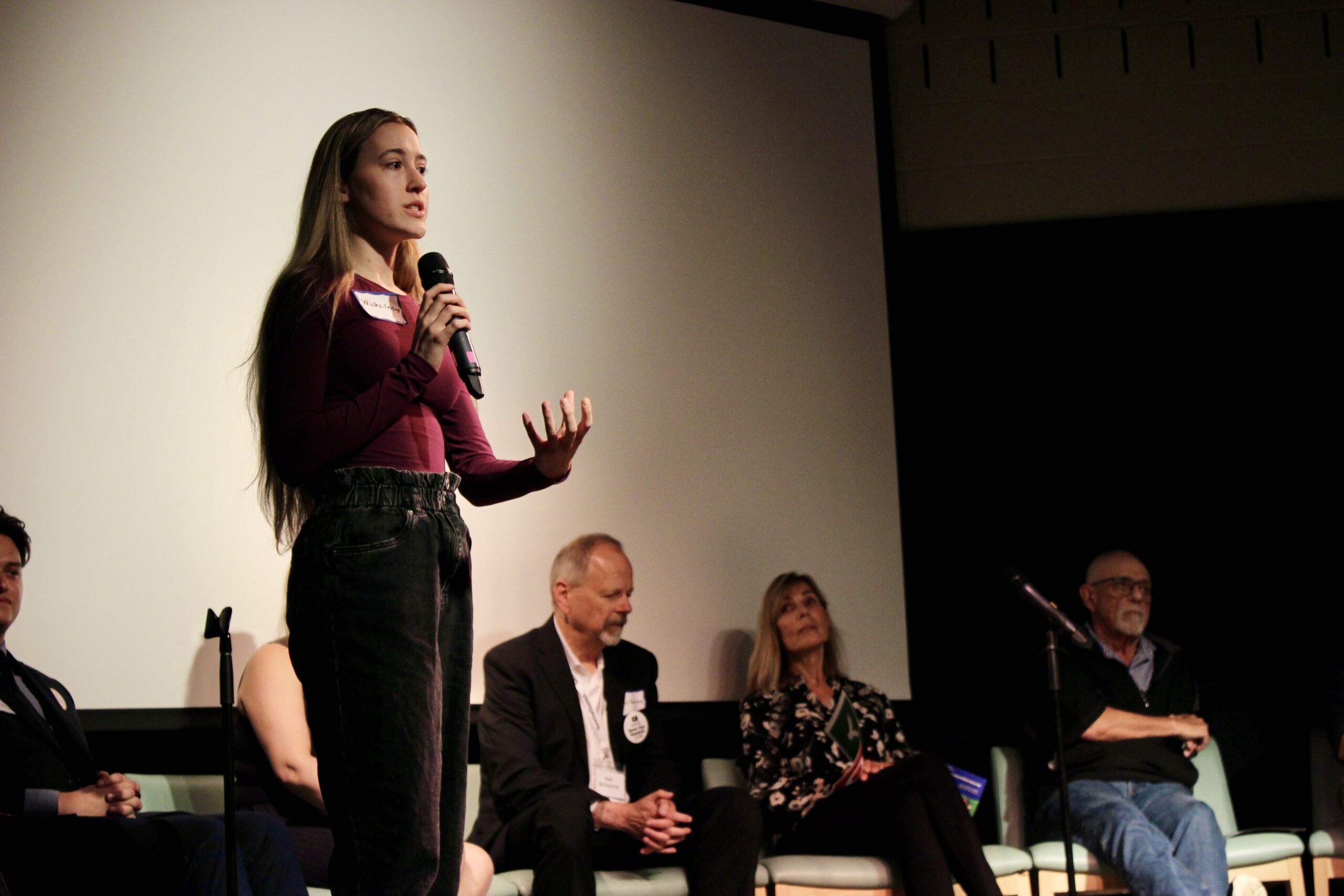
The visitor’s gallery of UVic’s Senate Chambers was packed for the Friday, May 8 meeting. On the agenda was the second vote in two months on updates to the university’s Academic Integrity Policy, which was criticized by student senators and the UVSS lead directors ahead of the vote.
The meeting lasted nearly three hours, with a substantial amount of that time spent discussing changes to academic integrity. A comprehensive written recap of the meeting is available online, and the Martlet’s live-tweeted coverage of the meeting is also available on BlueSky.
Voting on the policy was split, with undergraduate student senators and some faculty senators opposing it, though ultimately a majority of senators voted to approve the policy. With the policy approved, it will come into effect this September.
What does the policy actually do?
The academic integrity policy governs what actions are considered to violate academic integrity, such as plagiarism, cheating on exams, and more. It also outlines penalties for different types of violations, the responsibilities of students, instructors, chairs, and deans, among others, and other related concerns, such as the appeals process.
UVic already has an academic integrity policy in place, but it has not been updated since 2017. A UVic spokesperson told the Martlet that the previous policy “used a broad definition of academic integrity and its approach to violations was punitive.”
New features of the updated policy include an escalating penalty structure, a detailed breakdown of the responsibilities of each party (students, instructors, chairs, deans, etc) — previously integrity violation cases were handled by department chairs — and an expanded set of definitions, types of violations, and penalties.
The policy is designed to “provide more flexibility to instructors and students to address potential issues without an automatic formal reprimand,” the spokesperson said.
Why are some students concerned?
Key concerns about the policy were voiced by students serving on Senate, the UVSS lead directors in a published statement, and a number of students online.
These criticisms targeted aspects of the policy, such as the adoption of a “balance of probabilities” (more likely than not) standard of proof, the lack of a statute of limitations on violations of academic integrity, and whether students who rely on software approved by the Centre for Accessible Learning (CAL) would be adequately protected under the policy as potentially problematic.
Student senators and the UVSS also expressed concern about a perceived “silent authorization” loophole in the policy that might enable the university to approve AI detector software later on, as well as language that restricts the appeals process largely to “procedural” matters.
Dr. Danu Stinson, a professor of psychology at UVic who serves as the chair of the Senate Committee on Academic Standards (SCAS) — the committee responsible for bringing the policy forward — said during the meeting that the policy does explicitly ban AI detection tools.
According to her, if the university wanted to approve an AI detector in the future, it would have to pass through four committees, and the Academic Integrity Policy would have to be revised, before this could take place.
The UVic spokesperson told the Martlet that the university “does not permit the use of AI detection tools in academic integrity cases.”
“A final decision can never be based on an instructor’s unsubstantiated suspicion or AI detection software,” they said. “This standard already existed in practice under the previous policy; the updated policy simply makes it explicit and clearer.”
Evan Maher, an engineering student who serves on Senate, told the Martlet that some of his concerns had been addressed in a separate meeting on May 8, but he remains concerned that some areas of the policy are insufficiently clear and could lead to misuse down the road — such as in the case of appeals, which the policy says “will focus on procedural matters.”
“Multiple avenues are available if a student wants to appeal an instructor’s decision…. At every stage, students must be given the rationale for the decision, the opportunity to respond, and access to support such as the Ombudsperson,” the UVic spokesperson said.
The policy states that students “should gather all relevant documents that may be necessary for the conversation” before meeting to discuss a suspected integrity violation.
“Normally, a decision will not be reopened unless there is new material that could not have been reasonably presented at the original meeting and would have reasonably affected the outcome,” the policy continues.
Maher said he was told in the morning conversation that the meaning of “procedural” also comes down to interpretation.
“Policy should not be written to allow gray areas,” he said. “We need to write black and white policy, so that the procedure is very clear.”
Maher said the group agreed that the use of AI detector tools was not something the current university administration was interested in, but he fears this could change in the future.
After the vote to adopt the new policy was defeated on April 10, some changes were made based on feedback from senators. The section on “course materials and intellectual property,” which made it a violation for students to share course materials with individuals outside of a given course without the instructor’s permission due to copyright reasons, was removed.
An appendix of the policy addressing senators’ concerns also says that software approved by the Centre for Accessible Learning (CAL) is considered “university approved.”
Prior to the Senate meeting, Maher, as well as the UVSS Lead Directors, said they were concerned this section might pose a risk to students who upload course materials to text-to-speech readers or similar tools, which are often provided to students by the Centre for Accessible Learning (CAL).
Following the meeting, student senator Michael Caryk said he was “happy to see” this had been removed in the updated draft, and said that he is not too concerned about risks to students with CAL accommodations going forward.
“That was definitely something I requested,” he said.
UVSS Director of Outreach and University Relations Matthew Allen Curtis, however, said the lead directors remain concerned about the issues raised in their statement.
“While many of the concerns were directly addressed during the senate meeting, the concerns still remain as they are not addressed in the policy,” he said in an emailed statement.
“[It] leave[s] students with an unclear policy to guide them that doesn’t include the reassurances made during the meeting,” Curtis continued.
Extent of student consultation?
Multiple senators, including Maher and Dr. Andrew Weaver, a professor of earth and ocean sciences, said they were concerned that the UVSS had been consulted about updating the Academic Integrity Policy only once, multiple years ago.
Curtis said it was “concerning” that the society was only consulted once in four years, stating he doubts that “anyone on campus” would remember who held his position four years ago.
“A major policy change that affects all undergraduate students only having one period of consultation with the democratic body that represents them in a four-year period is inadequate and not in the spirit of working together that we hope to continue to build with UVic,” he said in an emailed statement.
Dr. Stinson, the chair of SCAS, said during the meeting that it would be difficult to get work done if consultation had to be repeated when Senate or UVSS personnel changed.
A UVic spokesperson told the Martlet in a statement that the UVSS was consulted in spring 2022 to help identify shortcomings of the previous policy.
“Students (GSS and UVSS members) were involved, as per regular Senate processes, throughout the policy development,” the statement continues, also highlighting the many UVSS members who sit on Senate and in most Senate committees.
Weaver also said the limited consultation was concerning.
“The concerns about AI were, in my view, not addressed…. [ChatGPT] had not even been made public when the students [had their] feedback sought on the policy.” ChatGPT was made public in November 2022 — months after the UVSS consultation took place.
“If it takes four and a half years to get policy to Senate, that would suggest to me that perhaps we need to speed that process up, because the policy is already out of date,” Weaver said.
Weaver, who served as an MLA for Oak Bay–Gordon Head from 2013 to 2020 and led the BC Green Party from 2015 to 2020, said that if B.C.’s climate plan, CleanBC, can be built “in eight months … surely to goodness, the university could develop an academic integrity policy in the same time.”
Nonetheless, a majority of Senate voted to approve the policy — even if they did not support every provision. Several faculty senators said on May 8 that they felt it was an improvement over the existing policy. Maher said it was better in certain respects, and Caryk said he understands why many faculty voted in favour of it.
Dr. Mark Laidlaw, an assistant teaching professor of physics and astronomy who serves on Senate, said in an interview with the Martlet he supports the policy because it addresses several shortcomings of the old policy.
“Everything had to go through the chair,” he said of the old policy, “whether it was the smallest little thing or something absolutely egregious,” he said, adding that the consequences were inflexible.
“From my perspective, almost the only thing that was worth the effort to send to the chair were things like cheating during exams, particularly final exams…. I think that it sort of incentivized [professors] doing stuff off the record for operational convenience,” he said.
Laidlaw said one of the reasons he supports the new policy is that it gives instructors a greater ability to intervene on “low stakes” violations, like under-citing sources, and allows instructors to arrange meetings with students and ask them probing questions about the work, such as explaining an argument in the case of an essay an instructor suspects may have been written using generative AI.
The penalties for a first minor violation range from giving the student a warning and requiring them to retake academic integrity modules, to asking the student to retake the work, lowering their grade, or assigning a grade of zero. More severe violations or repeat violations are handled by the chair, dean, vice-president academic and provost, and president, in that order.
The new policy also includes a remediation stage, which is one of the key changes the university is touting.
Implications for alumni
One of the concerns raised by students is that, because the policy explicitly states there is “no statute of limitations” for academic integrity violations, alumni could be at risk of having their degree rescinded years after graduation.
In the April 10 meeting, a senator asked if this potential scenario was intentional and was told it was. However, the ability to make recommendations about rescinding degrees is already within the terms of reference of SCAS, and has been there since 2007, a UVic spokesperson said.
“While this policy does apply to students and alumni, it does not expand UVic’s ability to rescind degrees,” they said. “The updated policy simply clarifies existing processes—it does not expand them.”
The spokesperson said that the rescinding of degrees is “extremely rare.” For it to take place, they said a Dean would have to bring a “particularly egregious” case before SCAS, who would then review the case and determine if it should be brought before Senate for a final decision.
In the interview, Laidlaw pointed to a section of the policy which requires penalties that could result in a student failing a course to be referred to the department chair.
“What the instructor would then have to do is … try to initiate a grade change for the course, because there’s already a grade in place,” Laidlaw said. “And grade changes require assent from the department chair and the dean of the faculty or their designate…”
“So there’s somebody at least at the dean level who would have a ‘yes’ or ‘no’ about a grade change that results in failure that would result in a degree being revoked … there’s no capacity for an instructor to just go rogue and fail somebody capriciously,” he said.
“Under UVic’s record-retention policy, most examination answer papers, essays and projects are only retained for one year after graduation,” the spokesperson added.
What’s next?
The policy comes into effect September 2026. A UVic spokesperson told the Martlet in a statement that between now and then, the Division of Learning and Teaching Innovation (LTI) will be leading the policy’s implementation.
“Implementation of academic policies primarily involves academic units and their leadership,” the statement continues.
“While UVSS and GSS are not typically involved in these processes, they are encouraged to raise questions, feedback and concerns with the university via our regular engagement with them.”
Students who receive a notice of suspected academic integrity violation have resources on campus they can access, such as the university’s Ombudsperson. A website developed by LTI to explain the policy can be expected in the coming months.