
This move supports the province’s “Look West” strategy to grow targeted sectors, including technology, AI and quantum, and life science.
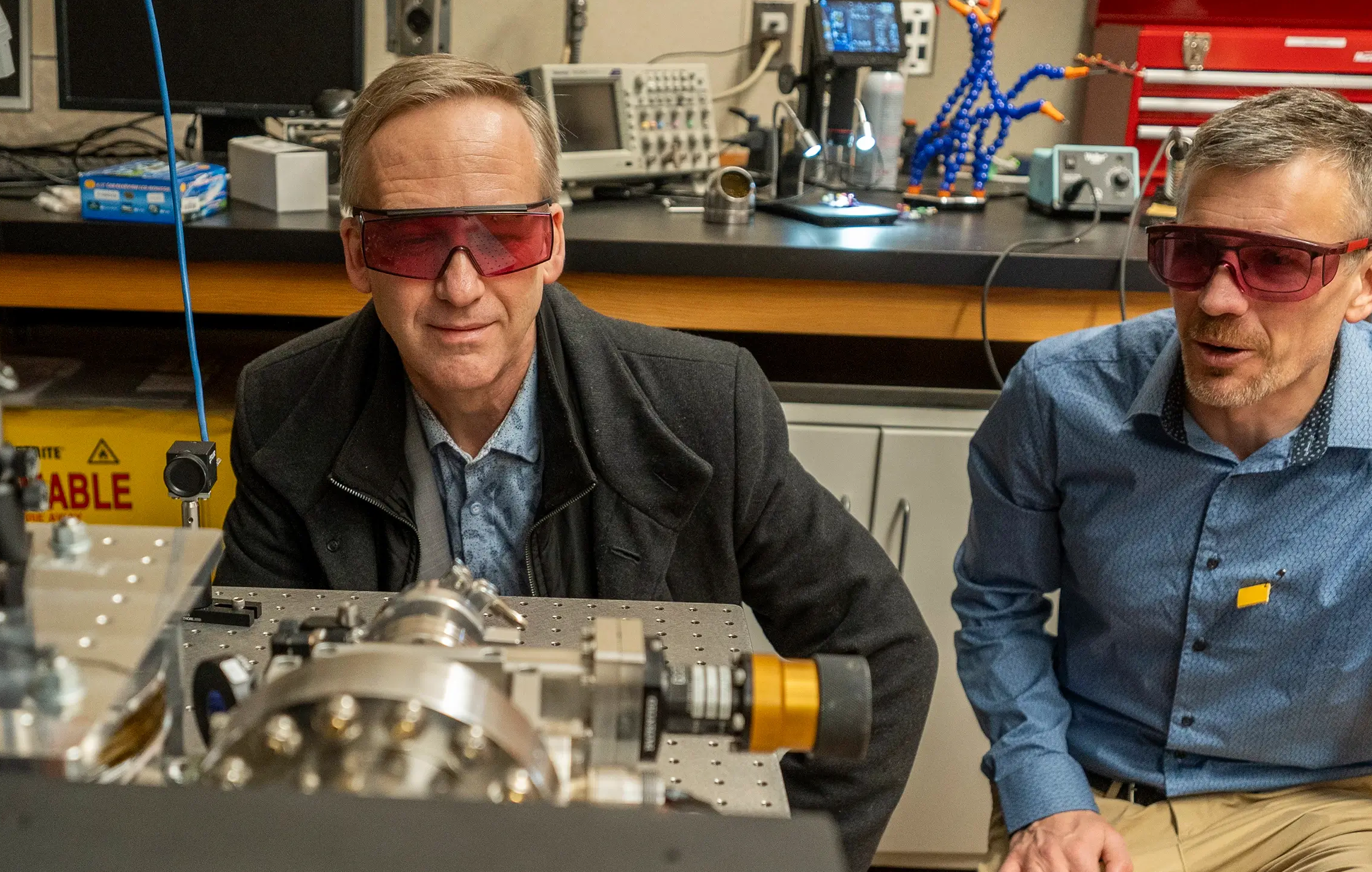
Photo via UVic News.
On Feb. 19, the B.C. government announced an investment of $1.9 million in UVic research infrastructure through the British Columbia Knowledge Development Fund. Though the funding will support ten UVic projects, the provincial government highlights one project in particular, research in quantum physics, to which $90 800 is allocated.
The investment will support achieving a “quantum computing advantage,” the province said, working toward powerful supercomputers with lower energy use.
This quantum investment is part of the government’s larger “Look West Strategy,” which aims to grow targeted sectors, including “technology, AI and quantum, and life science.”
According to a statement from the Ministry of Jobs and Economic Growth, the Look West plan seeks to increase the tech sector’s GDP contribution by 75 per cent, double employment in the sector to 400 000, and double the size of the AI and quantum sectors.
They said the Look West strategy emerged as B.C.’s response to U.S. tariff threats, “reducing reliance on the United States by reorienting trade, attracting investment, and positioning B.C. as Canada’s economic engine.”
The ministry said the funding will support energy-efficient computing infrastructure for quantum physics research at UVic, led by Dr. Thomas Baker, a UVic professor and Canada Research Chair in Quantum Computing for Modelling of Molecules and Materials.
In an interview, Baker described quantum research as a general method for solving problems, with applications across many different fields such as climate modelling, machine learning, and many other areas. The field requires interdisciplinary study, with elements of theoretical physics and computer science, and soft skills such as communication.
He said the provincial funding would support quantum computer simulations at UVic’s enterprise data centre, giving researchers across Canada — but particularly at UVic — access to large-scale quantum simulations. Baker added that this marks the first time this kind of research infrastructure is available to Canadian researchers.
Baker said there are few groups at UVic who work in the area of quantum computing, and that the funding may create more opportunities and quantum-related positions for undergraduate and graduate students.
Baker says quantum computing research at UVic could have economy-wide impacts in B.C., as small improvements can have a large impact and help optimize processes.
According to the ministry, “AI was embedded in Look West from the start,” reflecting the province’s view of AI as a “transformational force” across the economy. The province appointed Rick Glumac as minister of state for AI and new technologies in July 2025, which tasks him with identifying AI and quantum investment opportunities.
Baker explained that quantum machine learning is involved in training AI models, though he does not anticipate that the funding from B.C. will go directly to supporting advancements in AI at UVic at this time.
In a statement, a UVic representative said that “UVic researchers are exploring AI and quantum machine learning potential,” while emphasizing their ethical, human-centred, and interdisciplinary approach to using these tools.
The university supports the goals and opportunities outlined in the Look West plan, which aligns with their Distinctly UVic commitment to serve the public good through “innovation, partnership and place-based impact.”
“Look West supports UVic’s strengths in AI, quantum technologies, aerospace, oceans, life sciences and clean energy, and recognizes the vital role that universities play in building the highly skilled workforce B.C. needs for its future economy.”
They said the B.C. funding will allow students to gain hands-on training with advanced tools through theses, research internships, co-ops, and undergraduate research awards, preparing them for their careers and enhancing their job prospects.
UVic noted that the research supported through the funding leads to new discoveries to improve health and well-being, mitigate climate-change impacts, conserve the environment, and more.
The BC Knowledge Development Fund investment for the quantum project has already been received by UVic. UVic will provide an annual project progress and financial report to the province, regarding how the funding is being utilized.
“This really does put the University of Victoria on the map as a bit of a leader in terms of providing simulation capabilities that other people can use and making it so that quantum comes to Vancouver Island,” Baker said.