
Phelps Bondaroff launches re-election campaign, touting focus on housing, transportation, healthcare, and community-building.
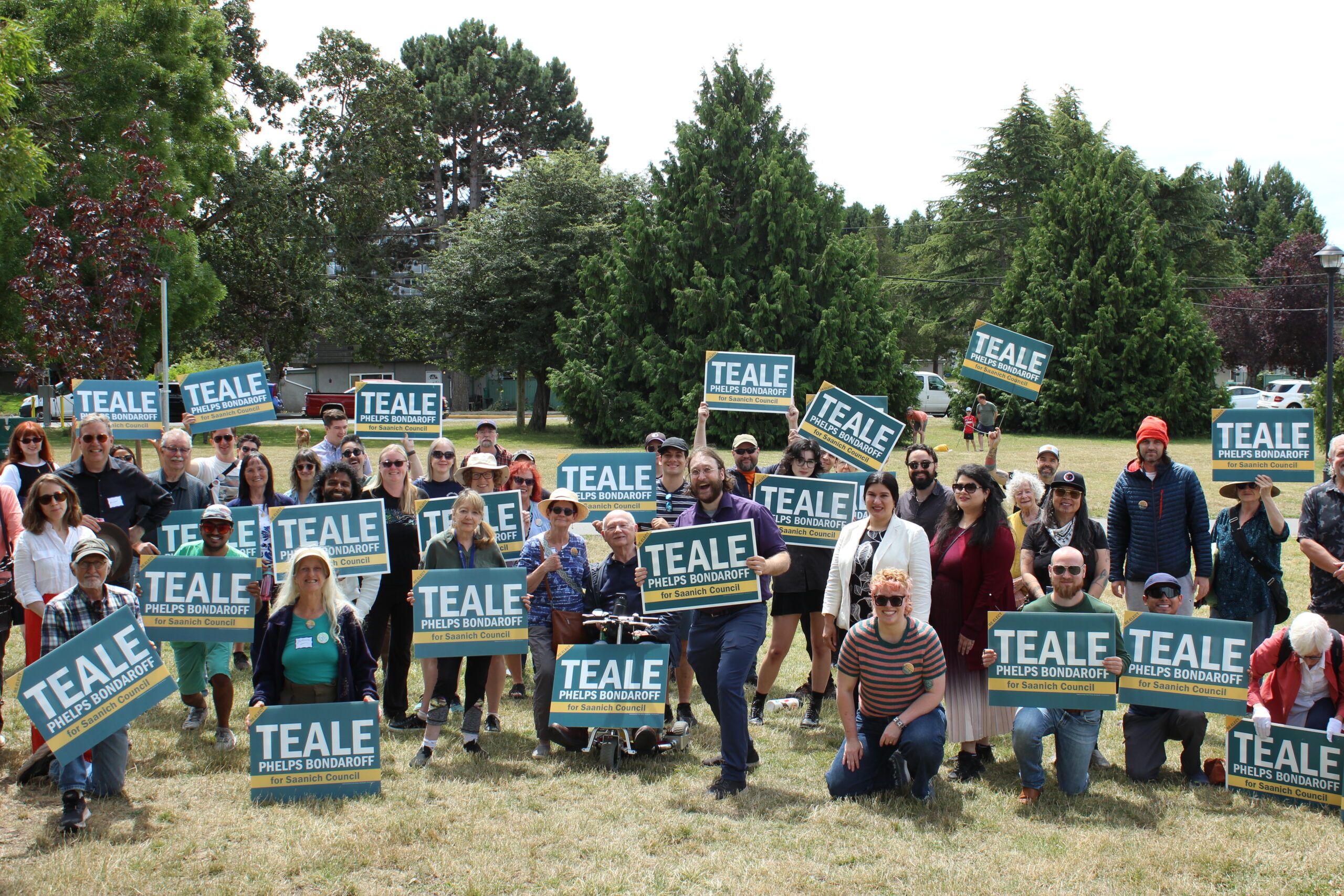
Photo by Abigail Fishman
District of Saanich Councillor Teale Phelps Bondaroff kicked off his campaign for re-election to Saanich council and election to the CRD with a launch party at Rutledge Park on July 11, featuring button making and a book swap.
As a councillor, Phelps Bondaroff serves on the Royal McPherson Theatre Board; is a trustee of the Greater Victoria Public Library; serves as director on the Regional Water Supply Commission for the Capital Regional District (CRD); and serves on the board of the Climate Caucus — a national non-profit that supports elected officials to enact and advocate for climate initiatives.
“One of the things that has been very important in this term is community engagement,” he said.
Phelps Bondaroff holds weekly office hours every Thursday at his local coffee shop, and sends a free monthly subscription-based newsletter to help keep residents informed on council decisions, upcoming events, and more.
“I often will go knock on doors and talk to people to meet them where they’re at,” he said.
In an interview with the Martlet, he shared that he wants to work on ensuring council engages with a wider demographic of people.
Many people cannot attend the council’s Monday meetings, he explained, “and those people are often shut out of the process.” Phelps Bondaroff said that this engagement has been very important to him as a councilor, and that it has led to much of his advocacy work.
“A lot of the advocacy stuff that I’ve done has been responding to community need…. As municipal councilors we serve as a conduit to other, higher levels of government.”
Phelps Bondaroff holds many roles outside of his elected capacity. He is the chair and co-founder of AccessBC — a grassroots campaign for free contraception — as well as the director of research for OceansAsia, a marine conservation organization that investigates and fights marine wildlife crime.
Phelps Bondaroff is also the research coordinator for the BC Humanist Association, a charitable organization that works to protect the separations of religion and government, and the lead of the Greater Victoria Placemaking Network’s Pocket Places Project, which maps, monitors, promotes, stocks, and builds little free libraries around Greater Victoria.
His educational background includes a PhD in politics and international studies from the University of Cambridge, United Kingdom. He also has two Bachelor of Arts degrees in political science and international relations from the University of Calgary, where he became involved in student politics.
In his last term, Phelps Bondaroff “mobilized 13 municipalities” to lobby the provincial government to recognize housing as a human right. The federal government and United Nations have both done this already.
“When housing is treated as a commodity, it leads to decisions that maximize profit…. When we recognize housing as a human right, it changes the conversation and prioritizes people’s well-being and their need for housing.”
He said that the council has been trying to get as close to the provincial housing targets as possible, but those targets only represent 75 per cent of the anticipated housing needs for the district.
Saanich has traditionally been a community of single-family homes with a small number of apartments and condos, Phelps Bondaroff said. He believes that diversifying the housing market is “critical.”
“I’ve been very consistent in my support for housing, because we critically need it and we’re in a housing crisis.”
He said that in 2024, half of the development permits the council approved were for non-market housing. “A lot of the work with respect to housing that I’ve done this term, I would hope to continue.”
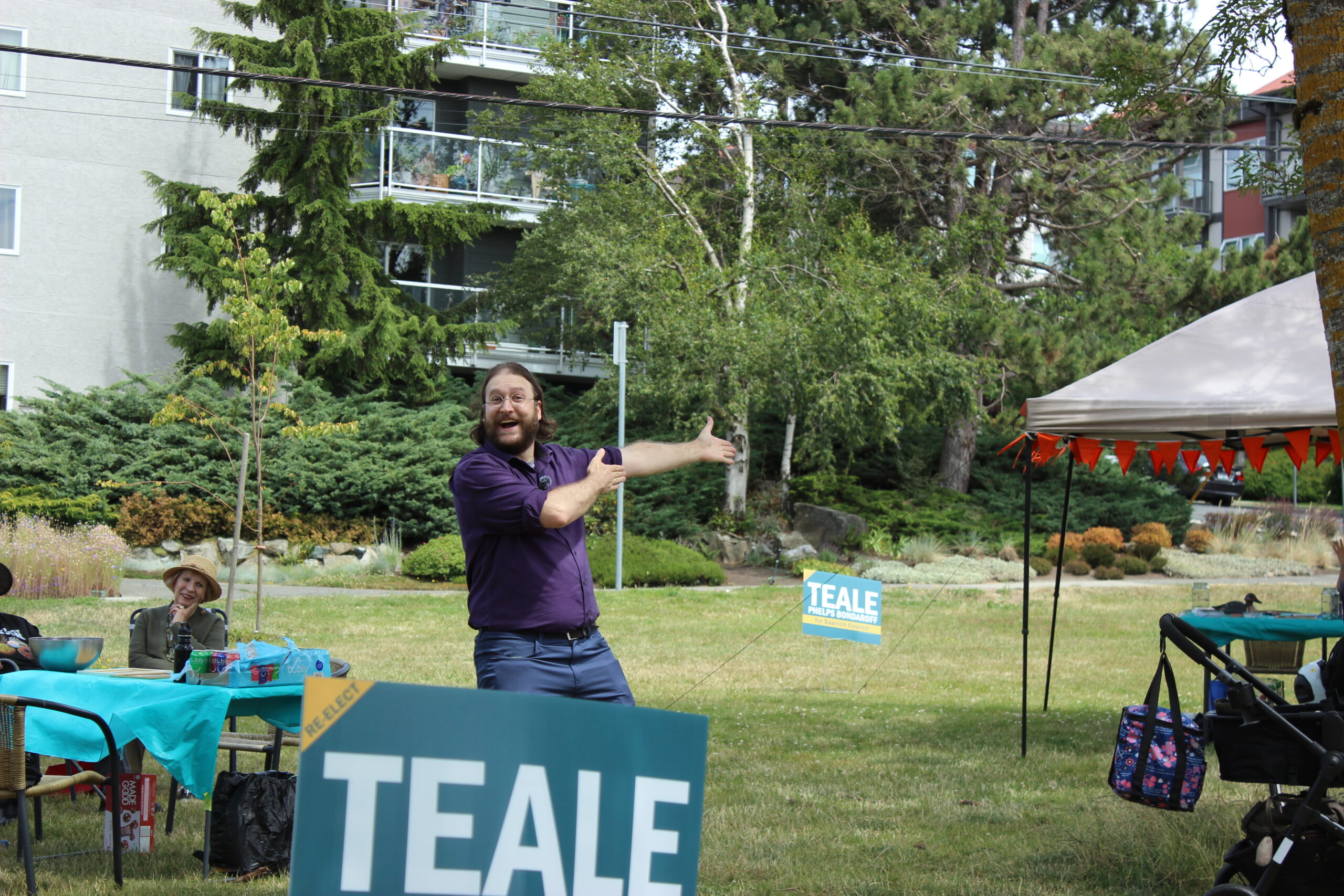
Photo by Abigail Fishman.
Phelps Bondaroff also emphasized community-planning, access to green spaces, transit options, and amenities as important factors in housing.
Transportation is another area where he has worked, and says he plans to continue working to make change.
Phelps Bondaroff said according to the council’s most recent climate report, the average annual transportation cost per household is $28 344. “We’re in a cost of living crisis, and it’s critical that we’re looking at ways to make things more affordable.”
He believes that if safe and affordable transportation options are made accessibly, then traffic and emissions can be reduced, and work can be done to approve affordability.
“The big focus for me this term and moving forward is going to be making sure that transit is fast, frequent, accessible, and reliable.”
Phelps Bondaroff said he voted against the 2026 budget because it proposed a $647 000 cut from the active transportation plan, which he says only delays the rollout. “Owning a vehicle should not be a requirement for active participation in society, nor should you have to break the bank to get around.”
He said the other reason he voted against the budget is that it did not fully fund the Urban Forest Strategy and the Biodiversity Conservation Strategy. He said that both are critical and need to be fully funded. “We need to be supporting these things now because it’s so much easier to protect the environment than it is to rebuild it.”
Another large focus of his over the last term has been finding primary care for Saanich residents. Phelps Bondaroff helped co-found the Family Doctors for Saanich campaign, a grassroots initiative which he participates in outside of his elected capacity.
The campaign is a grassroots initiative made up of community members that works to connect people with nurse practitioners and doctors in the district.
In the fall, the group is doing a “welcome wagon,” to welcome new doctors to town. “They get a basket of local goods. We make sure their spouse has a job. We make sure their kids have a sports team. We make sure they feel loved,” he said.
The group is also fundraising for two non-profit clinics, the South Island Primary Care Society and Shoreline Medical. “They’re trying to do some expansion of their clinics. We want to support those efforts.”
Another key factor in the Family Doctors for Saanich campaign is the Health Connect Registry — the waiting list that the province maintains for people who do not have primary care.
He explained that many people are deterred by the slow-moving rate of the list, adding that he himself has been on it for five years. However, according the the Family Doctors for Saanich website, there are almost 42 000 in the region that need primary care, and only half are on the list.
“So when the province looks at the data to see how many doctors to send us, they see 19 000 people are on the list,” he said. He encourages people to register if they are in need of primary care.
In the future, Phelps Bondaroff says wants to continue his work in community-building. He also says he wants to explore and revamp the council’s grant system, including exploring microgrants — small grants of around $50–$500 to be used toward community events and activities.
“[It] isn’t a lot of money, but it’s enough money to pay for a bunch of bulbs [for a community garden], or to buy food for a small community event,” he said.
The City of Victoria offers a similar option of My Great Neighborhood Grants, which offer up to $1 500 for events and activities.
He added that he also wants to explore hiring a social planner to liaise with community partners. “We want to have someone whose job it is to literally connect community organizations and community partners and rights holders, draw these different people together to make community events happen.”
Voting for the Saanich 2026 Municipal Election opens on Oct. 17. Canadian residents of 18 years and older who have held residence in B.C. for at least six months and hold residence in Saanich (no minimum days required) are eligible to vote.