
Local councils shape our daily lives, yet most students don’t vote for who sits on them. That absence leaves decisions on housing, affordability, and our future to those who do.
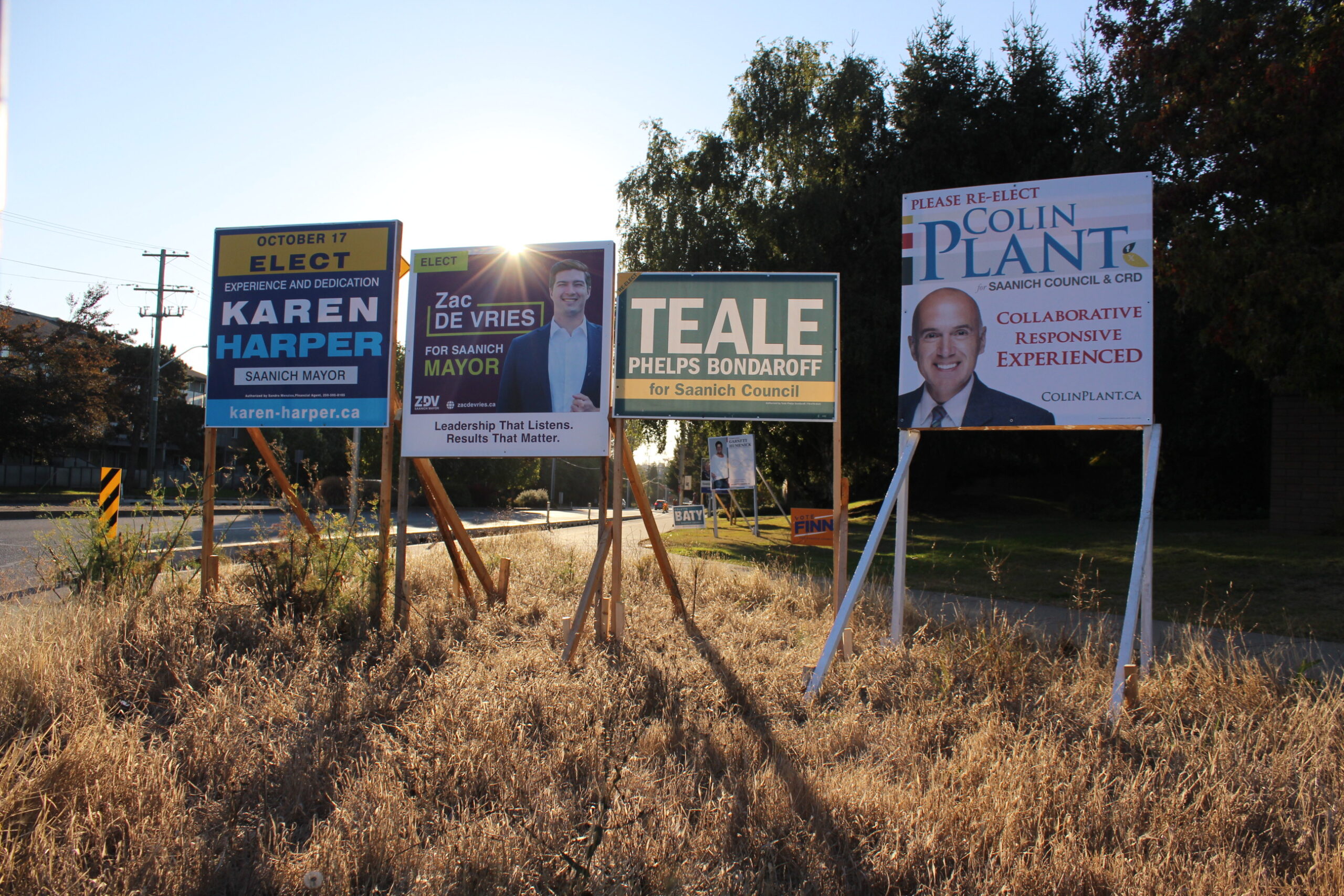
Photo by Shaniya Fraser.
Shaniya Fraser volunteers with the Zac de Vries, Teale Phelps Bondaroff, and Jack Sandor campaigns.
On Oct. 17, residents across B.C. will take part in one of the most direct ways to influence their communities: municipal elections.
However, if recent trends hold, only around 30 per cent of eligible voters will actually cast a ballot — compared to about 58 per cent provincially and 68 per cent federally. Among post-secondary students, who skew younger, it’s almost certainly lower still.
Part of that gap comes down to the cost of being informed. Local races are often less partisan, and lack the party labels that voters often use as shortcuts. It simply takes more research to figure out where candidates stand in municipal elections. And with a provincial election now scheduled for just one week later, voters have even more to keep track of.
But when the people elected to local office have such a direct impact on our lives, knowing who will represent our interests is worth the effort.
Local governments oversee much of what shapes daily life: housing, transportation, community planning, parks, recreation, roads, emergency services, and the budgets that fund it all.
Students have an enormous stake in these local decisions. Rezoning and permit approvals can determine whether more housing options are created near campus, at a time when the off-campus market is already tight. Transportation plans influence whether we can get to class, work, and home safely, reliably, and affordably. Long-term investments in infrastructure affect how much of the cost of aging infrastructure will be ours to bear.
Yet students often have less time to weigh in on these issues. Between school, work, and long commutes for some, few can spare the hours for weekly council meetings. That’s why we need representatives who will carry these issues forward when we can’t be in the room ourselves.
Student advocacy from elected representatives has worked before. Last spring, one Saanich councillor brought forward resolutions, calling on the district to lobby the province for a student food bank grant and $10 ferry fares for post-secondary students — both already endorsed by Oak Bay, and pushed by a province-wide student coalition. The majority of Saanich council rejected the motions before they could even be debated. Weeks later, the same ideas went on to pass with broad support at a regional convention. The issue wasn’t the ask; it was whether elected representatives were willing to ask it.
When that will is absent, the interests of those with more time, money, and power fill the gap by default. This can be particularly consequential for housing; where existing residents have both the opportunity and incentive to organize around developments, the beneficiaries of new housing don’t yet live there to speak up for it. Students can be just as affected by these decisions, but with less time and resources to make their voices heard.
The consequences of this imbalance are already visible in local housing decisions: Saanich council recently rejected two projects that would have added housing near UVic, including a 349-unit development across from campus and a 77-unit rental project in Gordon Head.
Local politics should matter to you because you matter to local politics — even if you’re ineligible to vote.
If you care, show that you care. Write to candidates and incumbents, attend an all-candidates debate, or respond to an AMA. Find out where everyone stands by reviewing candidate websites, local news coverage, and non-partisan candidate surveys — such as the one published by Livable CRD. If you’re particularly passionate about an issue or candidate, reach out to local campaigns and see how you can help.
We study for our future, so let’s vote for it, too.